What Happens If a Carrington-Level Solar Storm Hits Earth Today?
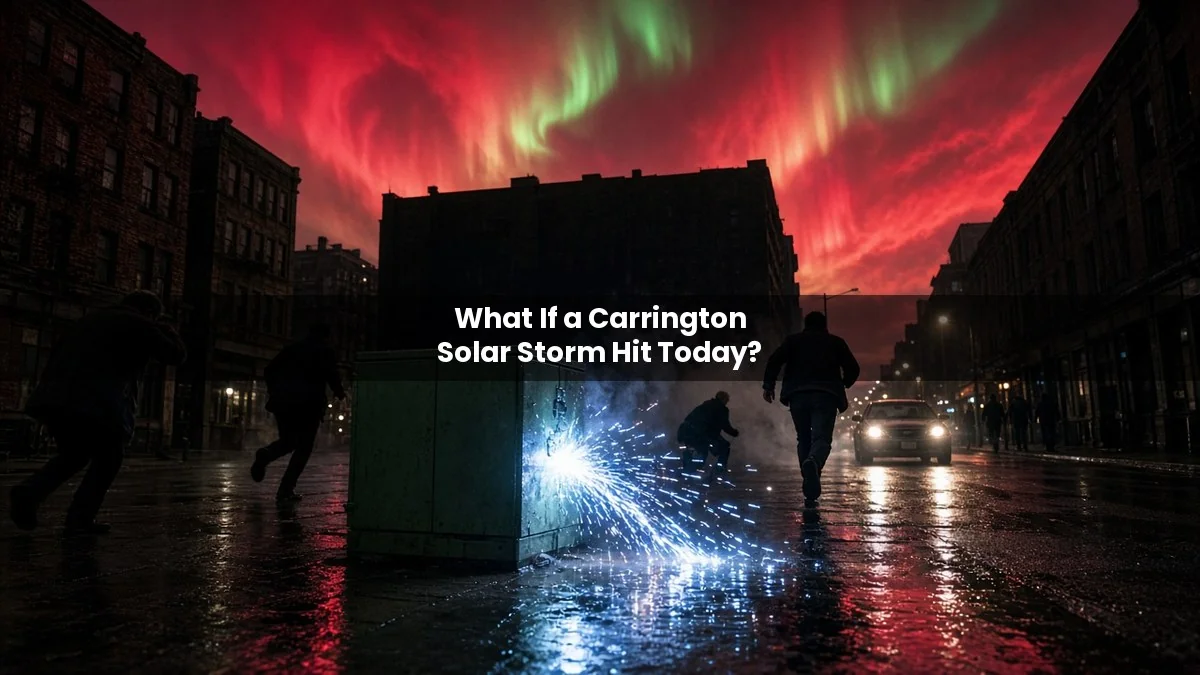
On the morning of September 1, 1859, British astronomer Richard Carrington was sketching sunspots when two blinding white patches of light flared up on the Sun. About a day later, telegraph lines around the world began to spark. Operators got electric shocks. Some offices caught fire. Auroras lit the sky as far south as Hawaii and Central America.
That was the Carrington Event, the most powerful geomagnetic storm on record. So what happens if a solar storm like that hits Earth today, when almost everything we depend on runs on electricity and satellites?
Below, we separate what has actually happened, what experts project, and what remains guesswork.
The short answer
- You would not be harmed directly. The atmosphere and magnetic field protect people on the ground.
- Technology would be. Satellites, GPS, radio, and especially power grids are vulnerable.
- Worst case (projection): a 2013 Lloyd’s study estimated a Carrington-level storm could leave 20 to 40 million people in the US without power for weeks to as long as one to two years, at a cost of $0.6 to $2.6 trillion.
- Odds: big storms happen regularly; true Carrington-scale storms are rare, but not impossible within our lifetimes.
What is a solar storm?
Status: established science.
“Solar storm” is a catch-all term for several things the Sun throws at us:
- Solar flares: sudden bursts of light and X-rays. They reach Earth in about eight minutes and can black out radio on the sunlit side.
- Coronal mass ejections (CMEs): huge clouds of magnetized plasma. They take roughly one to several days to arrive. The Carrington CME made the trip in about 17.6 hours, one of the fastest on record.
- Geomagnetic storms: the disturbance a CME causes when it slams into Earth’s magnetic field. This is the part that threatens power grids.
NOAA rates geomagnetic storms on a scale from G1 (minor) to G5 (extreme). Earth’s magnetic field is the shield these storms push against. We cover what would happen without it in our guide to what happens if Earth lost its magnetic field.
What happened in 1859
Status: historical record.
According to NOAA, the Carrington storm drove powerful currents through telegraph wires. Operators were shocked, small fires broke out in some offices, and some lines kept sending messages with their batteries disconnected. Auroras were so bright in places that people reportedly thought dawn had come.
In 1859 the telegraph was the only electrical network in wide use. Today the same storm would hit a world wired from end to end.
What a Carrington-class storm would do today
Status: projections based on modern storms and engineering studies.
Power grids: the biggest risk
A geomagnetic storm makes the ground’s electric field fluctuate. That pushes extra current, called geomagnetically induced current, through long transmission lines. The current flows into high-voltage transformers, which can overheat or fail.
We have a real example. In March 1989, a strong storm collapsed Quebec’s grid in under two minutes and left millions of people without power for about nine hours, according to NOAA. The same storm damaged a large transformer at a nuclear plant in New Jersey.
The Lloyd’s report found that the US East Coast corridor between Washington, DC and New York City faces the highest population-weighted risk. Its main worry is replacement transformers. They are huge, custom-built machines, and Lloyd’s estimated that ordering a new one could take at least five months.
Satellites and GPS
Storms heat and swell the upper atmosphere, which increases drag on satellites in low orbit. During the May 2024 “Gannon” storm, the extra drag forced so many satellites to adjust their orbits at once that it became one of the largest satellite migrations in history.
Charged particles can also damage satellite electronics, and disturbances in the ionosphere make GPS less accurate. During the 2003 Halloween storms, the FAA’s GPS-based aviation guidance system went down for about 30 hours, according to NOAA. We walk through the wider fallout in what happens if GPS stops working.
Radio and aviation
High-frequency radio, used by aircraft over oceans and polar regions, can black out during big flares. Airlines already reroute polar flights during strong events. In January 2005, United Airlines diverted 26 flights off polar routes. Even without a solar storm, a failure in air-traffic communications can stop departures nationwide. See what happens if the FAA issues a nationwide ground stop.
The knock-on effects
A long blackout spreads into everything. Water pumping, fuel supply, card payments, phone networks, hospitals and cold storage all depend on electricity. This is why a grid failure is the real concern, rather than the storm itself. We explore that domino chain in our guide to what happens when a storm cuts the power. For a week-by-week look at a long, regional outage, read what happens if the power grid fails for a month.
Why some places are more at risk than others
Status: established engineering, with modeled estimates.
A storm doesn’t hit every grid equally. Three things matter most:
- Latitude. The strongest induced currents usually appear under the auroral zone, which expands toward the equator during big storms. Canada, northern US states, Scandinavia and the UK sit closer to the danger zone.
- Geology. Old, poorly conducting rock such as the igneous bedrock under parts of Quebec forces more current into power lines instead of the ground. That helps explain why Quebec failed so quickly in 1989.
- Grid design. Long high-voltage lines collect more induced current. Coastal areas can also face higher risk, because of the sharp change in conductivity between land and seawater.
This is why the Lloyd’s study mapped risk county by county instead of giving one national figure. Two cities hit by the same storm could have very different nights.
What would you notice?
Status: projection, based on May 2024 and historical storms.
- Spectacular auroras, possibly visible in places that almost never see them.
- Glitchy GPS in phones, cars and delivery apps.
- Flight changes on polar and oceanic routes.
- Possible regional blackouts, depending on where you live, local ground conductivity, and how well your grid operator prepared.
Your body would be fine. Phones and laptops are not directly damaged by geomagnetic storms; the danger comes from the networks and power they depend on.
The May 2024 storm: a recent warning shot
Status: established.
In May 2024, a sunspot group about 17 times wider than Earth fired off a series of CMEs. NASA says they merged and hit Earth on May 10, triggering the first G5 storm in over two decades. Auroras were seen across much of the world.
The result was disruption rather than disaster: satellite drag, some GPS problems, and stress on grids, but no catastrophic blackout. NOAA describes it as a Carrington-class event, but notes the geomagnetic storm itself was not as large as 1859’s. Grid operators had warning and acted on it.
How likely is the next Carrington Event?
Status: estimates vary widely.
Nobody can give a reliable date. Researchers have published estimates for the chance of a Carrington-scale storm per decade, and they range widely depending on method and assumptions. The honest answer is that extreme storms are rare, but over a lifetime they are a realistic possibility, which is why governments now treat space weather as a national risk.
We also had a near miss. In July 2012, a powerful CME crossed Earth’s orbit at a point the planet had passed only days earlier. NASA scientists later said that, had it hit, it could have rivaled Carrington.
How we protect ourselves
Status: established practice.
- Forecasting: NOAA’s Space Weather Prediction Center watches the Sun around the clock, and spacecraft about 1.5 million km upstream give roughly 15 to 60 minutes of warning before a CME’s magnetic punch arrives.
- Grid procedures: operators can reduce loads, reconfigure networks and protect key transformers when warnings come in.
- Satellite operations: operators can put spacecraft into safe modes and plan for extra drag.
- Personal prep: the same kit you’d keep for any blackout, including water, food, medication, a battery radio and a way to charge your phone.
Fact vs projection vs speculation
- Established: the 1859 telegraph chaos; the 1989 Quebec blackout; the May 2024 G5 storm; storms damage transformers and satellites.
- Projection: Lloyd’s estimate of 20 to 40 million people affected and $0.6 to $2.6 trillion in losses.
- Uncertain: exactly how often Carrington-scale storms happen.
- Speculation: claims that a storm would “end civilization” or fry every electronic device.
Space weather is one path into a wide outage. The UK’s contingency name for that kind of failure is covered in what happens in a UK Black Sky event.
Solar storms also disrupt radio links with spacecraft. At Voyager 1’s distance, even a healthy signal needs a day to reach Earth. See what happens when Voyager 1 reaches one light-day.
FAQ
Can a solar storm hurt people directly?
Not on the ground. The atmosphere and magnetic field absorb the harmful radiation. Astronauts and, to a lesser degree, high-altitude flights face extra exposure.
Would my phone stop working?
The phone itself would be fine. Service might drop if cell towers lose power or GPS timing goes wrong.
How much warning would we get?
Forecasters usually see a CME leave the Sun one to three days before it arrives. Its exact strength is clear only about 15 to 60 minutes before impact.
Was the May 2024 storm as big as Carrington?
No. NOAA calls it Carrington-class, but the geomagnetic storm was smaller than 1859’s.
Could a solar storm cause a global blackout?
A worldwide simultaneous blackout is unlikely. Damage would depend on location, grid design and preparation. Regional blackouts are the realistic worst case.
The takeaway
A Carrington-scale solar storm would not hurt you directly, but it could knock out power for millions and scramble the satellite services we barely notice until they fail. The good news: we can see storms coming, and grids are better prepared than they were in 1989. The bad news: the Sun doesn’t follow a schedule.
Want more? Start with our Earth and space what-if scenarios guide, see what happens if space junk triggers Kessler syndrome, see what would happen if the Sun disappeared, how satellites come home in what happens when the Swift telescope falls to Earth, or browse all our “what would happen if” scenarios.
Sources
- NOAA: Five historically huge solar events
- NOAA: Space weather: Storms from the Sun
- NOAA Space Weather Prediction Center: NOAA Space Weather Scales
- NASA Science: What NASA Is Learning from the Biggest Geomagnetic Storm in 20 Years
- NASA Science: Near Miss: The Solar Superstorm of July 2012
- Lloyd’s and AER (2013): Solar Storm Risk to the North American Electric Grid