What Would Happen If Earth Lost Its Magnetic Field?
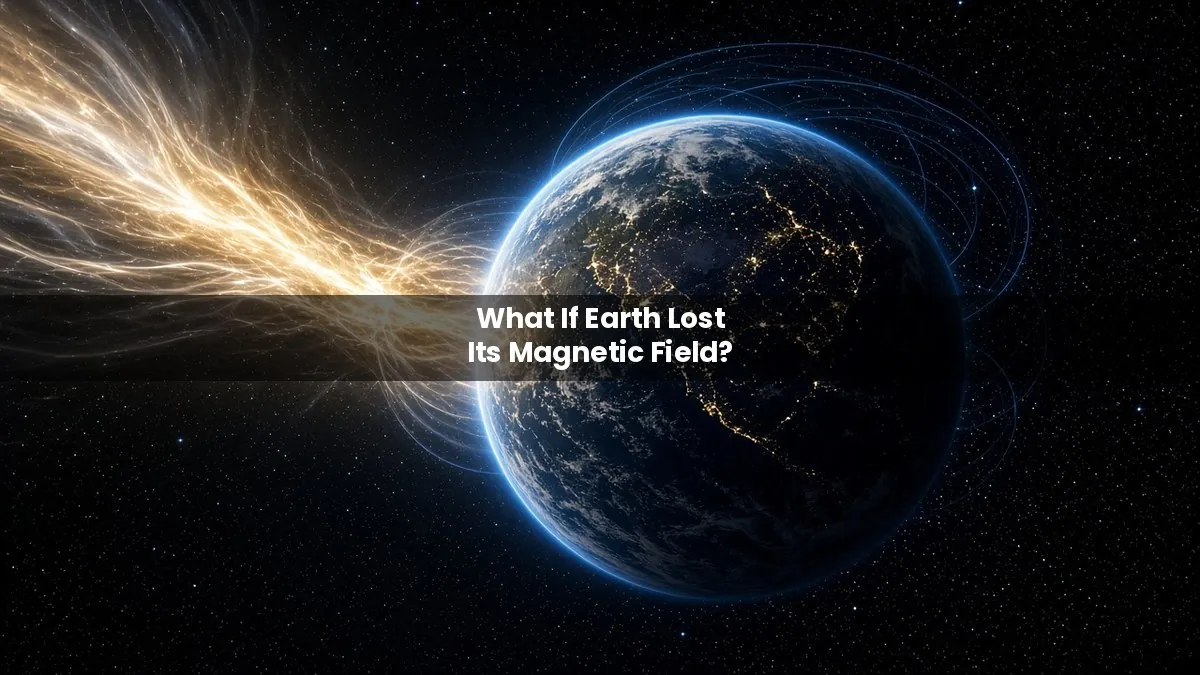
Right now, an invisible shield stretches tens of thousands of kilometers into space around you. It bends the solar wind away, traps radiation in belts high above your head, and paints the sky with auroras. That shield is Earth’s magnetic field. So what happens if Earth lost its magnetic field?
Most online answers jump straight to doom: the atmosphere gets ripped away, radiation fries the surface, and life ends. The real science is more interesting and a lot less cartoonish. Some effects would hit fast. Others would take millions of years. And some popular claims are simply wrong.
Throughout this article, we label each point as established fact, model-based projection, or speculation, so you always know how solid the ground is.
The short answer
- Within hours to days: satellites, GPS, radio and power grids would take a beating from space weather, and auroras would appear far from the poles.
- Over years: slightly more cosmic radiation would reach the ground and aircraft altitudes, and animals that navigate by magnetism would struggle.
- Over millions of years: the solar wind could slowly erode the upper atmosphere, but how much is debated.
- Could it happen? Not suddenly. The field weakens and even flips over thousands of years, but it has never been observed to switch off.
What the magnetic field actually does
Status: established science.
Earth’s field comes from churning liquid iron in the outer core, about 2,900 km below your feet. That moving metal acts like a giant dynamo. The field it creates extends into space as the magnetosphere.
NASA describes the magnetosphere as a gatekeeper. It deflects most of the solar wind, a stream of charged particles flowing from the Sun at around a million miles per hour. It also traps energetic particles in two doughnut-shaped zones called the Van Allen belts.
The shield is not perfect. Strong solar storms still squeeze it and pour energy in, which is why we get geomagnetic storms and auroras. But on an ordinary day, it keeps most of that energy at a safe distance.
The first days: technology takes the hit
Status: projection based on how space weather affects technology today.
If the field vanished overnight (which it can’t, but let’s imagine), the first casualties would be machines, not people.
Satellites and GPS
Satellites already suffer when they pass through the South Atlantic Anomaly, a known weak spot in the field over South America and the southern Atlantic. NASA notes that charged particles there can damage spacecraft electronics, even though they have no effect on life on the surface. Without any field at all, every satellite in low orbit would face that kind of exposure all the time. Navigation would suffer too. See what happens if GPS stops working.
Power grids and radio
Geomagnetic storms can drive electric currents through long power lines and damage transformers. In 1989, a storm knocked out Quebec’s grid for about nine hours, according to NOAA. (See what a Carrington-level solar storm would do today.) With no magnetosphere to absorb and redirect incoming solar energy, the way storms couple to the ground would change completely. Engineers would be working with conditions no one has designed for.
Auroras everywhere
Auroras happen when charged particles slam into the upper atmosphere. Today the field funnels them toward the poles. Without it, particles could strike the upper atmosphere far more widely, so faint auroras could become a far more common sight at low latitudes. This one is a reasoned projection rather than a measured fact.
Radiation: worse, but not instantly deadly
Status: mostly established, with some uncertainty about the exact dose.
Here is a point many articles get wrong. The magnetic field is not our only shield. The atmosphere itself absorbs a huge amount of incoming radiation. NASA notes that even during a magnetic pole reversal, when the field weakens badly, the magnetosphere and atmosphere together still protect the planet, with only a small amount of extra particle radiation reaching the ground.
So the realistic picture looks like this:
- On the ground: a modest increase in radiation from cosmic rays. Not the instant sickness some videos suggest.
- At cruising altitude: pilots and frequent flyers would get noticeably higher doses, especially during solar storms.
- In orbit: astronauts would face much higher exposure, because the Van Allen belts and the deflecting bubble would be gone.
The ozone layer, which blocks ultraviolet light, sits in the atmosphere, not in the magnetic field. Some research suggests intense particle events can deplete ozone temporarily, but the details are still being studied.
Would we lose our atmosphere?
Status: debated. This is where speculation often creeps in.
The scary version uses Mars as proof. Mars lost its global magnetic field about 4.2 billion years ago, according to NASA. NASA’s MAVEN spacecraft later found that solar wind and radiation stripped away most of the Martian atmosphere, turning a once wetter world into a cold desert. MAVEN measured the solar wind removing gas at roughly 100 grams per second today, with much higher losses during solar storms.
That sounds terrifying, but there are three big caveats:
- Time. Mars lost its air over hundreds of millions to billions of years, not in a human lifetime.
- Gravity. Mars has roughly a third of Earth’s surface gravity, so gas escapes it much more easily.
- Venus. Venus has no internally generated magnetic field either, yet it holds on to an atmosphere with a surface pressure about 90 times higher than ours. NASA explains that the solar wind interacting with Venus’s upper atmosphere creates a weak “induced” field that offers some protection.
Scientists still argue about how much a planetary magnetic field really protects an atmosphere. Some models suggest it helps a lot; others suggest the benefit is smaller than assumed. What is safe to say: a field-less Earth would lose gas faster, but over geological time, not overnight.
Animals that read the field
Status: established that many animals use magnetism; effects of total loss are projection.
Many species navigate using Earth’s field, including some migratory birds, sea turtles, salmon and certain bacteria. Without a field, long-distance migrations would get much harder. Some species rely on other cues too, such as the Sun, the stars and smell, so the impact would vary. Expect confusion, not instant extinction.
Has this happened before?
Status: established geology.
Earth’s field has never vanished in the geological record, but it has come close to collapsing for short spells.
- Full reversals: the north and south magnetic poles have swapped many times. The last full reversal happened about 780,000 years ago, according to the USGS.
- The Laschamp excursion: about 41,000 years ago, the field briefly flipped. Researchers at Germany’s GFZ found its strength fell to around 5% of today’s value during the transition.
- Today: NASA reports the field has weakened about 9% over the past 200 years. Yet it is still about twice as strong as its million-year average.
Life clearly survived every one of these events. There is no mass extinction neatly lined up with reversals in the fossil record.
Could Earth actually lose its magnetic field?
Status: established science, with long-term projection.
Not anytime soon. The dynamo is powered by heat escaping from the core and by the slow growth of the solid inner core, which stirs the liquid around it. That engine should run for a very long time. Over billions of years, as the core cools, the field could eventually fade, as Mars’s did. That is a problem for the extremely distant future.
A reversal is a different story. One will happen eventually, but nobody can say when, and it would unfold over centuries to thousands of years. During it, the field would weaken and get messy, with extra magnetic poles popping up at odd latitudes, according to NASA. It would not disappear.
Fact vs projection vs speculation
- Established: the field deflects the solar wind; Mars lost its field and most of its air; the field has reversed many times; it has weakened about 9% in 200 years.
- Projection: damage to satellites, GPS and grids; more radiation at altitude; struggles for magnetic navigators.
- Debated: how much the field protects the atmosphere over billions of years.
- Speculation: any claim that losing the field would kill everyone quickly.
FAQ
Would we die if Earth lost its magnetic field?
Not quickly. The atmosphere still blocks most harmful radiation. Technology would suffer first. The long-term risks play out over vast stretches of time.
Is Earth’s magnetic field getting weaker?
Yes, by about 9% over 200 years according to NASA, but it is still stronger than its long-term average. A weakening field does not mean it is about to vanish.
Is a pole reversal the same as losing the field?
No. During a reversal, the field weakens and becomes jumbled, but it does not switch off.
Would compasses stop working?
Yes. With no field, a compass needle would have nothing to align with.
Why doesn’t Venus lose its atmosphere without a magnetic field?
Venus is heavy enough to hold on to most of its gas, and the solar wind creates a weak induced field in its upper atmosphere that offers partial protection.
The takeaway
Losing the magnetic field would be bad news for satellites, power grids and long-haul migrants, and it would slowly raise the radiation we all live with. But the image of an atmosphere torn away in days is fiction. The real threat lives on a geological clock, and the field shows no sign of shutting down.
Curious about other ways the planet could change? Start with our Earth and space what-if scenarios guide, read what happens if gravity disappears for 7 seconds, or what would happen if Earth stopped spinning, see what would happen if the Sun disappeared, learn why our power cuts during storms are so disruptive, or browse all our “what would happen if” scenarios.
Sources
- NASA Science: Earth’s Magnetosphere: Protecting Our Planet from Harmful Space Energy
- NASA Science: Earth’s Magnetosphere
- NASA: MAVEN Reveals Most of Mars’ Atmosphere Was Lost to Space
- NASA: NASA Mission Reveals Speed of Solar Wind Stripping Martian Atmosphere
- NASA Science: Venus Facts
- NOAA: Space Weather: Storms from the Sun
- USGS: Is it true that Earth’s magnetic field occasionally reverses its polarity?
- GFZ Potsdam: An extremely brief reversal of the geomagnetic field (Laschamp)