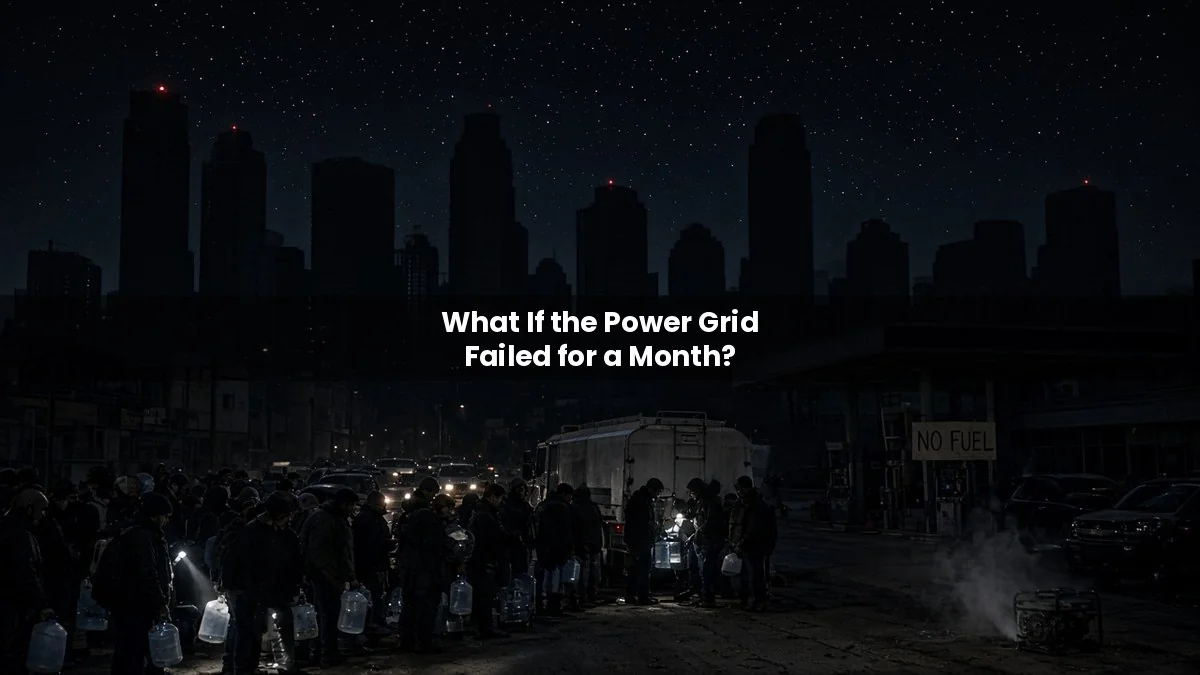
What Happens If the Power Grid Fails for a Month?
Most power cuts last a few hours. The lights flicker back on, the fridge hums again, and life carries on. But what if the power grid failed for a month? Not just your street, but your whole region, with no realistic promise of when it would come back.
It sounds like the opening of a disaster movie, yet it has already happened. After Hurricane Maria in 2017, some Puerto Ricans waited about 11 months for electricity. In Texas in 2021, a few days of grid failure during a deep freeze led to hundreds of deaths.
Communications networks depend on power and on seabed cables. For the cable side, read what happens if an undersea internet cable gets cut.
This guide walks through what would happen during a month without power, week by week. It draws on real blackouts and guidance from US agencies, and separates what’s documented from what’s a reasonable projection.
The short answer
- Day 1: phones, internet and card payments start failing; food in the fridge is at risk after about 4 hours.
- Week 1: water pressure, fuel and medical care become serious problems; people who depend on powered medical devices are in danger.
- Weeks 2 to 4: shortages, health risks and economic losses pile up. Deaths rise, mostly from heat, cold, carbon monoxide and interrupted medical care.
- What causes it: major storms, extreme heat or cold, severe solar storms, cyberattacks or physical attacks on key equipment.
Could the grid really be down for a month?
Status: established, from real events.
Yes. Here are three real examples:
- Hurricane Maria, Puerto Rico (2017): the US Army Corps of Engineers calls it the longest blackout in US history. Full restoration for the last eligible customers took about 11 months. A George Washington University study estimated 2,975 excess deaths in the six months after the storm.
- Texas winter storm (2021): millions lost power for days in freezing temperatures. The Texas Department of State Health Services confirmed 246 storm-related deaths, most of them from hypothermia.
- Quebec (1989): a geomagnetic storm collapsed the grid in about 90 seconds, leaving millions without power for around nine hours.
A month-long, regional outage is rare, but it’s not hypothetical. The biggest factor is damage to equipment that’s hard to replace, especially large transformers. A 2013 Lloyd’s study on solar storms estimated that replacing high-voltage transformers could take at least five months.
Why a regional blackout is so much harder than a local one
Status: established, from how utilities respond.
When a storm knocks out power to one town, help pours in from outside. Utilities send line crews from neighboring states, trucks bring in fuel and food, and people can drive to a relative’s house with electricity. Shops just outside the outage zone keep supply chains moving.
A month-long regional failure removes that safety net. Neighboring areas may be dealing with their own problems, mutual aid crews are stretched, and the fuel that keeps backup generators running has to travel farther. Every backup system, from hospital generators to cell tower batteries, is designed for hours or days, not weeks. That’s why duration matters as much as size. A short, huge blackout is a scare; a long one becomes a public health emergency.
Hour 1 to Day 1: the quiet start
Status: established from past blackouts.
- Lights, heating and cooling stop. Gas furnaces need electricity for fans and controls, so many go off too.
- Phones still work, for a while. Cell towers often have backup batteries or generators, but these may last hours to a few days.
- Cards stop working at many shops. Card readers and bank systems need power and connectivity. Cash becomes king.
- The fridge clock starts. The USDA’s Food Safety and Inspection Service says a fridge keeps food safe for about 4 hours if you keep the door closed. A full freezer holds for about 48 hours, a half-full one for about 24.
Days 2 to 7: systems start to fail
Status: projection, based on documented outages.
Water
Many water systems use electric pumps. Utilities often have backup generators, but these need fuel. As backup systems fail, water pressure can drop, and boil-water notices may follow. Tall buildings lose water first, because they rely on pumps to lift it.
Fuel
Gas station pumps need electricity. Stations with generators will have long lines. Fuel deliveries depend on refineries, pipelines and depots that also need power.
Health care
Hospitals run on generators but must ration fuel and services. People at home who rely on oxygen concentrators, dialysis or refrigerated medicines like insulin are in serious danger. In Puerto Rico, interrupted medical care was a major factor in deaths after Maria.
Communication
As tower batteries run down, mobile networks get patchy. Battery-powered or hand-crank radios become the most reliable way to get official updates. Even when the grid stays up, a cloud outage can still freeze email and workplace chat. See what happens if Microsoft 365 goes down.
Weeks 2 to 4: the long grind
Status: projection.
- Food supply: supermarkets struggle without refrigeration, payment systems and reliable deliveries. Shelves of fresh food empty.
- Sanitation: sewage pumps may fail, raising the risk of disease.
- Jobs and money: many businesses can’t operate. People without savings or cash feel it fastest.
- Health: heat waves or cold snaps become deadly without air conditioning or heating, especially for older people.
- Community: history shows people mostly help each other. Neighbors share generators, food and information. Widespread chaos is less common than movies suggest.
The hidden killer: carbon monoxide
Status: established.
During long outages, people turn to generators, grills and gas heaters. The CDC warns these can produce deadly carbon monoxide if used indoors or near windows. Carbon monoxide poisoning was among the causes of death listed in Texas’s 2021 storm report. CDC guidance is clear: never run a generator inside a home, garage or basement, even with windows open. Keep it outdoors and at least 20 feet from doors, windows and vents, and use a battery-powered carbon monoxide detector inside.
Who is most at risk?
Status: established from disaster research.
- Older adults living alone.
- People with chronic illnesses or powered medical devices.
- Infants and young children.
- People without cars, savings or support networks.
- Anyone in extreme heat or cold without shelter.
What would bring it back?
Status: established practice.
Restoration usually works from the top down: power plants and high-voltage lines first, then substations, then local lines to homes. Utilities share crews across regions, and the military may help, as the Army Corps of Engineers did in Puerto Rico. Hospitals, water plants and emergency services typically get priority.
The slowest part is replacing major equipment. If large transformers are destroyed, a region may run on limited power for months while replacements are built and shipped.
How to prepare for a long outage
Status: guidance from US agencies.
- Water: store drinking water for several days or longer. Ready.gov suggests about one gallon per person per day.
- Food: keep non-perishable food you can eat without cooking.
- Medicine: keep a supply of prescriptions and a plan for refrigerated medicines.
- Light and power: flashlights, spare batteries, power banks and a battery or hand-crank radio.
- Cash: some small bills for when cards don’t work.
- Safety: a battery-powered carbon monoxide detector, and a plan for heat or cold.
- Medical devices: talk to your provider and utility about backup power and priority lists.
For shorter outages, see our guide to what happens when a storm cuts the power.
Fact vs projection vs speculation
- Established: Puerto Rico’s roughly 11-month blackout; Texas’s 246 confirmed deaths; food safety limits; carbon monoxide risks.
- Projection: the week-by-week breakdown of water, fuel and health systems in a new event.
- Speculation: the idea that society collapses into lawlessness. Real disasters rarely look like that.
For the UK’s official 72-hour playbook, read what happens in a UK Black Sky event.
Preparation matters in other emergencies too. See what happens if you’re trapped in a building collapse, including the four signals Ready.gov recommends.
FAQ
How long could the power grid be down?
Most outages last hours or days. Major disasters can cause outages lasting weeks to months, as in Puerto Rico after Hurricane Maria.
What fails first in a long blackout?
Refrigeration, card payments and internet usually fail first, followed by water pressure and fuel supply.
How long is fridge food safe without power?
About 4 hours if you keep the door closed, according to the USDA. A full freezer stays safe for about 48 hours.
Could a cyberattack take down the grid for a month?
Cyberattacks have caused real blackouts, such as in Ukraine in 2015. But outages from those attacks were relatively short. A month-long outage from a cyberattack alone remains uncertain.
What’s the biggest danger during a long outage?
Extreme heat or cold, carbon monoxide poisoning, and interrupted medical care.
Should I buy a generator?
It can help, especially for medical devices or a fridge, but only if you use it safely outdoors and store fuel properly. Many people get by with power banks, a small battery station and a good supply kit.
The takeaway
A month without power wouldn’t look like a zombie movie. It would look like a slow, grinding emergency: spoiled food, dry taps, long fuel lines, overwhelmed hospitals and quiet tragedies among the most vulnerable. Real events show it can happen, and simple preparation, done calmly and ahead of time, makes a big difference for you and your neighbors.
Related reads: what happens if the polar vortex collapses, what happens if World War 3 starts, what if Earth stopped spinning, or browse all our “what would happen if” scenarios.
Water is usually the first thing to fail: see what happens if you go without water for 3 days.
Sources
- US Army Corps of Engineers: The Longest Blackout in US History: Hurricane Maria
- Texas DSHS: February 2021 Winter Storm-Related Deaths
- George Washington University: GW Researchers: 2,975 Excess Deaths Linked to Hurricane Maria
- USDA FSIS: Keep Your Food Safe During Emergencies
- CDC: What to Do to Protect Yourself During a Power Outage
- CDC: Generator Safety Fact Sheet
- Ready.gov: Build a Kit
- NOAA: Space weather: Storms from the Sun