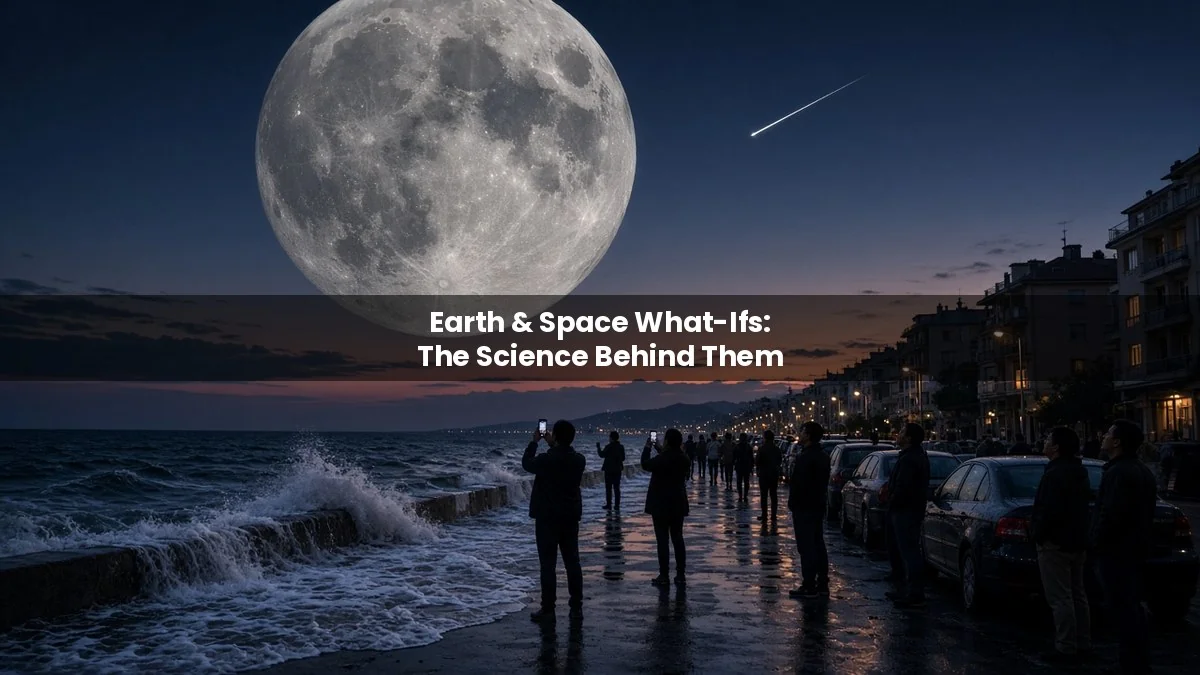
Earth & Space What-Ifs: The Science Behind 8 Wild Scenarios
What if Earth stopped spinning? What if the Sun went dark? What if the Moon drifted away, or a solar storm knocked out the power grid? These questions sound like late-night thought experiments, but each one opens a door to real science about how our planet and the cosmos actually work.
This guide collects our Earth and space “what if” scenarios in one place. For each one, you’ll get the quick answer, how realistic it is, and where to read the full explainer. Every scenario we cover follows the same rule: we separate established facts, model-based projections, pure hypotheticals and speculation, so you always know what kind of claim you’re reading.
How to read these scenarios
Not all “what ifs” are created equal. Some describe events that have happened and will happen again. Others are physically impossible but useful for understanding how things work. We sort them into three groups:
- Things that really happen: solar storms, magnetic field changes, space debris collisions. These come with real data and real risks.
- Things that will happen, eventually: the Sun’s slow brightening and its red giant phase. These are reliable projections, but billions of years away.
- Thought experiments: Earth stopping its spin, the Sun vanishing, the Moon stopping in its orbit. Physics says these can’t happen suddenly, but imagining them reveals how much we depend on the systems around us.
Thought experiments: impossible, but revealing
What if Earth stopped spinning?
Realism: physically impossible as a sudden stop.
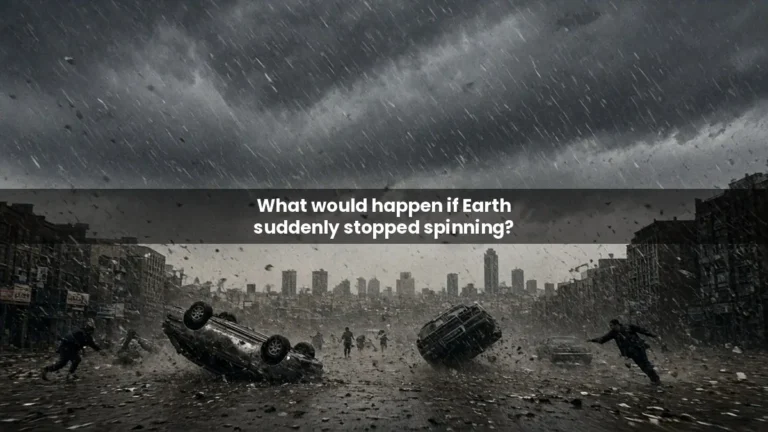
Earth’s surface at the equator moves at about 1,670 km/h. If the planet stopped instantly, the atmosphere, oceans and anything not bolted to bedrock would keep moving at that speed, producing winds and waves far beyond any hurricane. A slow stop would be survivable but strange: one day would last a year, oceans would drain toward the poles, and a single giant continent would rise around the equator.
Full explainer: What Would Happen If Earth Stopped Spinning?
What if the Sun went dark for 8 minutes?
Realism: impossible. Stars don’t switch off.
Sunlight takes about 8 minutes and 20 seconds to reach Earth, so we wouldn’t notice anything at first. Then the sky would go black, and gravity’s grip would change at the same moment, because gravity also travels at the speed of light. The planet would start to cool, but it would take time for the oceans to freeze. This scenario is a vivid way to understand just how much the Sun does for us.
Full explainer: What Happens If the Sun Went Dark for 8 Minutes
What if the Moon stopped orbiting Earth?
Realism: impossible without an enormous outside force.
The Moon only stays up because it’s moving sideways fast enough to keep “falling around” Earth. Stop that motion, and it would fall toward us. Long before that, the Moon also matters in subtler ways: it drives ocean tides and helps stabilize the tilt of Earth’s axis, which keeps our seasons relatively steady.
Full explainer: What Happens If the Moon Stopped Orbiting Earth
What if water disappeared from Earth?
Realism: impossible as a sudden event.
Water covers about 71% of Earth’s surface and is in every living cell. Removing it would end life as we know it, change the weather completely and even alter how rocks behave deep underground. It’s a useful way to see how water shapes everything from climate to plate tectonics.
Full explainer: What Would Happen If Water Disappeared From Earth
Real risks: things that have happened and will again
What if a massive solar storm hit Earth?
Realism: real. Big storms happen regularly; extreme ones are rare.
In 1859, the Carrington Event set telegraph offices on fire. In 1989, a storm blacked out Quebec for about nine hours. In May 2024, the first G5 “extreme” geomagnetic storm in over two decades lit up skies worldwide. A Carrington-class storm today could damage power grids and satellites. A 2013 Lloyd’s study estimated it could leave 20 to 40 million Americans without power for weeks or longer.
Read our full explainer: What Happens If a Carrington-Level Solar Storm Hits Earth Today?
What if Earth lost its magnetic field?
Realism: the field won’t vanish, but it does weaken and flip.
Earth’s magnetic field deflects the solar wind and protects satellites and power grids. NASA says it has weakened about 9% in the last 200 years, but it’s still about twice its long-term average. About 41,000 years ago, during the Laschamp excursion, it briefly fell to about 5% of today’s strength. Life survived. The real impacts of losing it would hit technology first, while atmospheric loss would play out over geological time.
Read the full explainer: What Would Happen If Earth Lost Its Magnetic Field?
What if space junk triggered Kessler syndrome?
Realism: real and possibly already starting in some orbits.
The European Space Agency tracks about 40,000 objects in orbit, and estimates more than 1.2 million fragments larger than 1 cm. Kessler syndrome describes a chain reaction of collisions that could make some orbits too dangerous to use. It would unfold over years to decades, not minutes like in the movies.
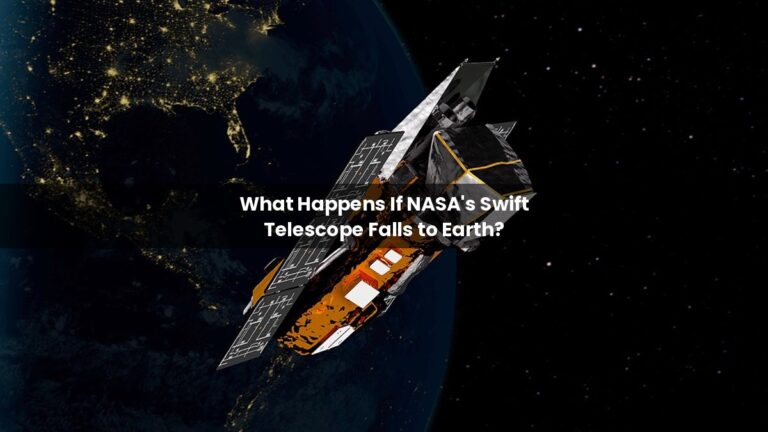
Related: see how satellites come home in What Happens When the Swift Telescope Falls to Earth. Read the full explainer: what happens if space junk triggers Kessler syndrome.
The far future: certain, but billions of years away
What happens when the Sun becomes a red giant?
Realism: a reliable projection, very far in the future.
The Sun is about 4.6 billion years old and slowly getting brighter. In roughly a billion years, that extra energy could boil away Earth’s oceans. In about 5 billion years, the Sun will begin swelling into a red giant. One widely cited model predicts it will engulf Earth about 7.6 billion years from now, before shrinking into a white dwarf.
Read the full explainer: what happens when the Sun becomes a red giant.
More Earth and space explainers
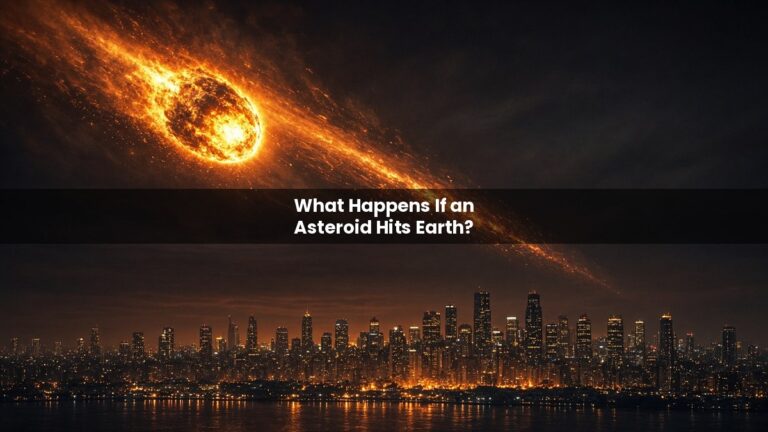
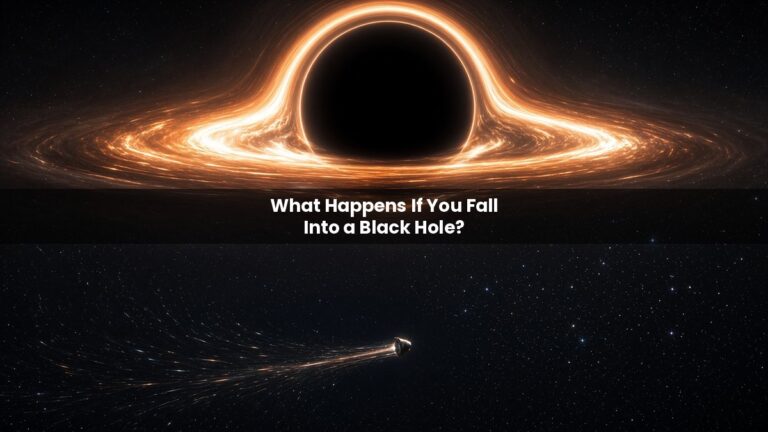
These guides are already live and belong with this series: what happens if an asteroid hits Earth, what happens if you fall into a black hole, what happens if GPS stops working, and what happens if gravity disappears for 7 seconds. A newer guide looks at what happens if Starship becomes fully reusable, after SpaceX caught an upper stage from orbit for the first time. We also have a current climate explainer on what happens if global warming passes 1.5 degrees. As new Earth and space explainers go live, we link them here so this page stays your starting point for the series.
Human-scale space questions
What happens if you go to space without a spacesuit?
Realism: real. It has happened in accidents.
Forget the movie version. You wouldn’t explode or freeze instantly. You’d lose consciousness in about 15 seconds and die within a minute or two without rescue, mainly from lack of oxygen. A NASA technician survived a 1966 vacuum chamber accident after being repressurized in about 87 seconds.
For what oxygen loss does to the body, read What Happens When Your Brain Runs Out of Oxygen. Read the full explainer: What Happens If You Go to Space Without a Spacesuit?.
Quick comparison: how realistic is each scenario?
| Scenario | Could it happen? | Timescale | Main impact |
|---|---|---|---|
| Earth stops spinning | Not suddenly | Billions of years (gradual slowing) | Winds, oceans, climate |
| Sun goes dark | No | Not applicable | Darkness, cold, orbit |
| Moon stops orbiting | No | Not applicable | Tides, axis stability |
| Water disappears | No | Not applicable | All life |
| Extreme solar storm | Yes | Any year | Grids, satellites |
| Magnetic field loss | Weakening and flips, yes; vanishing, no | Centuries to millennia | Technology, radiation |
| Kessler syndrome | Yes, gradually | Years to decades | Satellite services |
| Sun becomes a red giant | Yes | About 5 billion years | Earth’s habitability |
Why these questions matter
Thought experiments aren’t just fun. Asking “what if Earth stopped spinning” teaches you about momentum and the atmosphere. Asking “what if the Sun went dark” teaches you about light travel time and gravity. And the real-risk scenarios, like solar storms and space debris, are shaping decisions right now, from how power grids are built to how satellites are designed and retired.
The best way to understand our planet is to imagine it changing, then check that imagination against real data.
How we research these scenarios
Every explainer in this series is built from authoritative sources: NASA, NOAA, the USGS, the European Space Agency and peer-reviewed research. Where scientists disagree, we say so. Where an idea is speculation, we label it. And when a number can’t be verified, we leave it out.
FAQ
Which Earth and space “what if” is most likely to affect me?
An extreme solar storm. Strong storms happen regularly, and a severe one could disrupt power, GPS and satellite services.
Could Earth actually stop spinning?
Not suddenly. Earth’s spin is slowing very gradually because of the Moon’s tides, but only by tiny fractions of a second over centuries.
Is Earth’s magnetic field about to flip?
No one can predict it. The field has weakened, but it’s still strong by historical standards, and reversals take centuries to millennia.
When will the Sun die?
The Sun will start becoming a red giant in about 5 billion years, and end as a white dwarf.
Where can I find more scenarios beyond space?
Browse all our “what would happen if” scenarios, covering the body, technology, disasters and more.
Sources
- NASA Science: Earth: Facts
- NASA Science: Sun: Facts
- NASA Science: Earth’s Magnetosphere
- NOAA: Five historically huge solar events
- ESA: ESA Space Environment Report 2025
- Schröder and Smith (2008), MNRAS: Distant future of the Sun and Earth revisited
- Lloyd’s (2013): Solar Storm Risk to the North American Electric Grid