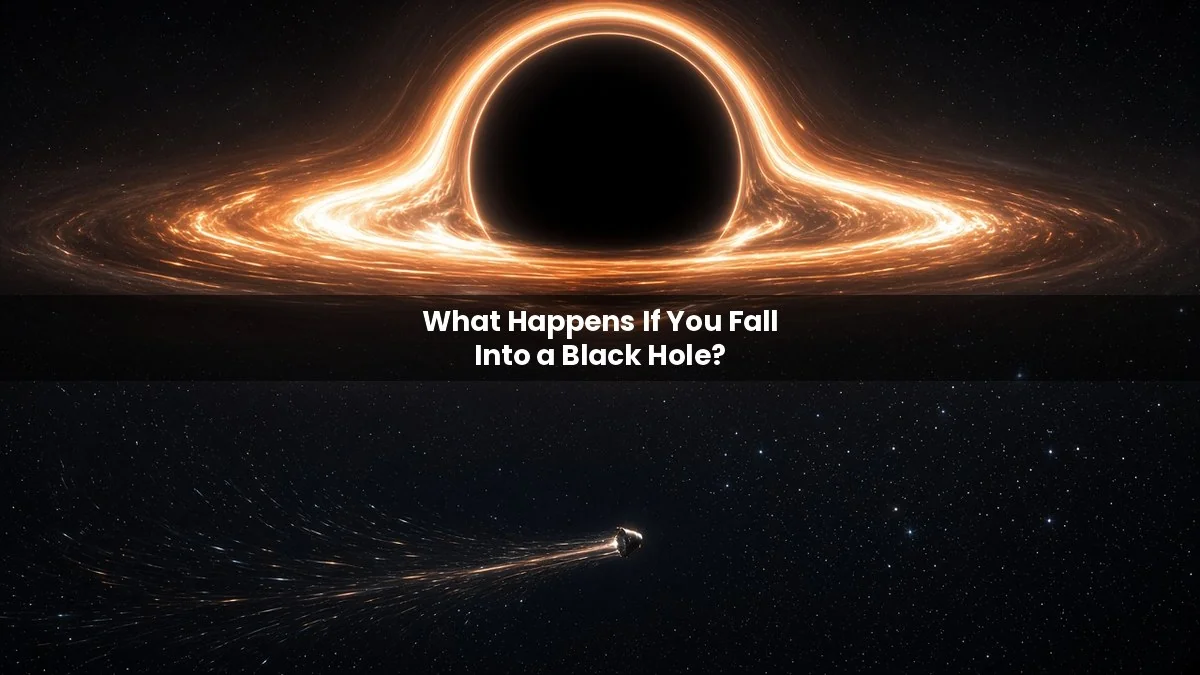
What Happens If You Fall Into a Black Hole? Step by Step
Picture yourself drifting toward a black hole. The stars around you start to bend, and time seems to slow down. Then, the pull grows stronger with every second. So what happens if you fall into a black hole? Physics gives us a surprisingly detailed answer, and it depends heavily on the size of the black hole.
Short answer: tidal forces would stretch you like spaghetti, a process called spaghettification. A small black hole would kill you before you reach the event horizon, while a supermassive one would let you cross the horizon in one piece, but nothing, not even light, could get back out. No known black hole is close enough to threaten Earth.
Key Takeaways
- A black hole’s gravity is so strong that not even light escapes.
- Tidal forces would stretch you like spaghetti, a process called spaghettification.
- Small black holes would kill you before you reach the edge.
- You could cross a supermassive black hole’s event horizon in one piece.
- No known black hole is close enough to threaten Earth.
What Is a Black Hole?
A black hole is a region of space where gravity is so strong that nothing, not even light, can escape. According to NASA, black holes form when a huge amount of matter gets packed into a tiny space. Many stellar-mass black holes form when a massive star collapses at the end of its life.
Every black hole has two key parts:
- The event horizon: The boundary of no return. Once you cross it, escape is impossible.
- The singularity: The center, where our current laws of physics break down.
Scientists group black holes by size. Stellar-mass black holes weigh a few to dozens of times the Sun‘s mass. Supermassive black holes, by contrast, weigh millions to billions of Suns and sit at the centers of galaxies.
What Happens If You Fall Into a Black Hole? Step by Step
1. Time starts to look strange
Einstein’s general relativity says that strong gravity slows time. This effect is called time dilation. For you, time would feel completely normal. However, a friend watching from far away would see you slow down as you approached the event horizon. Your image would also grow redder and dimmer until you seemed to fade away.
2. Your view of the universe warps
The black hole bends light around it, an effect called gravitational lensing. As a result, the sky behind you would appear distorted, and starlight would squeeze into a bright ring.
3. Tidal forces stretch you
Gravity pulls harder on the part of you closest to the black hole. If you fell feet first, your feet would feel a stronger pull than your head. Scientists call the result spaghettification, because the forces stretch objects into long, thin strands. NASA has even observed stars being torn apart this way, in events called tidal disruption events.
4. You cross the event horizon
Surprisingly, you might not notice the exact moment. There is no wall or surface. Yet once you pass this point, every possible path leads inward. Not even light can carry a signal back out.
5. You reach the singularity
Nobody knows exactly what happens here. Our equations predict infinite density, which means the theory has reached its limits. Physicists hope a future theory of quantum gravity will explain it.
Does the Size of the Black Hole Matter?
Yes, and the answer is counterintuitive.
- Small black holes are deadlier at the edge. A stellar-mass black hole has extreme tidal forces near its event horizon. Therefore, you would be spaghettified long before you crossed it.
- Giant black holes are gentler at first. A supermassive black hole has a much larger event horizon. As a result, tidal forces at its edge are weaker, and you could cross it in one piece. Spaghettification would come later, closer to the center.
For example, Sagittarius A*, the black hole at the center of the Milky Way, holds about 4 million times the Sun’s mass. In 2022, the Event Horizon Telescope captured its first image.
What Would You See From Inside?
This remains theoretical. Computer simulations, such as those produced by NASA, suggest that light from the outside universe would keep falling in behind you. Consequently, you might still see a distorted view of the sky for a while.
Could a Black Hole Swallow Earth?
No, there is no known threat. The nearest known black hole, Gaia BH1, lies about 1,560 light-years away. That is far too distant to affect us.
Also, black holes do not “suck” everything in like a vacuum cleaner. If the Sun suddenly became a black hole of the same mass, Earth would keep orbiting at the same distance. It would, however, get very dark and cold.
Do Black Holes Last Forever?
Probably not. In 1974, physicist Stephen Hawking predicted that black holes slowly lose energy through what we now call Hawking radiation. For large black holes, however, this process would take far longer than the current age of the universe.
How Long Would It Take to Fall In?
From your point of view, not long. Near a stellar-mass black hole, the final plunge from the event horizon to the center would take a tiny fraction of a second. For a supermassive black hole, the trip inside could take longer, perhaps minutes or hours for the very largest ones, depending on their mass.
For an outside observer, however, you would never quite seem to cross. Your image would freeze, redden and fade at the edge. Both views are correct; they simply describe time from different places.
Black Hole Facts at a Glance
- Nothing escapes: Inside the event horizon, the escape speed exceeds the speed of light.
- They can spin: Most black holes likely rotate, which drags space around them.
- They glow indirectly: Gas swirling around them heats up and shines brightly in X-rays.
- They merge: When two black holes collide, they send gravitational waves through space. LIGO first detected these ripples in 2015.
- They are common: Scientists think our galaxy alone may contain millions of stellar-mass black holes.
What If a Black Hole Passed Through the Solar System?
This scenario is extremely unlikely, but it shows how gravity works. A wandering black hole would not need to touch Earth to cause trouble. Its gravity could tug on planetary orbits, pushing Earth closer to or farther from the Sun. Even a small change could alter our climate dramatically. Fortunately, astronomers have no evidence of any such object heading our way.
Why Scientists Study Black Holes
Black holes are natural laboratories for extreme physics. They test Einstein’s theory of gravity under the harshest conditions. They also help explain how galaxies grow, since most large galaxies host a supermassive black hole at their center.
Black holes are a distant threat, but some cosmic dangers are much closer to home. See what happens if an asteroid hits Earth, from small rocks to extinction-level impacts, or browse our Earth and space what-if scenarios guide.
Frequently Asked Questions
Would you die instantly in a black hole?
Not necessarily. In a stellar-mass black hole, you would die before reaching the edge. In a supermassive one, you could survive crossing the event horizon, at least for a short time.
What is spaghettification?
It is the stretching effect caused by tidal forces. Gravity pulls much harder on one end of an object than the other.
Can anything escape a black hole?
Nothing can escape from inside the event horizon, not even light. However, matter outside it can be flung away in powerful jets.
Has anyone seen a black hole?
Yes, indirectly. The Event Horizon Telescope imaged the shadow of M87* in 2019 and Sagittarius A* in 2022.
Is a black hole a portal to another universe?
Some theories speculate about wormholes. Still, no evidence shows that black holes lead anywhere else.
Related: what happens if the Moon stopped orbiting Earth, what happens when a space telescope falls back to Earth, what would happen if Earth stopped spinning, what happens if gravity disappears for 7 seconds, what happens if you go to space without a spacesuit.
The Bottom Line
So, what happens if you fall into a black hole? Time would appear to freeze for outside observers, and tidal forces would stretch you apart. In a small black hole, that happens before the edge. In a giant one, you could cross the event horizon first. After that, physics itself runs out of answers.