What Happens If Gravity Disappears for 7 Seconds?
Every few months a new viral claim says Earth’s gravity will “switch off” for seven seconds. The latest wave tied the scare to black holes, a fake NASA plan called Project Anchor, and the August 12, 2026 total solar eclipse. So what actually happens if gravity disappears for 7 seconds?
Short version: the viral date is false, NASA has no such project, and gravity cannot flip like a light switch. Still, the thought experiment is useful. It shows what gravity really does, what it does not do, and why falling back down would hurt more than floating up.
We separate established physics, careful hypotheticals and debunked claims so you can tell rumor from science.
The short answer
- Will gravity stop on a set date? No. BBC Bitesize, Jodrell Bank educators and NASA eclipse guidance all say there is no mechanism for that, and no Project Anchor.
- If gravity vanished for seven seconds (hypothetical): you would not instantly blast into space. Loose objects, air and water would start to drift. When gravity returned, everything would slam back.
- Biggest danger in the thought experiment: the landing, plus stress inside a planet that suddenly lost the force holding it together.
- Could black holes or an eclipse do this? No. Gravitational waves from distant mergers are unimaginably weak at Earth. An eclipse does not change Earth’s gravity.
Why the viral claim is wrong
Status: established (debunked).
Social posts claimed that colliding black holes would cancel Earth’s gravity for exactly seven seconds on August 12, 2026, and that NASA had spent tens of billions on “Project Anchor” bunkers. BBC Bitesize checked with Jodrell Bank. Education officer Lexie Southern explained the basic point: objects pull because they have mass. To “turn off” Earth’s gravity you would need to remove Earth’s mass, which is impossible.
NASA has also stated that a total solar eclipse has no unusual impact on Earth’s gravity. Tidal forces from the Sun and Moon change in predictable ways. They do not zero out the planet’s pull. There is no public NASA program called Project Anchor. Snopes-style fact checks and science outlets treated the leak story as fabricated.
Gravitational waves are real. LIGO detects them. By the time those ripples reach Earth, the strain is about one part in 1021. That is a length change far smaller than a proton across a human body. Waves stretch spacetime a tiny bit. They do not cancel gravity.
What gravity actually does
Status: established science.
Gravity is not a cable holding you down. In Newton’s picture, every mass attracts every other mass. In Einstein’s picture, mass-energy curves spacetime and free-falling objects follow that curve. Either way, Earth’s pull comes from Earth’s mass. Your weight is that pull; your mass stays even if weight vanished.
Astronauts on the ISS are not in a place with “no gravity.” They and the station are in continuous free fall around Earth. That is why they float. It is not a preview of Earth suddenly losing its field.
The seven-second thought experiment
Status: pure hypothetical. Physics does not allow a clean switch-off while Earth keeps its mass.
HowStuffWorks and other explainers walk through a brief loss of Earth’s self-gravity while other forces stay. Useful results:
You do not rocket upward
Losing gravity gives you no upward kick. Newton’s first law says you keep the velocity you already have. At the equator you and the ground already move east at about 465 m/s because Earth rotates. Without gravity to curve that path, a free object separates from the surface only slowly at first. HowStuffWorks notes a rough separation on the order of tens of centimeters over a few seconds at the equator if the ground stayed rigid, not a sudden launch to orbit.
Loose objects, liquids and air start to misbehave
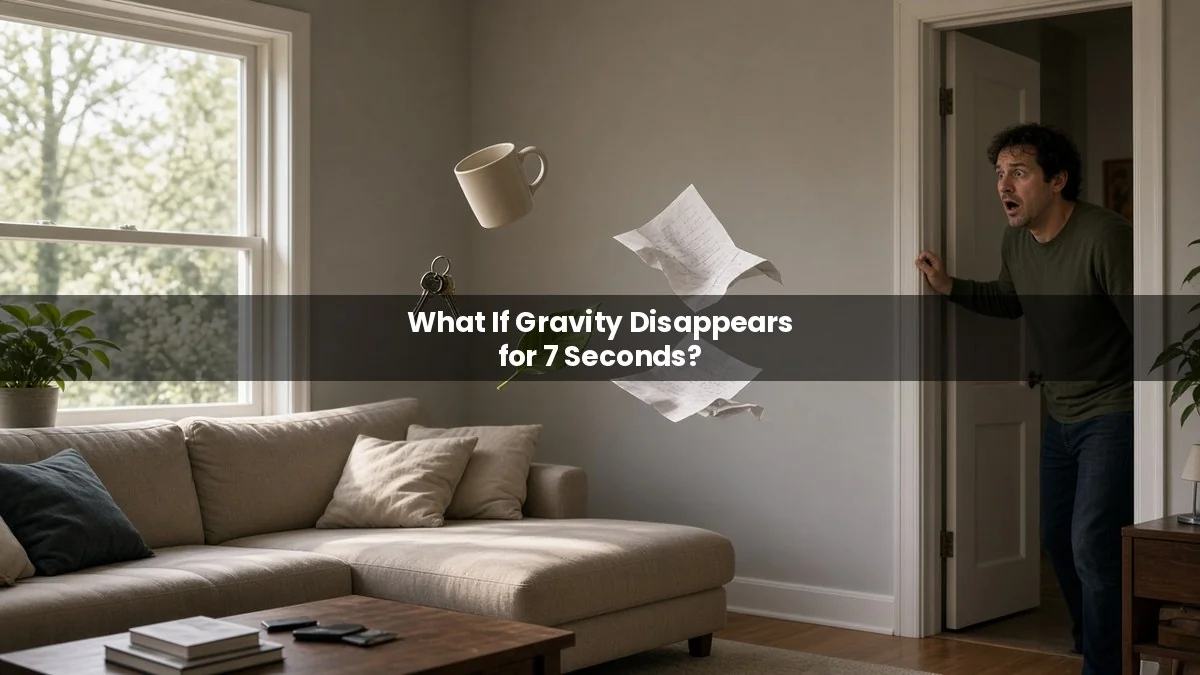
Unrestrained mugs, phones and people not holding on begin to drift. Water leaves its usual “down.” The atmosphere is held by gravity; without it, air would begin expanding outward. Seven seconds is not enough for Earth to lose its air, but pressure and buoyancy would already act strangely.
Your body does not dissolve
Chemical bonds are electromagnetic. Bones, concrete and molecules do not need gravity to stay molecules. Losing gravity is not the same as removing oxygen or tearing atoms apart.
The scary part is the return
When gravity snaps back in the thought experiment, everything that drifted falls. Injuries would come from impacts, not from “floating away forever.” Oceans and air that shifted would also crash back, which is why serious explainers talk about waves and structural damage rather than cartoon levitation.
For a related “stop the planet” scenario with real rotational physics, see what would happen if Earth stopped spinning. For how Earth’s magnetic shield works, see what happens if Earth lost its magnetic field. Extreme spacetime near compact objects is covered in what happens if you fall into a black hole.
What about Earth itself?
Status: speculative inside an impossible setup.
Earth’s interior is compressed by its own gravity. If that compression vanished even briefly, rock and metal would be out of mechanical equilibrium. Pressure waves and expansion could follow. We cannot time that confidently to seven seconds because the premise breaks known physics. Treat “the planet cracks open” claims as speculation layered on top of an already impossible switch.
How this compares with real risks
Status: established contrast.
Real space hazards look different: solar storms that hit satellites and grids, asteroid impacts, and orbital debris. Those have measurements, agencies and mitigation plans. A scheduled gravity blackout does not. If a social post gives you an exact clock time for gravity to fail, that alone is a red flag.
Gravity itself also takes time to travel. If the Sun vanished, Earth would keep orbiting for about 8 minutes 20 seconds before flying off in a straight line. We walk through that timeline in what happens if the Sun went dark for 8 minutes.
More grounded scenarios live in our what would happen if scenarios hub.
Frequently asked questions
Is Project Anchor real?
No public evidence supports it. Fact-checkers and BBC Bitesize treat it as a fabricated social-media story.
Can an eclipse turn off gravity?
No. NASA states that a total solar eclipse has no unusual impact on Earth’s gravity. Tides change in well-known ways; planetary gravity does not shut off.
Would everyone die in seven seconds?
In the viral story, yes. In careful physics explainers, seven seconds of weightlessness would cause chaos and injuries, especially on the way down, but not automatic extinction. The scenario remains impossible.
Do black hole mergers threaten Earth?
Detected mergers send gravitational waves that are extraordinarily weak here. They are scientific signals, not apocalypse switches.