What Happens If Yellowstone Erupts? Ash, Climate and Real Odds
Beneath Yellowstone National Park lies one of the largest volcanic systems on Earth. It has produced three enormous eruptions in the past 2.1 million years, and the craters it left behind are so large you can drive across one without noticing. Every few months, a viral video claims it’s “overdue” and about to wipe out America.
So what really happens if Yellowstone erupts? The answer depends on what kind of eruption you mean, and the most likely kind isn’t the apocalyptic one. This guide sticks to what the US Geological Survey (USGS) and published research actually say, and clearly marks where projection ends and speculation begins.
The short answer
- The most likely eruption is small: a lava flow or a hydrothermal (steam) explosion, affecting mainly the park itself.
- A supereruption is possible but very unlikely. USGS puts the annual chance at about 1 in 730,000, and stresses that even this figure is rough.
- If a supereruption did happen: ash would fall across much of the US, heavy near the park and lighter farther away, and global climate could cool for years.
- Yellowstone is not “overdue.” Volcanoes don’t erupt on a schedule.
Three kinds of Yellowstone eruption
Status: established, based on USGS.
1. Hydrothermal explosions (the most common)
Superheated groundwater can flash to steam and blast out craters. These events don’t involve magma reaching the surface. They are dangerous within a small area and happen at Yellowstone fairly often on geological timescales.
2. Lava flows (the most likely volcanic eruption)
Since the last giant eruption, Yellowstone has produced about 80 smaller, non-explosive eruptions, according to the USGS. Most were thick lava flows. The most recent was the Pitchstone Plateau flow, about 70,000 years ago. USGS says a lava flow is the most likely type of future eruption. It would cause serious damage inside the park but wouldn’t threaten the rest of the country.
3. Caldera-forming supereruptions (rare)
These are the giants. Yellowstone has had three: about 2.1 million, 1.3 million, and 640,000 years ago. Each one emptied a huge volume of magma so quickly that the ground collapsed into a vast depression called a caldera.
Is Yellowstone overdue?
Status: established, with a USGS clarification.
The “overdue” idea comes from simple arithmetic. The gaps between the three big eruptions were about 800,000 and 660,000 years. It has now been about 640,000 years since the last one, so people conclude the next is due.
USGS rejects this logic. Volcanoes don’t erupt on regular schedules, and two intervals are far too few to define a pattern. The 1-in-730,000 annual probability comes from averaging those intervals, and USGS itself says it isn’t a reliable forecast. USGS also notes that the magma reservoir beneath Yellowstone is only about 5% to 15% molten. Most of it is solid, hot rock, which makes a supereruption much harder to trigger.
What a supereruption would do
Status: model-based projection.
Near the volcano
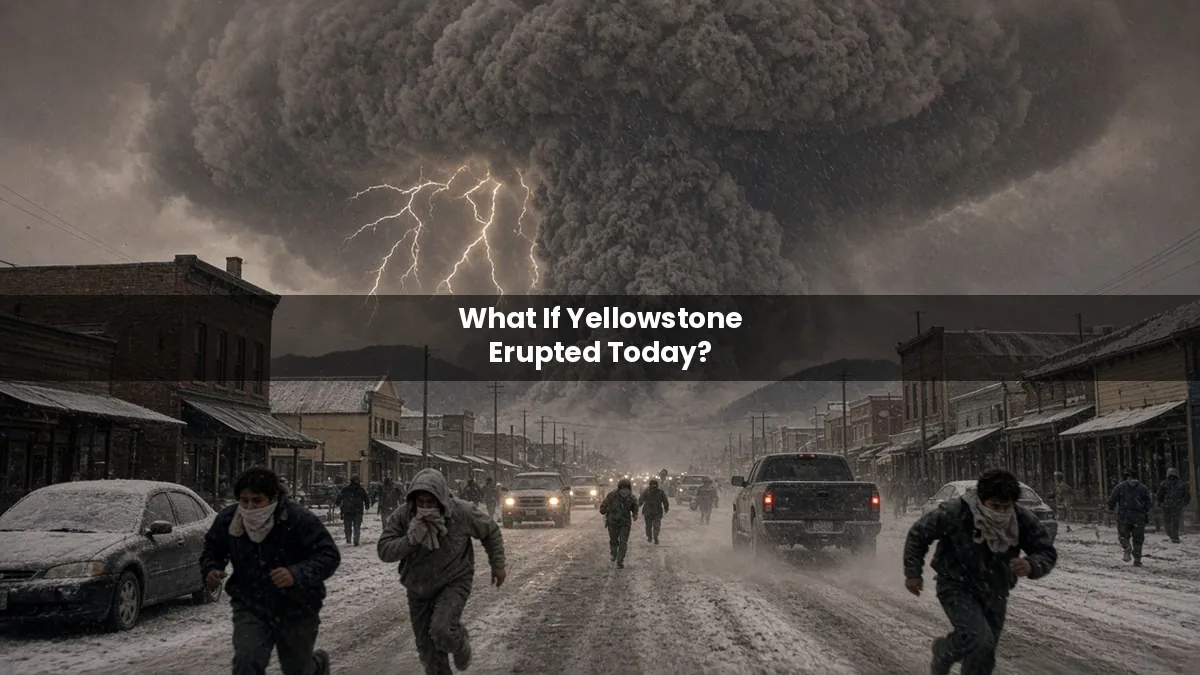
Close to the volcano, the effects would be catastrophic. Pyroclastic flows, fast-moving avalanches of hot gas and rock, would sweep the surrounding landscape. Areas closest to the park would be devastated.
Ash across the United States
In 2014, USGS scientists led by Larissa Mastin modeled how ash from a large Yellowstone eruption would spread, using a computer model called Ash3D. They found that the eruption would form a giant “umbrella cloud” that spreads outward in all directions, even upwind, creating a bull’s-eye pattern of ash fall centered on Yellowstone.
In the modeled scenario:
- Cities in the northern Rocky Mountains, such as Billings, Montana, and Casper, Wyoming, could be buried under more than a meter of ash.
- The northern Midwest could get centimeters to tens of centimeters.
- The East, West and Gulf coasts could receive millimeters to centimeters.
Even a few millimeters of ash causes real problems. It can short out electrical equipment, clog air filters and engines, contaminate water supplies, and collapse roofs when it’s wet and heavy. The researchers noted the impacts would be severe, but the ash amounts were far less than some doomsday portrayals suggest.
Air travel and infrastructure
Volcanic ash is pulverized rock and glass. It can melt inside jet engines and cause them to fail, so flights over a wide area would be grounded. Power grids, water treatment and roads could all be disrupted. Our guide to what happens when a storm knocks out power shows how quickly those failures cascade.
Global climate
Large eruptions inject sulfur gases into the stratosphere, forming tiny droplets that reflect sunlight. USGS says a supereruption could cool the climate for years to decades. Crop failures in some regions would be a serious risk.
For a smaller-scale preview, look at 1815, when Indonesia’s Tambora erupted. The following year became known as the “Year Without a Summer” in Europe and North America, with crop failures and food shortages. A Yellowstone supereruption would likely be much larger.
What it might feel like far from the park
Status: speculation built on the USGS ash model and past eruptions.
Imagine you live in Chicago or Denver when the eruption starts. You probably wouldn’t hear it or feel it. The first signs would be news alerts, mass flight cancellations and, within a day or two depending on winds, a darkening sky. Fine gray ash would begin settling on cars, roofs and roads, feeling more like gritty flour than snow.
Officials would tell people to stay indoors, wear masks outside and keep ash out of water supplies. Drains would clog. Power could flicker as ash coated insulators on power lines, especially after rain. Grocery shelves might empty as transport slowed. Further east, life would be disrupted rather than destroyed: a messy, expensive cleanup lasting months.
In the following years, cooler summers and poor harvests in some regions could push up food prices worldwide. That longer, quieter impact might end up affecting more people than the ash itself.
Would it be an extinction event?
Status: projection, with speculation clearly labeled.
No. Volcano scientists, including those at USGS, stress that a Yellowstone supereruption would not end human civilization or cause human extinction. It would be one of the worst natural disasters in recorded history, with enormous economic and humanitarian costs, but it would not wipe out humanity.
Earth has seen supereruptions before. The most recent was New Zealand’s Taupō, about 27,000 years ago. Life and humans continued after it.
Would we get a warning?
Status: established monitoring practice, plus projection.
Yes, very likely. The Yellowstone Volcano Observatory monitors earthquakes, ground movement, gas emissions and heat flow around the clock. Before magma reaches the surface in a large eruption, scientists expect intense earthquake swarms, rapid ground deformation and changes in gas, probably weeks to months or longer ahead of time.
Yellowstone is always moving a little. It typically records 1,000 to 3,000 earthquakes a year, and the ground rises and falls over years. Those normal changes are not signs of an imminent eruption.
The bigger hazard you never hear about: earthquakes
Status: established.
In practical terms, earthquakes are a bigger day-to-day risk in the Yellowstone region than eruptions. In 1959, the magnitude 7.3 Hebgen Lake earthquake just west of the park triggered a massive landslide that killed 28 people. For more on how large quakes play out, see our explainer on what would happen if an earthquake reached an impossible intensity.
Fact vs projection vs speculation
- Established: three caldera-forming eruptions; about 80 smaller eruptions since; lava flows are the most likely next eruption; constant monitoring.
- Projection: the ash distribution in the USGS model; years to decades of climate cooling.
- Rough estimate: the 1-in-730,000 annual probability.
- Myth: that Yellowstone is overdue or could wipe out humanity.
Another debated volcanic disaster scenario: what happens if La Palma triggers a megatsunami.
FAQ
Is Yellowstone going to erupt soon?
There’s no sign of that. USGS monitoring shows normal activity, and the annual chance of a supereruption is about 1 in 730,000.
How far would Yellowstone ash reach?
In USGS modeling of a large eruption, ash reached all of the contiguous US, with meters near the park and millimeters on the coasts.
Would a Yellowstone eruption end the world?
No. It would be a severe disaster for the US and affect global climate, but it wouldn’t cause human extinction.
Is it safe to visit Yellowstone?
Yes. The real hazards for visitors are hot springs, wildlife and normal outdoor risks, not eruptions.
What’s the most likely eruption at Yellowstone?
A lava flow or a hydrothermal explosion, mostly affecting the park itself.
Why do scientists monitor Yellowstone if an eruption is so unlikely?
Because smaller hazards are real. Hydrothermal explosions, earthquakes and ground changes can affect the millions of people who visit each year, and monitoring would give the earliest possible warning if anything bigger ever began to stir.
The takeaway
A Yellowstone supereruption would be devastating, but it’s unlikely in any human lifetime, and it wouldn’t end civilization. The more realistic future is a lava flow or a steam explosion inside the park, with plenty of scientists watching for warning signs.
More what-ifs: what would happen if Earth stopped spinning, or browse all our “what would happen if” scenarios.
Sources
- USGS: Is Yellowstone overdue for an eruption?
- USGS: Modeling the Ash Distribution of a Yellowstone Supereruption (2014)
- Mastin, L.G. et al. (2014), Geochemistry, Geophysics, Geosystems: Modeling ash fall distribution from a Yellowstone supereruption
- USGS Yellowstone Volcano Observatory: Yellowstone Caldera
- USGS: 60 years since the 1959 M7.3 Hebgen Lake earthquake
- USGS: Earthquakes at Yellowstone