What Happens If the FAA Issues a Nationwide Ground Stop?
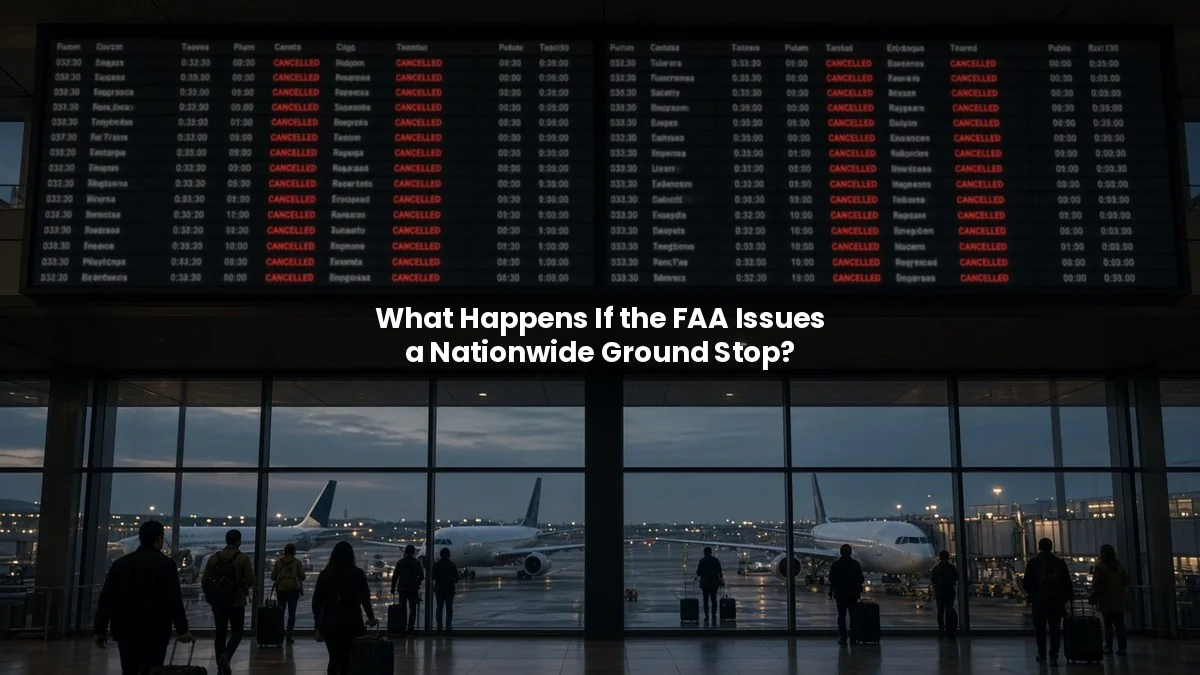
On Friday, November 13, 2026, the Federal Aviation Administration issued a nationwide ground stop after telecommunications trouble disrupted air-traffic communications and radar. Flightradar24 recorded the order at 3:54 p.m. Eastern (20:54 UTC). The FAA lifted it at 8:15 p.m. Eastern, after more than four hours. Reuters and NPR called it the longest U.S. flight halt since the September 11, 2001, attacks. Saturday was still a slog for travelers.
Short answer: A nationwide ground stop means no commercial flight in the United States may take off until the FAA lifts the order. Planes already in the air are landed safely. Even a few hours on the ground can cancel or delay thousands of later flights, because crews, aircraft and gates end up in the wrong places.
Below we separate official accounts from tracker counts and questions that remain open.
What is a nationwide ground stop?
A ground stop is an air-traffic order that holds planes at the gate, or at the airport, so they do not depart into a problem the FAA cannot safely manage. Most stops are local: a storm over Dallas, a closed runway in Chicago, a radar outage at one facility. A nationwide ground stop is rare. It covers the entire National Airspace System.
NPR noted that Friday’s event was only the second halt of this scale since September 11, 2001. The previous comparable shutdown came in 2023, when an outage in the Notice to Air Missions, or NOTAM, system stopped U.S. departures. Transportation Secretary Sean Duffy said Saturday that if officials do not think you can get there safely, “we will keep you on the ground.”
What happened during Friday’s nationwide ground stop?
Status: official DOT and FAA account of the timeline; cancellation totals vary by data source and time of day.
According to a U.S. Department of Transportation readout of the November 14 briefing:
- Problems with communications and radar used by air traffic control led the FAA to halt departures “out of an abundance of caution.”
- About 3,500 aircraft were already in the air. Controllers and pilots landed all of them.
- After the agency lifted the order, more than 8,000 flight operations resumed that night.
- On Saturday the airspace was open again, but passengers were told to expect more delays and cancellations.
Reuters reported that the FAA lifted the nationwide ground stop at 8:15 p.m. Eastern, after about four hours, and that departures would resume only gradually. Flight-tracking sites, counted at different hours, produced different totals, so none should be treated as a single official cancellation number:
- Flightradar24, cited by Reuters, recorded nearly 10,000 canceled flights by 11:30 p.m. Friday, including more than 2,200 each at Delta and American and 1,800 at United.
- FlightAware, cited by NPR, recorded nearly 25,000 delays and more than 9,000 cancellations on Friday.
- FAA Administrator Bryan Bedford said Saturday that as many as 5,000 flights would still be canceled that day, with airlines aiming to be back to normal by Sunday evening, Axios and the Associated Press reported. AP also said about 41,000 flights were scheduled for Saturday.
Why did the FAA halt every U.S. departure?
Status: officials have described the trigger; they have not yet named the exact fault.
Duffy said a contractor, L3Harris, was doing routine maintenance at a remote FAA site, switching old copper telecommunications lines to fiber as the copper service was being discontinued. During that cutover, a router being replaced “started flooding other routers” in the air-traffic system with more than 1,000 connection attempts every four to five seconds. That surge interfered with controller-to-pilot communications and disrupted radar feeds.
The FAA then shut the airspace, landed the airborne flights and isolated the problem. Duffy said officials do not believe the event was a cyberattack, because systems came back once the remote work was isolated. What they still have not determined is whether the flood came from a contractor error or from a faulty piece of equipment. “We haven’t determined what the fault was,” he said.
The episode is a reminder that modern travel still depends on aging infrastructure. A similar vulnerability shows up when navigation signals fail, as we explain in what happens if GPS stops working, or when the electric system itself goes down, as in what happens if the power grid fails for a month.
What happens to planes that are already in the air?
They do not hover until the computers come back. In Friday’s nationwide ground stop, the 3,500 aircraft already aloft were brought in and landed. Once they are on the ground, the knock-on effects start. A plane meant to leave New York for Dallas at 5 p.m. may now be sitting in Chicago, with a crew close to a legal duty limit and a gate already assigned to someone else. That is why a four-hour halt can still wreck Saturday’s schedule. Reuters, citing Flightradar24, said some planes at major airports waited more than five hours for a gate on Friday night.
How long do delays last afterward?
It depends on how many aircraft and crews are out of place, and whether weather piles on. After Friday’s event, Bedford said he thought “the worst is behind us” but that significant recovery work remained, and he pointed to Sunday evening as the target for normal operations. That was a forecast, not a guarantee. Saturday morning was still messy: Cirium data cited by NPR showed more than 4,000 cancellations, about 18% of flights departing the United States. By 11:50 a.m. Eastern Saturday, FlightAware, cited by Axios, had recorded more than 4,700 canceled international and domestic flights and more than 13,500 delays. Duffy said Saturday that FAA systems were back at “full operations,” while airlines were still repositioning aircraft and crews. Duffy also said Congress had provided $12.5 billion as a “partial payment” toward modernization, and that the FAA had already replaced 69% of its copper communications with fiber. Bedford cautioned that the router work at the remote site was ordinary maintenance of the older network, not part of that program.
When a storm knocks out local systems, the recovery path looks similar, only smaller, as we explain in what happens during a storm power cut.
The next night, a UPS cargo jet and a Copa passenger jet collided on a Miami taxiway. Officials have not reported any link to Friday’s halt; see what happens if two planes collide on a taxiway. Flights can also be halted for security reasons, not just technical failures. See what happens if your flight gets a bomb threat.
What should you do if your flight is affected?
- Check the airline app before you leave for the airport. A nationwide ground stop can be lifted while your specific flight is still canceled.
- Ask about rebooking and refunds. Bedford said Saturday that passengers should be put on new flights or receive a full refund, and should contact their airlines directly.
- Build slack into connections, and keep medicines and chargers in a carry-on. Overnight delays are common after a halt this large.
What is still unknown?
Status: open questions as of Saturday, November 14, 2026.
- The exact equipment fault. Officials have not said whether the router flood was a human error or a bad device.
- A single official cancellation total. Tracker counts moved through the night and disagreed. Use time-stamped figures, not one headline number.
- Whether recovery finishes on Sunday. As of Saturday afternoon, November 14, that remained the FAA’s goal, not a completed result.
Staffing problems can also shut a single tower. See what happens if an airport control tower goes empty, after Hollywood Burbank Airport went ATC Zero on November 18, 2026.
Frequently asked questions
What happens if a nationwide ground stop starts while I am already flying?
Your flight should continue to a safe landing. The order is meant to stop new departures, not to leave aircraft circling indefinitely.
Is this the same as closing U.S. airspace after an attack?
No. Friday’s order was a safety halt after a communications and radar disruption. Officials said they do not believe it was a cyberattack. It was still one of the longest nationwide stoppages since 2001.
Why were flights still canceled a day later?
Aircraft, pilots and flight attendants end up in the wrong cities, and duty-time rules limit how long crews can keep working. Untangling that takes longer than restarting the computers.
Will I get my money back?
The FAA administrator said Saturday that passengers should be rebooked or given a full refund. The actual policy and request process still run through your airline.
Could this happen again?
Yes. Officials described the underlying telecommunications network as old, and they have not yet finished explaining why this cutover failed.
Sources
- U.S. Department of Transportation: Duffy and Bedford briefing readout (November 14, 2026)
- Reuters: FAA lifts nationwide ground stop; flights to resume gradually
- NPR: FAA ground stop ends, but passengers remain stranded
- Axios: FAA back at full operations, with Saturday cancellations still expected
- Associated Press: What to know about flights after the nationwide ground stop
- Flightradar24: nationwide ground stop timeline and Friday cancellation counts