What Happens If Space Junk Triggers Kessler Syndrome?
Imagine a piece of metal the size of a marble moving at about 28,000 km/h. At that speed, it carries the energy of a speeding car. Now imagine more than a million fragments of that size or bigger circling Earth, crossing paths with the satellites that run your phone’s maps, weather forecasts and bank payments.
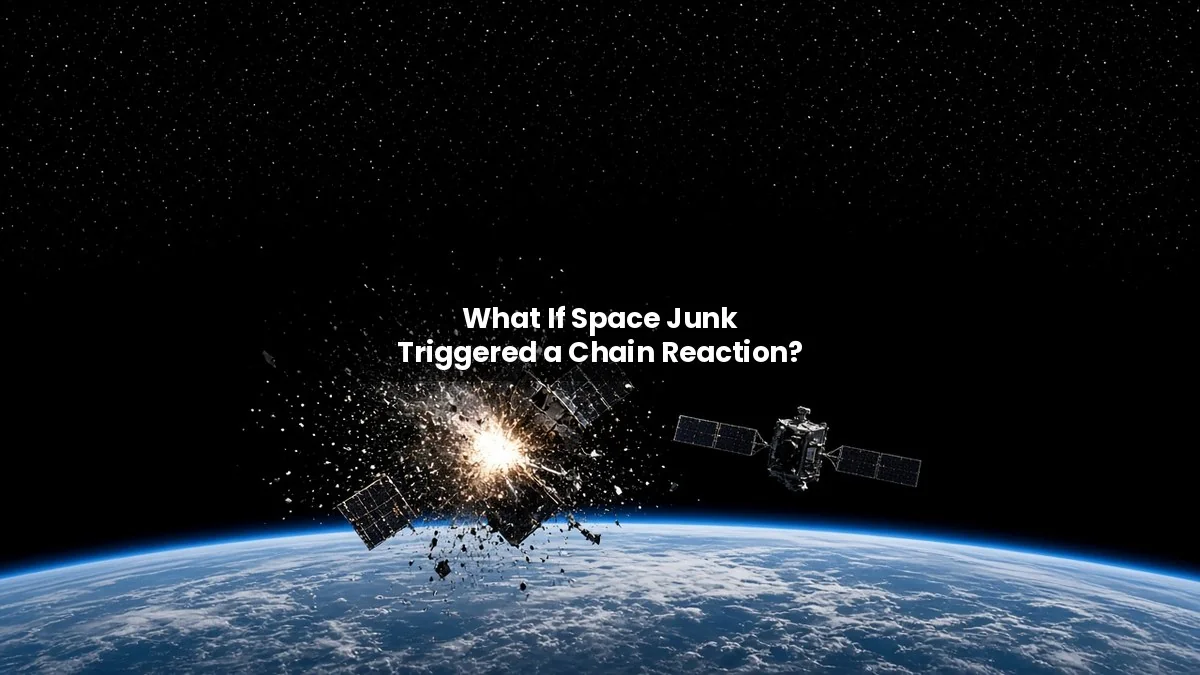
That’s not science fiction. It’s the current state of low Earth orbit. And it’s why scientists worry about Kessler syndrome: the point where collisions between objects in orbit create so much debris that they trigger more collisions, in a chain reaction that could make some orbits unusable for generations.
So what happens if Kessler syndrome actually happens? Let’s separate what’s already measured, what models predict, and what Hollywood exaggerates.
The short answer
- It would be slow, not sudden. Experts expect a cascade to unfold over years to decades, not in a single afternoon like in the film Gravity.
- Some orbits would become too risky to use. Launching and operating satellites there would cost far more, or stop being worth it.
- Daily life would feel it indirectly: weather forecasting, climate monitoring, satellite internet, navigation and imaging could degrade.
- It may already be starting in some crowded altitudes, according to the European Space Agency.
What is Kessler syndrome?
Status: established theory.
In 1978, NASA scientists Donald Kessler and Burton Cour-Palais published a paper warning that collisions between satellites could produce fragments that collide with other objects, creating ever more fragments. Past a certain density of objects, they argued, the debris belt would keep growing on its own, even if nobody launched anything new.
The key idea isn’t a sudden explosion of destruction. It’s a tipping point. Once you cross it, debris creation outpaces the natural cleanup, which happens when atmospheric drag pulls objects down to burn up.
How bad is space debris right now?
Status: established, from ESA’s 2025 Space Environment Report.
- About 40,000 objects are tracked by space surveillance networks.
- Only about 11,000 of them are working satellites.
- ESA estimates more than 1.2 million pieces larger than 1 cm, and about 54,000 larger than 10 cm.
- Smaller pieces, from 1 mm to 1 cm, number roughly 130 million.
Most of the smaller fragments are too tiny to track but large enough to damage a spacecraft. In 2024 alone, several breakups added more than 3,000 new tracked objects.
ESA’s modeling concludes that even if launches stopped completely, the amount of debris in some orbits would keep growing because of collisions between existing objects. That is exactly the self-sustaining effect Kessler predicted.
The collisions that showed us what’s possible
Status: documented events.
2007: China’s anti-satellite test
China destroyed its own defunct Fengyun-1C weather satellite with a missile. It became the single worst debris-creating event in history, producing more than 3,000 tracked fragments, many of which will stay in orbit for decades.
2009: Iridium 33 vs Cosmos 2251
For the first time, two intact satellites collided by accident. An active US communications satellite slammed into a dead Russian military one at about 11.7 km per second over Siberia. By the end of that year, more than 1,600 fragments had been catalogued.
2021: Russia’s anti-satellite test
Russia destroyed its own Kosmos 1408 satellite, scattering more than 1,500 trackable fragments. Astronauts on the International Space Station had to shelter in their docked spacecraft as a precaution.
Why low orbit is filling up so fast
Status: established trend.
For decades, a few hundred launches carried a modest number of large satellites. That changed in the late 2010s, when companies began launching mega-constellations of thousands of small satellites for broadband internet. ESA’s reports show the number of active payloads climbing steeply in just a few years. Reusable heavy-lift rockets could speed that build-out further; we look at the stakes in what happens if Starship becomes fully reusable.
More satellites aren’t automatically a disaster. Modern constellations are designed to maneuver around threats and to deorbit within a few years when they fail. The danger comes from what’s left behind: dead satellites that can’t move, spent rocket stages, and fragments from breakups. Every close approach between those uncontrolled objects is a roll of the dice that nobody can steer.
There’s also a squeeze in operations. Satellites that can maneuver must dodge more often as traffic grows. Each maneuver uses fuel, shortens a satellite’s life and requires coordination between operators who may not share data well.
What would a full Kessler cascade look like?
Status: model-based projection.
Year by year, not minute by minute
In the movie Gravity, a debris cloud tears through orbit in minutes. Real cascades are far slower. Collisions are still rare events. What changes is the trend: each decade, the background risk gets worse, and collision-avoidance maneuvers become more frequent.
Some orbits become no-go zones
The worst-hit band would be low Earth orbit, especially between roughly 700 and 1,000 km, where many old satellites and rocket bodies sit and drag is too weak to clear them quickly. Satellites there would need heavy shielding, constant dodging, or would simply be abandoned.
Higher orbits are mostly safer
Geostationary satellites, which sit about 36,000 km up and carry a lot of TV and weather services, are in a much less crowded region. A low-orbit cascade would not directly destroy them, though launches heading up there would still have to pass through the debris.
A glimpse of the worst case
Status: speculation, for illustration.
Picture the 2060s in a pessimistic scenario. Insurers refuse to cover satellites in the most crowded altitude bands. Weather agencies lose some polar-orbiting satellites and can’t afford to replace them at the same rate, so forecasts a week out become a little less reliable. Space agencies route crewed missions through narrow, carefully timed windows. None of this is a single dramatic catastrophe. It’s a slow loss of capability that we would only fully notice in hindsight.
How it would affect life on Earth
Status: projection.
You would not see debris raining from the sky. Most fragments burn up when they eventually re-enter, as many satellites do at the end of their lives. (We covered one example in what happens when the Swift telescope falls to Earth.) The impact would come from services we take for granted:
- Weather forecasts: many weather and climate satellites fly in low, polar orbits.
- Satellite internet: large constellations operate in low Earth orbit and would face rising costs and risks.
- Navigation and timing: GPS satellites orbit higher, around 20,000 km, so they are less exposed, but replacements still need to launch through lower orbits.
- Earth observation: crop monitoring, disaster response and mapping rely heavily on low orbits.
- Human spaceflight: crewed missions would face higher risks and more frequent avoidance maneuvers.
A severe cascade could also slow down space exploration by making launches riskier and insurance more expensive.
Can we stop it?
Status: current practice and ongoing research.
- Deorbiting old satellites: international guidelines ask operators to remove satellites from low orbit after their mission ends. In 2022, the US FCC replaced the old 25-year guideline with a five-year deadline for satellites it authorizes in low orbit.
- Avoiding new debris: designing rockets and satellites that don’t explode or shed parts.
- Active debris removal: missions to capture large dead objects are in development. ESA’s ClearSpace-1 and Japan’s Astroscale demonstrations are early examples.
- Better tracking: more precise tracking reduces false alarms and helps operators dodge real threats.
- No more destructive weapons tests: several countries have pledged not to conduct destructive anti-satellite missile tests.
ESA’s view is clear: current efforts are improving, but they are not yet enough to make the orbital environment stable.
Fact vs projection vs speculation
- Established: about 40,000 tracked objects; the 2007 and 2009 debris events; the theory of self-sustaining collisions.
- Projection: ESA models showing debris growth even without new launches.
- Uncertain: how close we are to a runaway cascade, and which orbits fail first.
- Exaggerated: the instant, everything-destroyed scenario from Gravity.
Closer to Earth, debris is the problem. Much farther out, the challenge is distance and fading power. See what happens when Voyager 1 reaches one light-day.
Even without a debris cascade, a single radio failure can stall a mission. See what happens if a Mars rover loses contact.
FAQ
Has Kessler syndrome already started?
ESA’s analysis suggests some crowded orbits already have enough debris for collisions to keep increasing the population on their own. That’s an early warning sign, not a full cascade.
Could Kessler syndrome trap us on Earth?
Unlikely. Rockets cross dangerous orbits in minutes, so the risk per launch would rise but remain manageable. The bigger problem is operating satellites there for years.
Would debris fall on people?
Most small debris burns up on re-entry. Larger objects occasionally survive, but the risk to any individual is extremely low.
How fast does space debris travel?
In low Earth orbit, objects move at about 7 to 8 km per second, roughly 28,000 km/h.
Can debris be cleaned up?
Partly. Removal missions are being tested, but capturing large objects is expensive. Preventing new debris is still the most effective strategy.
The takeaway
Kessler syndrome isn’t a sudden apocalypse in the sky. It’s a slow-moving traffic disaster that could make parts of space too dangerous and expensive to use. The warning signs are here, and what we launch and how we clean up in the next decades will decide how bad it gets.
Explore more: Earth and space what-if scenarios, what would happen if a Carrington-level solar storm hit today, what happens when the Swift telescope falls to Earth, or browse all our “what would happen if” scenarios.
Sources
- ESA: ESA Space Environment Report 2025
- ESA: Space debris by the numbers
- Kessler, D.J. and Cour-Palais, B.G. (1978): Collision frequency of artificial satellites: The creation of a debris belt
- NASA Orbital Debris Program Office: Orbital Debris Program Office
- FCC: FCC adopts new 5-year rule for deorbiting satellites