
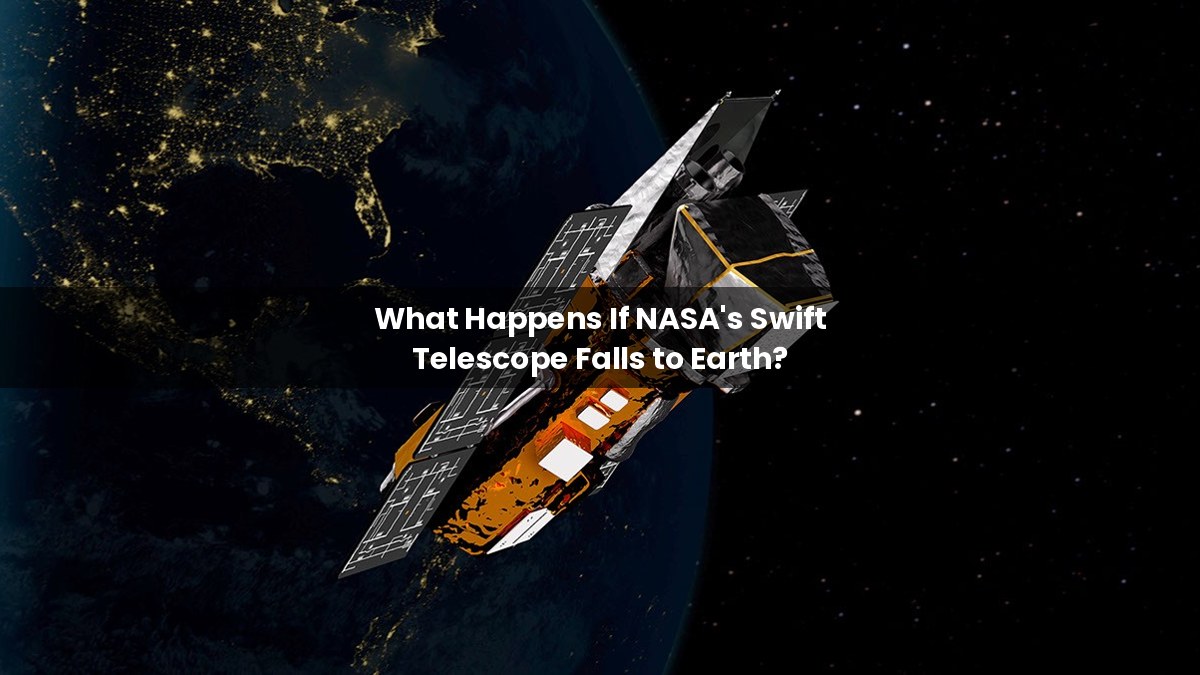
What Happens If NASA’s Swift Telescope Falls to Earth? Reentry Explained
A NASA space telescope is about to fall out of the sky, and nobody knows exactly where it will land. The Swift telescope reentry is expected within weeks, after a rescue mission failed and NASA shut the observatory down on October 23. So what happens when a 22-year-old spacecraft drops back into the atmosphere? Here is a clear, calm look at the risks, the science, and what comes next.
This is a developing story. Reentry timing and location will stay uncertain until the final days, so treat any forecast as a moving target.
What Is Swift, and Why Is It Falling?
The Neil Gehrels Swift Observatory launched in 2004. Its job was to catch gamma-ray bursts, the most powerful explosions in the universe. Over time, however, it became a fast-reacting tool for many other cosmic events, from flaring black holes to comets.
Every satellite in low Earth orbit feels a little drag from the thin upper atmosphere. When the Sun is very active, that atmosphere puffs up. As a result, drag gets stronger. According to NASA, recent solar activity made Swift sink rapidly.
On October 20, Swift reached 171 miles (275 kilometers). At that point, it could no longer cope with the drag and entered safe mode. Then the team at Penn State sent a command that effectively ended operations.
Why the Rescue Mission Failed
NASA did try to save it. As Space.com reports, Arizona-based Katalyst Space Technologies won a $30 million NASA contract to boost Swift into a higher orbit. The company built a robotic spacecraft called LINK, which launched on July 3.
Unfortunately, LINK suffered attitude-control problems after launch. NASA and Katalyst called off the attempt. Later, SpaceNews reported that LINK itself reentered on September 25. In other words, the rescuer fell before the patient did.
What Happens During the Swift Telescope Reentry?
Swift will make an uncontrolled reentry. That means no engine will steer it toward a safe patch of ocean. Instead, drag will slowly pull it lower until it plunges into the thick lower atmosphere.
At that stage, friction and compression heat the spacecraft to extreme temperatures. Solar panels, antennas, and thin structures break off first. Next, the main body tears apart. Most of the material melts or vaporizes high above the ground.
However, not everything is expected to burn up. NASA told Space.com that “some components are expected to survive reentry,” while adding that the risk of harm to anyone on Earth is unlikely.
Swift is not huge by satellite standards. CNN puts the observatory at about 3,200 pounds (1,452 kilograms). Its dry mass, without fuel, is 613 kilograms (1,351 pounds), according to Space.com.
Which Parts Could Reach the Ground?
Dense, heat-resistant parts are the usual survivors. Darren McKnight of LeoLabs told Space.com that the inner workings of Swift’s X-ray and optical telescopes might survive. He also named optical lenses and titanium tanks as possible survivors.
Titanium tanks are a common find after reentries, because the metal handles heat well. Lenses and mirror parts can also be tough. Still, any surviving pieces would be small fragments, not an intact telescope.
Where Could Swift Come Down?
This is the part nobody can answer yet. Swift orbits at an inclination of about 21 degrees. So, as researcher Ewan Wright of the University of British Columbia told Space.com, it could reenter anywhere between 21 degrees north and 21 degrees south of the equator.
That band covers a lot of tropical ocean. It also includes parts of Central America, northern South America, Africa, South Asia, Southeast Asia, and northern Australia. Notably, it does not reach the continental United States, the UK, or Canada.
Wright said the most likely outcome is that surviving debris lands in the sea. Even so, he noted there is a chance it could hit a built-up area.
Why Is the Timing So Hard to Predict?
The biggest unknown is the upper atmosphere itself. Its density changes with solar storms and daily heating. Even small changes alter drag, and drag decides when Swift drops.
In fact, NASA’s Community Coordinated Modeling Center calls thermosphere density “the dominant source of uncertainty” in reentry prediction. It has even turned Swift into a modeling challenge for scientists. Teams will test how well they can forecast its fall.
Because Swift circles Earth roughly every 90 minutes, an error of one hour can shift the impact point by thousands of miles. For that reason, final forecasts usually narrow only in the last day or so.
Should You Worry About Falling Space Debris?
For one person, the odds are tiny. Most of Earth’s surface is ocean, and much of the land is thinly populated. NASA has said the risk to anyone on the ground is unlikely.
That said, the bigger trend matters. Wright told Space.com that uncontrolled reentries of satellites and rockets are increasing every year. Consequently, he said, the chance that someone will be hit is growing.
If you ever find suspected space debris, do not touch it. Some parts can carry leftover fuel residue or sharp edges. Instead, take photos and contact local authorities.
What Science Do We Lose?
Swift was special because it was fast. It could spot a sudden flash and swing its other telescopes toward it within minutes. That made it a key alert system for astronomers worldwide.
Even in its final months, it kept working. NASA says Swift observed hundreds of targets after the rescue mission ended, from stellar explosion remnants to active supermassive black holes. Its archive will keep producing research for years.
Meanwhile, the failed rescue offers a lesson. Servicing old satellites in orbit is possible in theory. In practice, a fast-turnaround mission carries real risk, as LINK showed.
The Bigger Picture
Swift’s story is a reminder that space is not empty, and orbits do not last forever. The Sun shapes how long our satellites survive. In addition, every object we launch will come down one day, either by design or by chance.
If you enjoy big “what if” space questions, read our explainer on what would happen if the Moon stopped orbiting Earth. For a look at how fragile our systems can be, see what would happen if water disappeared from Earth.
Bottom Line
The Swift telescope reentry will most likely end with a bright streak over the ocean and a few scattered fragments. The exact day and place remain unknown, and NASA says it will share updates as the date nears. For now, the safest bet is simple: it will probably miss everyone, and the science it leaves behind will outlive the spacecraft by decades.