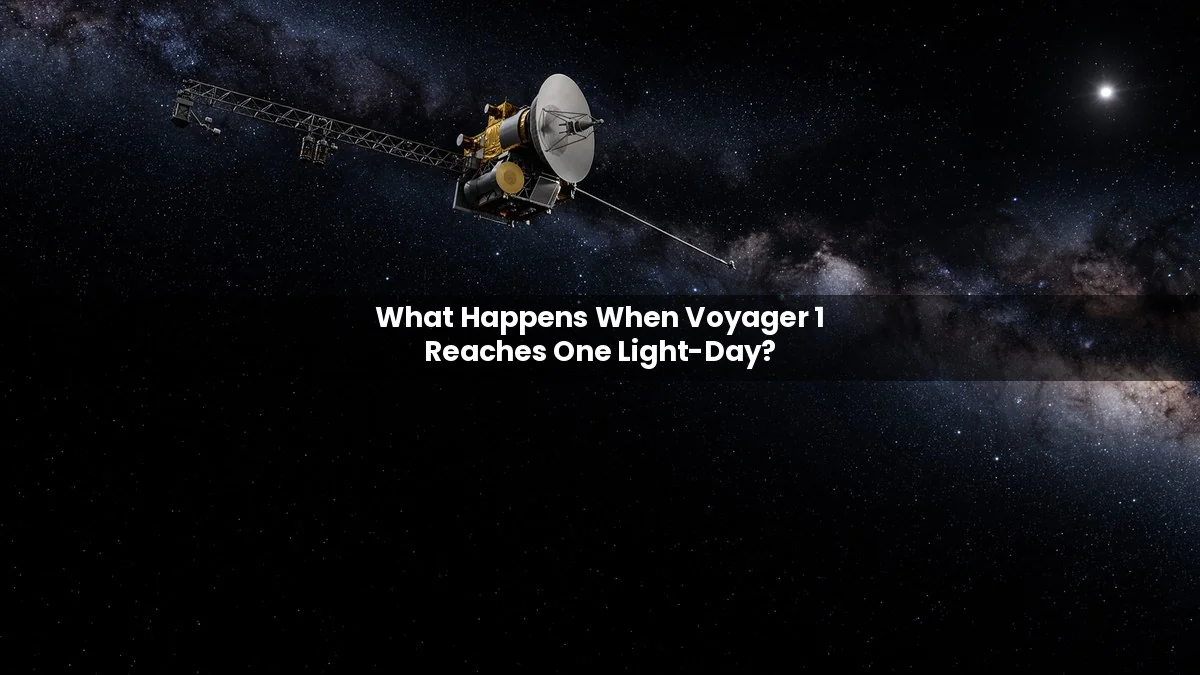
What Happens When Voyager 1 Reaches One Light-Day?
On November 18, 2026, at 5:16:07 a.m. EST (2:16:07 a.m. PST), NASA’s Voyager 1 reaches one light-day from Earth — the first human-made object to do so. So what happens when Voyager 1 reaches one light-day? On the spacecraft itself, almost nothing changes. Back on Earth, though, the milestone changes how we talk to it.
Short answer: When Voyager 1 reaches one light-day, it is 16.094 billion miles from Earth. A radio command now needs 24 hours to arrive, and the reply needs another 24 hours. The probe feels no change. The milestone highlights its shrinking power supply and the limited years it has left to send data.
Below, we separate confirmed facts from NASA’s projections and a few open questions.
What exactly is a light-day?
A light-day measures distance, not time. It is how far light travels in 24 hours. Light moves at about 186,000 miles per second, so one light-day equals 16,094,799,096 miles, or 25,902,068,356 kilometers, according to NASA.
For comparison, sunlight reaches Earth in roughly eight minutes. Voyager 1 is so far away that the same light would need a whole day to catch up with it. That eight-minute lag is also why we would not notice immediately if the Sun went dark. We walk through the full timeline in what happens if the Sun went dark for 8 minutes.
NASA set the crossing time at 5:16:07 a.m. EST (10:16:07 UTC) on November 18. By then, the probe had been flying for 49 years, two months and 11 days.
What happens when Voyager 1 reaches one light-day, on board?
In short, nothing dramatic. There is no boundary at this distance, no wall and no new kind of space. NASA’s Jet Propulsion Laboratory (JPL) said plainly that the spacecraft “will not detect any change in its environment” when it passes the mark.
Instead, the milestone matters for what it shows. It proves how vast space is. It also shows how long a 1970s machine can keep working.
Voyager 1 keeps cruising at nearly 38,000 mph (about 61,000 kph). Even so, that speed is a crawl compared with light. Caltech’s Voyager 50 project estimates the probe will not reach one light-year for roughly 17,000 more years.
How does communication change when Voyager 1 reaches one light-day?
This is the part that does change. Radio waves travel at the speed of light. Therefore, every command from NASA’s Deep Space Network now takes a full day to reach the probe. Its answer needs another day to come home.
Voyager project manager Suzanne Dodd described it this way: “If you want to say ‘hello’ to Voyager, you send your message and then you go home and you wait two days before you finally get a response.”
That two-day loop makes problem-solving slow. NASA’s Deep Space Network could not detect Voyager 1’s signal during two scheduled contacts on October 18 and 19, 2026, spaced 24 hours apart. The signal reappeared on October 20, before engineers sent any troubleshooting commands, and JPL said the team has maintained communication with the spacecraft since then. Engineers are still investigating what caused the loss. So far, they have determined that one group of thrusters went offline and backup thrusters turned on automatically, a built-in “fault protection” response that puts the spacecraft in a safe configuration. “This is the first time we’ve seen the spacecraft do something like this,” Voyager mission manager Kareem Badaruddin said in JPL’s October 29, 2026 update.
In other words, the team cannot react in real time. Voyager 1 has to protect itself first, and humans catch up later.
How much power does Voyager 1 have left?
Even as Voyager 1 reaches one light-day, power is the real clock on this mission. Voyager 1 runs on a radioisotope thermoelectric generator, which turns heat from decaying plutonium into electricity. NASA says each Voyager loses about 4 watts of power every year.
As a result, the team has been shutting things down for years. Here is the recent timeline from NASA:
- February 27, 2026: Voyager 1’s power dipped unexpectedly during a routine roll maneuver.
- April 17, 2026: Engineers switched off the Low-energy Charged Particles instrument, which had run almost nonstop since 1977.
- Early September 2026: The team completed the “Big Bang,” swapping three devices for three lower-power alternatives at the same time.
Today, Voyager 1 still runs two science instruments. One listens to plasma waves, and the other measures magnetic fields. According to JPL, without the Big Bang swap, another instrument might have gone dark as early as summer 2027.
What happens if Voyager 1 runs out of power?
This section covers NASA’s projections, not certainties. First, the science will stop. Once the last instrument shuts off, Voyager 1 will no longer measure interstellar space.
Next, the radio link will fade. NASA says engineering data could continue for several years after science ends. It adds that both Voyagers could stay within range of the Deep Space Network through about 2036, depending on how much power remains to transmit.
After that, the probe goes silent but keeps moving. Nothing will slow it down in any meaningful way. NASA expects Voyager 1 to pass within about 1.7 light-years of a star called Gliese 445 (AC +79 3888) in roughly 40,000 years.
Meanwhile, the probe still carries its Golden Record, with sounds and images from Earth. That message will keep drifting long after the last signal fades.
Why does Voyager 1 reaching one light-day matter for science?
Voyager 1 crossed into interstellar space in 2012. It and its twin, Voyager 2, are the only spacecraft ever to study that region directly. No other probe sits far enough away to sample it.
As a result, every extra month of data is unique. The plasma wave and magnetic field readings help scientists understand where the Sun’s bubble of influence, called the heliosphere, ends. They also reveal what lies beyond it.
The milestone also offers perspective. Space weather and cosmic distances shape our own planet in ways that are easy to forget. Our guide to what happens if a Carrington-level solar storm hits Earth shows how the Sun’s reach affects daily life.
Could anything replace Voyager 1?
Not soon. No mission now in flight will match Voyager 1’s distance for decades. New Horizons is also leaving the solar system, but it travels more slowly and remains far behind.
Mission planners have studied a dedicated “interstellar probe” concept. However, it is a proposal, not an approved mission. Any successor would likely take decades to build, launch and travel.
So for now, as Voyager 1 reaches one light-day and beyond, it stays our only voice at this range. If you enjoy the big questions, explore our Earth and space what-if scenarios. You can also read what happens if you go to space without a spacesuit and what happens when the Sun becomes a red giant.
Closer to home, NASA is also dealing with a radio problem on Mars. See what happens if a Mars rover loses contact.
Frequently asked questions
When did Voyager 1 reach one light-day from Earth?
NASA put the moment at 5:16:07 a.m. EST (10:16:07 UTC) on Wednesday, November 18, 2026, about 49 years after launch.
How far away is Voyager 1 when it reaches one light-day?
When Voyager 1 reaches one light-day, it is 16,094,799,096 miles (25,902,068,356 kilometers) from Earth. That is the distance light covers in 24 hours.
Is Voyager 1 still sending data?
Yes. As of JPL’s October 29, 2026 update, Voyager 1 was back in contact after the brief October signal loss and still returns data from two science instruments: the plasma wave subsystem and the magnetometer.
How long will Voyager 1 keep working?
No one knows exactly. NASA says engineering data could continue for years after science ends. Both Voyagers may stay in Deep Space Network range until about 2036.
Will Voyager 1 ever reach another star?
Not closely. In about 40,000 years, it should pass within roughly 1.7 light-years of the star Gliese 445.
Sources
- NASA Science: Voyager 1, What Is a Light-Day
- NASA Science: Where Are Voyager 1 and Voyager 2 Now?
- NASA JPL: Voyager 1 Conserves Power, Resolves Brief Communications Pause (Oct 29, 2026)
- NASA Science: NASA Shuts Off Instrument on Voyager 1 to Keep Spacecraft Operating (Apr 17, 2026)
- NASA Science: Voyager Frequently Asked Questions
- Caltech Voyager 50: One Light-Day to One Light-Year