What Happens If an Asteroid Hits Earth? From Small Rocks to Extinction
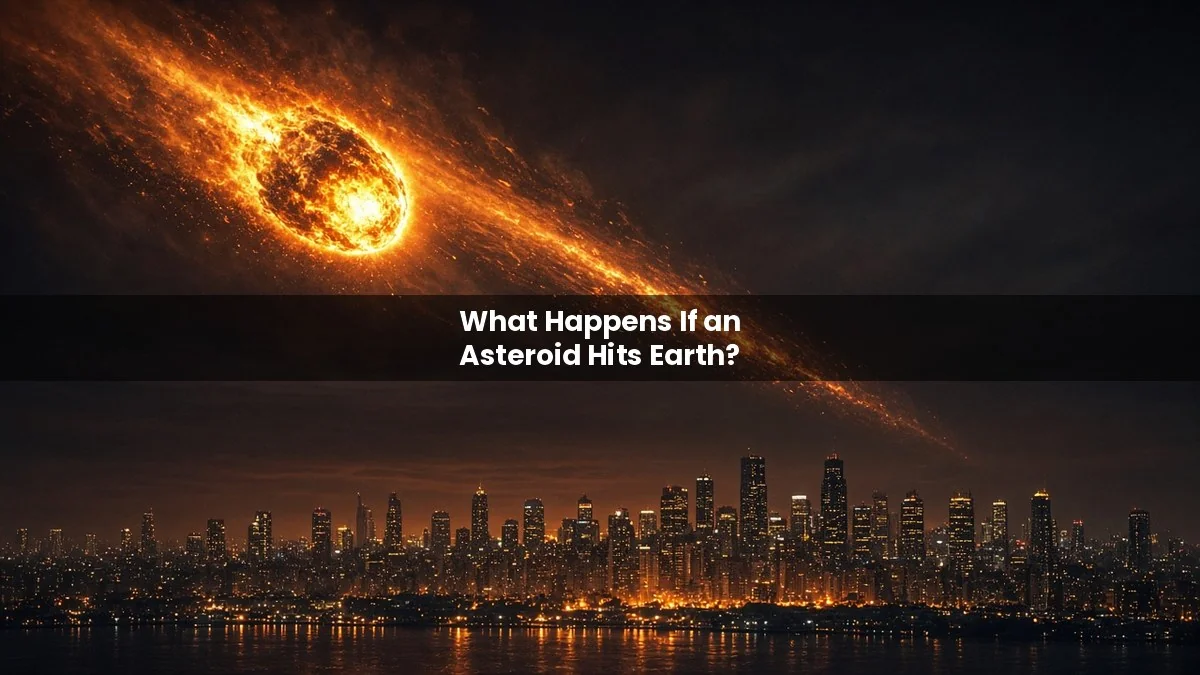
Sixty-six million years ago, a rock about 10 kilometers wide slammed into what is now Mexico. Within a short time, the dinosaurs were gone. So what happens if an asteroid hits Earth today? The answer depends on the size of the rock, and on whether we see it coming. Fortunately, for the first time in history, we may be able to push one away.
Short answer: it depends on the size of the rock. A small one shatters windows, as a 20-meter meteor did over Chelyabinsk, Russia, in 2013, while a larger one could destroy a region, and a 10-kilometer asteroid helped wipe out the dinosaurs 66 million years ago. NASA says no known large asteroid threatens Earth for at least the next century, and its DART mission proved we can change an asteroid’s path.
Key Takeaways
- Small space rocks hit Earth daily, but most burn up harmlessly.
- A 20-meter meteor injured about 1,500 people in Chelyabinsk, Russia, in 2013.
- A 10-kilometer asteroid helped wipe out the dinosaurs 66 million years ago.
- NASA says no known large asteroid threatens Earth for at least the next century.
- NASA’s DART mission proved we can change an asteroid’s orbit.
- Early detection is the key to planetary defense, because deflection needs years of warning.
How Often Do Asteroids Hit Earth?
Small space rocks strike Earth all the time. Most burn up harmlessly as shooting stars. Larger impacts are much rarer. Here is a rough guide, based on NASA and ESA estimates:
- Dust and pebbles: Every day. They create meteors.
- About 20 meters wide: Roughly once or twice a century, causing airbursts like Chelyabinsk.
- About 140 meters or larger: Rare, but capable of destroying a region.
- About 1 kilometer or larger: Very rare, with global consequences.
- About 10 kilometers: Roughly every 100 million years, a mass-extinction event.
What Happens If a Small Asteroid Hits Earth?
On February 15, 2013, a meteor about 20 meters wide exploded over Chelyabinsk, Russia. According to NASA, the shock wave shattered windows across the city. About 1,500 people were injured, mostly by flying glass.
Notably, nobody saw it coming. It approached from the direction of the Sun, where telescopes struggle to spot objects. That event became a wake-up call for planetary defense.
What Happens If a City-Killer Asteroid Hits?
An asteroid about 140 meters wide would release energy equal to many nuclear bombs. If it hit land, it could:
- Create a crater several kilometers wide.
- Flatten buildings over a large area with its blast wave.
- Start fires and cause widespread injuries.
If it hit the ocean, it could trigger tsunamis that threaten coastlines. For this reason, the US Congress directed NASA to find at least 90% of near-Earth objects 140 meters or larger.
What Happens If a Giant Asteroid Hits Earth?
A rock more than a kilometer wide could change the whole planet. The Chicxulub impact that ended the age of the dinosaurs shows what this looks like:
- The impact: A massive explosion carves a crater roughly 180 kilometers wide.
- Fire and tsunamis: Molten debris rains down, sparking wildfires, while huge waves sweep across oceans.
- Darkness: Dust, soot and sulfur fill the atmosphere and block sunlight.
- “Impact winter”: Temperatures fall, plants die and food chains collapse.
- Extinction: About three-quarters of species disappeared, according to the Natural History Museum.
Is an Asteroid Going to Hit Earth Soon?
No known large asteroid poses a significant threat to Earth for at least the next century, according to NASA. Astronomers have already found most near-Earth asteroids larger than 1 kilometer.
Smaller ones are harder to track. In early 2025, for example, asteroid 2024 YR4 briefly made headlines with a small chance of hitting Earth in 2032. Further observations ruled out an Earth impact, as NASA reported.
Can We Stop an Asteroid?
Yes, at least in some cases. In September 2022, NASA’s DART mission deliberately crashed a spacecraft into a small asteroid moon called Dimorphos. The impact shortened its orbit by about 32 minutes. It was humanity’s first test of planetary defense.
Other ideas include:
- Gravity tractors: A spacecraft flies alongside an asteroid and slowly tugs it with gravity.
- Nuclear devices: A last-resort option for large objects with little warning time.
- Early warning: Telescopes such as NASA’s planned NEO Surveyor will hunt for hidden asteroids.
Most importantly, deflection needs time. Years of warning make even a small nudge enough to miss Earth.
What Would Happen If We Saw One Coming?
Agencies such as NASA’s Planetary Defense Coordination Office and ESA’s Planetary Defence Office would track it. Then, governments would decide whether to deflect it or evacuate the impact zone. For small objects, evacuation may be the simplest answer.
Asteroid Impact Effects by Size
- Under 25 meters: Usually burns up or explodes in the air. Local damage is possible.
- About 50 meters: Could flatten a forest or a city. In 1908, the Tunguska event in Siberia flattened about 2,000 square kilometers of forest.
- About 140 meters: Regional devastation.
- About 1 kilometer: Global climate effects and widespread crop failures.
- 10 kilometers or more: Mass extinction.
Where Would an Impact Be Worst?
Location matters as much as size. About 71% of Earth’s surface is water, so an ocean impact is statistically more likely. A large ocean strike could send tsunamis to distant coastlines. A land impact near a big city, by contrast, would cause the greatest immediate loss of life. Meanwhile, an impact in a remote area might cause little harm at all.
How Scientists Track Dangerous Asteroids
Survey telescopes scan the sky every night. When they spot a new object, astronomers calculate its orbit and estimate the chance of an impact. Then, they rate the risk using scales such as the Torino Scale, which runs from 0 (no hazard) to 10 (certain global catastrophe).
Often, an object’s impact odds rise at first and then drop to zero as more data arrive. That is exactly what happened with 2024 YR4. In other words, a scary headline does not always mean real danger.
Could We Survive a Big Impact?
For smaller impacts, yes, especially with warning and evacuation. For a global-scale impact, survival would depend on stored food, shelter and how long sunlight stayed blocked. Fortunately, such events are extremely rare on human timescales.
An impact could also change how our planet moves, so the scale of an asteroid strike is easier to grasp next to what would happen if Earth stopped spinning.
Ocean-crossing hazards also include volcanic landslides. See what happens if La Palma triggers a megatsunami.
Frequently Asked Questions
How big does an asteroid need to be to destroy a city?
An object about 140 meters wide could devastate a region. Even a 20-meter rock can cause damage, as Chelyabinsk showed.
Could an asteroid wipe out humanity?
Only a very large one, roughly several kilometers wide. No known asteroid of that size is on a collision course.
What is the difference between an asteroid and a meteor?
An asteroid is a rocky body in space. A meteor is the streak of light when a space rock burns up in the atmosphere. A meteorite is a piece that reaches the ground.
Did DART work?
Yes. It changed Dimorphos’s orbit far more than the minimum NASA considered a success.
Where can I check upcoming asteroid approaches?
NASA’s Center for Near-Earth Object Studies lists close approaches online.
Related: Earth and space what-if scenarios, what happens if the Moon stopped orbiting Earth, what happens if an earthquake reaches an impossible intensity, what happens if Yellowstone erupts.
The Bottom Line
So, what happens if an asteroid hits Earth? A small one shatters windows, a medium one destroys a region, and a giant one changes life on the planet. The good news is that no known large asteroid threatens us, and DART proved we can change an asteroid’s path. With enough warning, we can protect ourselves.