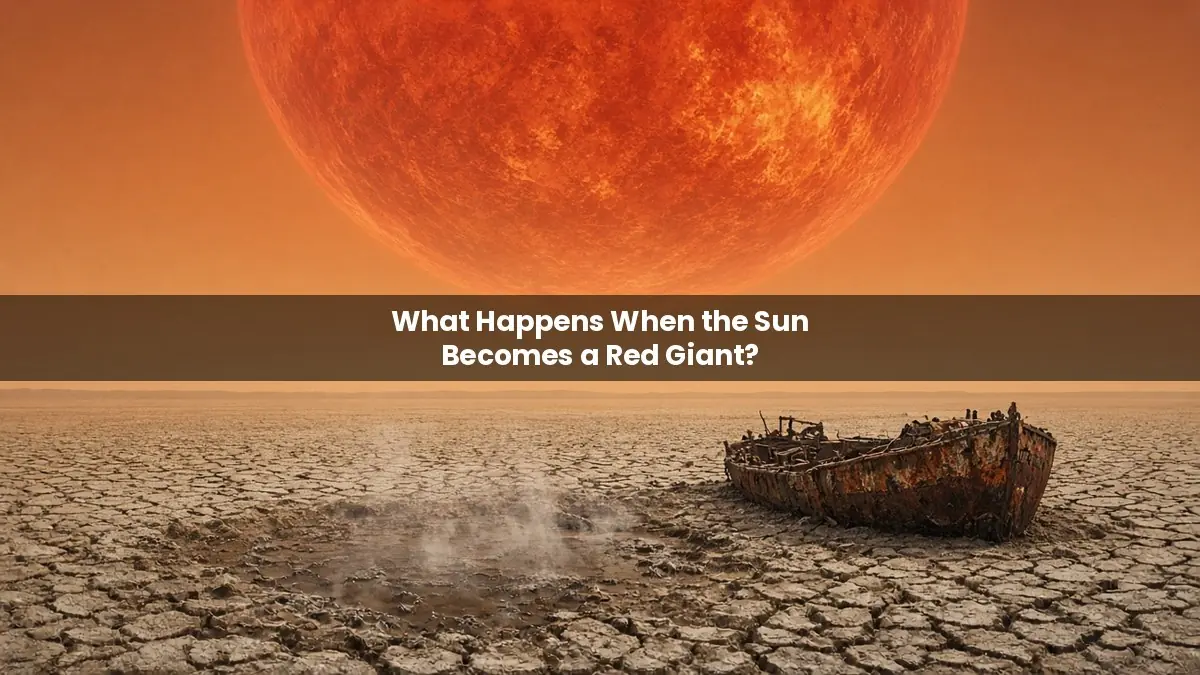
What Happens When the Sun Becomes a Red Giant?
The Sun feels permanent. It has risen every morning for all of human history and for billions of years before that. But it is a star, and stars change. One day, our Sun will swell into a red giant, a bloated, glowing ball hundreds of times wider than it is today.
So what happens when the Sun becomes a red giant? Will it swallow Earth? And what happens to our planet long before that? The answers come from decades of stellar physics, and they include a twist most people miss: Earth’s biggest problem arrives billions of years before the red giant phase.
Everything here is a scientific projection, because no one can watch our Sun’s future. But it’s a well-tested projection, built on observations of thousands of other stars at different stages of their lives.
The short answer
- In about 1 billion years: a slowly brightening Sun will likely make Earth too hot for oceans to survive.
- In about 5 billion years: the Sun runs out of hydrogen in its core and starts swelling into a red giant.
- In about 7.6 billion years: one widely cited model predicts the Sun will grow large enough to swallow Earth.
- Afterward: the Sun sheds its outer layers and shrinks into a white dwarf, a dense stellar ember about the size of Earth.
The timeline at a glance
| Time from now | What happens | Confidence |
|---|---|---|
| Today | Sun is about 4.6 billion years old and halfway through its hydrogen-burning life | Established |
| ~1 billion years | Sun about 10% brighter; oceans begin to be lost | Projection |
| ~5 to 5.5 billion years | Core hydrogen runs out; Sun starts to expand | Projection |
| ~7.6 billion years | Red giant reaches its maximum size; Earth likely engulfed | Projection, debated |
| Afterward | Outer layers drift away; white dwarf remains | Established for Sun-like stars |
Notice the gap. The ocean problem comes billions of years before the dramatic red giant phase, and that gap is the part most people never hear about.
Why the Sun will change
Status: established stellar physics.
The Sun is about 4.6 billion years old. In its core, it fuses hydrogen into helium, releasing the energy that lights and warms our planet. NASA estimates it has enough hydrogen to keep this up for roughly another 5 billion years.
As helium builds up in the core, the core slowly contracts and heats up. That makes fusion happen faster, so the Sun gets gradually brighter. It’s already about 30% brighter than when it formed. This slow brightening is the first threat to Earth, and it’s already underway.
Stage 1: Earth loses its oceans (about 1 billion years from now)
Status: model-based projection.
Astronomers Klaus-Peter Schröder and Robert Connon Smith modeled the Sun’s future in a 2008 paper in the Monthly Notices of the Royal Astronomical Society. Their models show the Sun brightening by about 1% every 110 million years. That adds up to about 10% brighter in roughly a billion years.
A 10% increase sounds small. It isn’t. More sunlight means warmer oceans, more water vapor in the air, and water vapor is itself a greenhouse gas. The authors describe a “moist greenhouse” effect that could take hold, with water climbing into the upper atmosphere where sunlight breaks it apart and hydrogen escapes to space. Over time, the oceans would be lost.
That means complex life on Earth’s surface likely has around a billion years left, give or take, depending on how clouds and the carbon cycle respond. Researchers still debate the exact timing, but the direction of travel is clear.
Stage 2: The Sun becomes a subgiant, then a red giant
Status: model-based projection, supported by observations of other stars.
In roughly 5 billion years, the hydrogen in the Sun’s core runs out. Fusion moves to a shell around the core, and the Sun’s outer layers start to expand dramatically. As they spread out, they cool, turning the Sun’s color from yellow-white to red.
At its largest, the red giant Sun could be around 250 times wider than it is today and thousands of times more luminous, according to the Schröder and Smith models. Mercury and Venus would be swallowed early.
From Earth (or whatever is left of it), the Sun would fill a huge part of the sky. The surface of our planet would be a molten, airless world.
Will the Sun swallow Earth?
Status: projection with real uncertainty.
This is the classic question, and the answer depends on a tug of war.
- The Sun loses mass as a red giant, blowing strong winds of gas into space. With less mass, its gravity weakens, and the planets’ orbits drift outward. That could help Earth escape.
- Tidal drag pulls Earth inward. The Sun’s swollen outer layers raise tides that slow Earth down, and the extended, thin outer atmosphere adds drag.
Schröder and Smith found that drag wins. Their models predict Earth will be engulfed about 7.59 billion years from now, near the tip of the red giant phase. They calculated that a planet would need to start at least about 1.15 times Earth’s current distance from the Sun to survive.
Other models disagree on the details, and some earlier studies suggested Earth might just escape. The 2008 result is widely cited, but this remains an open question. Either way, the planet would already be lifeless long before.
Stage 3: White dwarf
Status: established for Sun-like stars.
After the red giant phase, the Sun will burn helium in its core for a while, then swell again. Eventually it will puff off its outer layers into space, forming a glowing shell called a planetary nebula. What’s left is the hot, dense core: a white dwarf.
A white dwarf packs roughly half the Sun’s mass into something about the size of Earth. It no longer fuses anything. It simply cools and fades over an enormous span of time.
The Sun is not massive enough to become a supernova or a black hole. It will end quietly.
What about the rest of the solar system?
Status: projection.
- Mercury and Venus: almost certainly swallowed.
- Mars: likely survives as a scorched rock, as its orbit widens.
- The outer planets: they survive, and their icy moons may warm up for a while. Some scientists have speculated that places like Jupiter’s moon Europa or Saturn’s Titan could briefly become more temperate during the red giant phase. This is interesting but speculative.
Could humans survive?
Status: speculation.
These events lie billions of years ahead, far longer than our species has existed (about 300,000 years). Any answer is pure speculation. Ideas people have proposed include moving to the outer solar system, building space habitats, or even slowly nudging Earth’s orbit outward using repeated gravity assists from asteroids. None of these is remotely possible today.
The more realistic message: Earth’s long-term habitability has a known expiration date, and it isn’t in our lifetimes, or our species’ foreseeable future.
How do we know any of this?
Status: established method.
We can’t wait billions of years to watch the Sun age, but we can see other stars at every stage. Astronomers have catalogued countless Sun-like stars in their prime, red giants and white dwarfs. Combining those observations with the physics of nuclear fusion lets scientists build detailed models of stellar evolution and check them against real stars. Helioseismology, the study of the Sun’s internal vibrations, also lets us measure what’s going on inside our own star today.
Fact vs projection vs speculation
- Established: the Sun is about 4.6 billion years old and slowly brightening; Sun-like stars become red giants and then white dwarfs.
- Projection: oceans lost in roughly a billion years; red giant phase in about 5 billion years; possible engulfment of Earth in about 7.6 billion years.
- Debated: whether Earth is swallowed, and the exact timing of ocean loss.
- Speculation: anything about human survival.
FAQ
When will the Sun become a red giant?
In about 5 billion years, when its core runs out of hydrogen.
Will the Sun explode?
No. It isn’t massive enough to go supernova. It will become a red giant and then a white dwarf.
Will Earth be destroyed?
Probably. A widely cited model predicts the Sun will engulf Earth about 7.6 billion years from now. Even if it doesn’t, Earth will be a scorched, lifeless rock.
How long can life survive on Earth?
Complex life likely has around a billion years before the brightening Sun makes the oceans evaporate.
How big will the Sun get?
Models suggest about 250 times its current diameter at its largest.
The takeaway
The Sun’s red giant phase is one of the most predictable “end of the world” scenarios in science, and also one of the most distant. Long before the Sun swells, its slow brightening will boil away our oceans. Then the giant Sun will probably swallow what’s left. It’s a reminder that our planet’s comfortable conditions are a phase, not a permanent state.
For more cosmic what-ifs, read what would happen if the Sun disappeared, what if water disappeared from Earth, what if Earth stopped spinning, browse the Earth & space what-if scenarios, or see all our scenarios.
Sources
- Schröder, K.-P. and Smith, R.C. (2008), MNRAS: Distant future of the Sun and Earth revisited (arXiv preprint)
- NASA Science: Sun: Facts
- NASA Science: Stars