What Would Happen If Earth Stopped Spinning? Instant vs Slow Stop
Right now, if you are standing near the equator, you are moving east at about 1,670 km/h (roughly 1,037 mph). You don’t feel it because everything around you, from the air to the ocean to the coffee in your cup, is moving at the same speed. So what happens if Earth stopped spinning?
The honest answer depends on how it stops. A sudden stop would be the worst day in the planet’s history. A slow, gentle stop would be survivable for the rock but would still rebuild the map, the sky and the climate from scratch. Below, we walk through both, and we flag clearly what is established science, what comes from models, and what is pure thought experiment.
The short answer
- Instant stop (hypothetical): the air, the oceans and anything not anchored to bedrock would keep moving east at up to about 1,670 km/h. Supersonic winds, enormous surges and global destruction would follow.
- Gradual stop (hypothetical): no dramatic fling, but the oceans would slowly drain toward the poles, one “day” would last a full year, and the weather would reorganize completely.
- Could it happen? (established science): no. Earth’s spin is slowing, but only by fractions of a millisecond per century. Nothing known in the solar system could stop it.
How fast is Earth actually spinning?
Earth turns once on its axis every 23 hours, 56 minutes and about 4 seconds relative to the stars. The equator is about 40,000 km around, so a point on it covers that distance in roughly a day. That works out to about 1,670 km/h.
The speed drops as you move toward the poles. At 45° latitude (think Minneapolis, Bordeaux or Turin) it is roughly 1,180 km/h. At the poles themselves, you just turn slowly on the spot once a day.
That latitude difference matters a lot in what follows. In almost every scenario, the people nearest the poles have the best odds.
Scenario 1: Earth stops instantly
Status: hypothetical. No known physical process could do this.
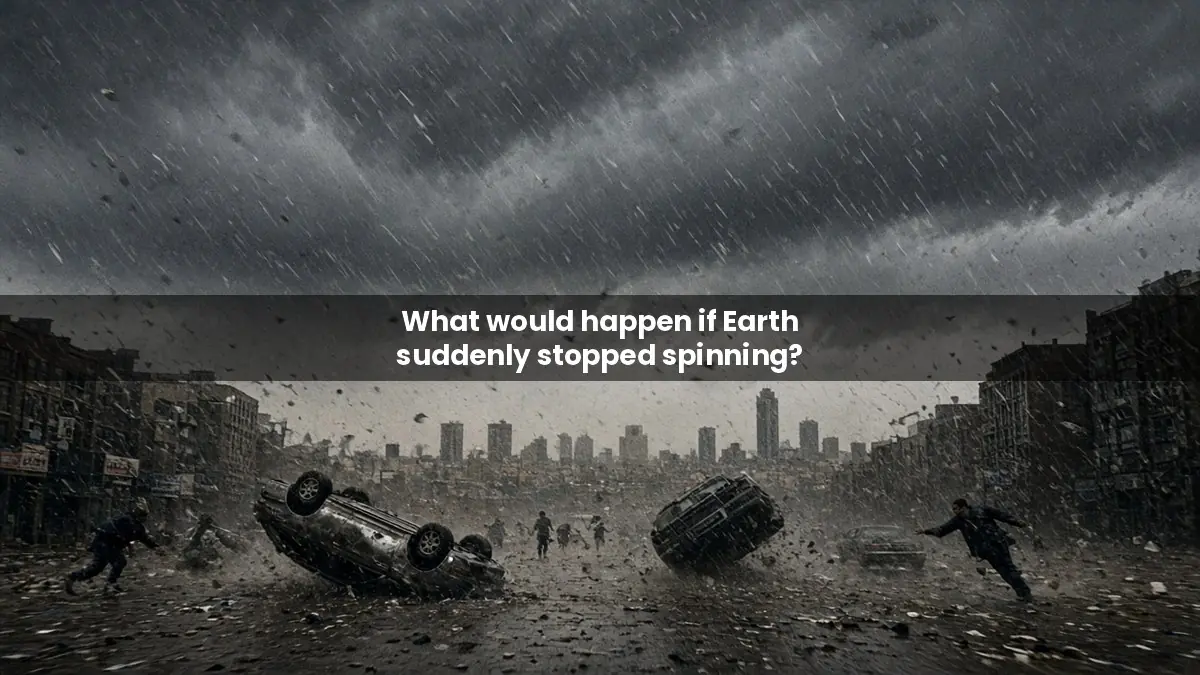
Imagine the solid planet locking in place in a single moment. Nothing else gets the memo. Physics says moving things keep moving unless a force stops them, so everything loose carries on east at its old speed.
The atmosphere becomes a weapon
At the equator, the air would suddenly be moving across the ground at around 1,670 km/h. That is faster than the speed of sound at sea level and several times faster than the strongest tornado winds ever measured. The Smithsonian’s National Air and Space Museum describes land being “wiped clean of anything not attached to bedrock.” Buildings, trees, soil and people would be swept away.
Oceans leap out of their basins
The oceans would do the same thing as the air, only with far more mass. Water would surge eastward over coastlines and deep inland, producing waves far beyond any tsunami on record. Scientists quoted by Space.com and Live Science also expect powerful earthquakes, because the rock itself would be under enormous stress as the planet’s shape tries to adjust.
Even a one-minute stop is deadly
BBC Science Focus ran the numbers on a slightly kinder version: braking to a halt over one minute instead of instantly. You would still feel a sideways push of about three-quarters of normal gravity, so “down” would seem tilted by around 38°. That alone would topple most buildings.
Bottom line: an instant stop is not survivable for civilization. Only the polar regions, which barely move today, would escape the worst of the sideways blast, and even they would face tsunamis and quakes.
Scenario 2: Earth slows down gradually
Status: hypothetical, but the consequences come from real physics and published models.
Now picture the spin fading over years or centuries. Nothing gets flung sideways. Instead, the planet slowly turns into a strange new world.
The oceans drain toward the poles
This is the most surprising part. Earth’s spin creates an outward, centrifugal effect that is strongest at the equator. Over billions of years, that has given the planet a bulge: the distance from Earth’s center to sea level is about 21.4 km greater at the equator than at the poles, according to a widely cited Esri analysis by geographer Witold Fraczek.
Part of that bulge is water. Fraczek estimates the oceans pile up about 8 km higher at the equator because of the spin. Remove the spin, and gravity pulls that water toward the poles, where it ends up closer to Earth’s center.
The result, in his model, is a world split into three zones:
- A northern ocean flooding much of Canada, northern Europe and Siberia.
- A southern ocean swallowing Antarctica.
- A single equatorial megacontinent wrapping around the middle of the planet.
Mountains near the equator would become absurdly tall relative to the new sea level. In the model, Mount Chimborazo in Ecuador would stand about 13.6 km above the water. The rock would keep its equatorial bulge for a very long time, because solid rock adjusts far more slowly than water, and that is exactly why the oceans would split.
One caveat: the Esri map is a simplified thought experiment. It does not attempt to model how the solid Earth would slowly relax its shape over geological time.
Thin air at the equator
The atmosphere also bulges at the equator, so it would migrate poleward too. The new equatorial highlands would have thin air, a little like living on a very high plateau today. This is a reasoned projection rather than a precise forecast.
What happens to day and night?
Status: established physics, applied to a hypothetical.
Here is a detail many people miss. Even if Earth stopped spinning completely, it would still orbit the Sun. So the Sun would still appear to move across the sky, just very slowly: once per year.
That means:
- Any spot on Earth would get roughly six months of daylight followed by six months of darkness.
- Sunrise and sunset would each drag on for days.
- The night sky would change slowly across the year rather than wheeling overhead every night.
Every living thing that runs on a 24-hour body clock, which is nearly all of them, would lose its daily cue. Crops, pollinators and sleep cycles would all be thrown into chaos.
If you have ever wondered how much the Sun shapes everything, our piece on what would happen if the Sun disappeared covers the opposite extreme.
What would happen to the climate?
Status: model-based projections, with real uncertainty.
Earth’s spin is the reason global winds and ocean currents curve. NOAA explains that rotation deflects moving air to the right in the Northern Hemisphere and to the left in the Southern Hemisphere. This is the Coriolis effect, and it shapes trade winds, jet streams, hurricanes and the great ocean gyres.
Without rotation, that deflection disappears. Air would flow much more directly from the hot day side to the cold night side, and from the equator to the poles. Hurricanes as we know them, which need the Coriolis effect to spin up, would not form the same way.
So would the day side bake? Simple estimates say it would get extremely hot. However, climate models point to an interesting twist. A 2014 study in The Astrophysical Journal Letters by Jun Yang and colleagues found that slowly rotating planets tend to build a thick, bright cloud deck under the noon Sun. Those clouds reflect a lot of sunlight and can keep the planet cooler than you’d expect.
The fair summary: the climate would be radically different, with brutal contrasts between day and night. Exactly how hot or cold it would get depends on cloud behavior that scientists still model rather than measure.
Would Earth lose its magnetic field?
Status: genuinely uncertain. Many popular articles overstate this.
Earth’s magnetic field comes from churning liquid iron in the outer core. Rotation helps organize that churning, which is why many explainers say a stopped Earth would lose its field and its shield against solar radiation.
The real picture is more nuanced. Venus spins extremely slowly (one rotation takes about 243 Earth days) and has no internally generated magnetic field. That looks like proof. But planetary scientists generally do not blame Venus’s slow spin. A major review in Space Science Reviews notes that slow rotation is not thought to explain the missing field. A weaker flow of heat out of the core, and the convection it drives, is the more likely culprit.
In other words, a non-spinning Earth might lose its field, might keep a weaker or messier one, or might change in ways nobody can confidently predict. Anyone who tells you it would definitely vanish is speculating.
Could Earth actually stop spinning?
Status: established science.
No. Here is what is really happening:
- Earth is slowing, very slowly. Tides raised by the Moon act like a brake. Records of ancient eclipses show the day has lengthened by an average of about 1.8 milliseconds per century (Stephenson, Morrison and Hohenkerk, 2016).
- The Moon is drifting away. As Earth slows, the Moon gains orbital energy. Laser measurements using reflectors left by Apollo astronauts show it moving away by about 3.8 cm per year, according to NASA.
- It will never reach zero on its own. At this pace, Earth would need far longer than the Sun’s remaining lifetime to lock its spin in step with the Moon, let alone stop.
The only way to stop or drastically change Earth’s spin quickly would be a collision with something planet-sized. Astronomers think a giant impact early in Earth’s history created the Moon. Today, the planets’ orbits are stable, and no such object is on a collision course. You can read more about our cosmic neighbor in what would happen if the Moon disappeared.
Fact vs projection vs speculation
- Established: equatorial speed of about 1,670 km/h; the day lengthening by about 1.8 ms per century; the Moon receding about 3.8 cm per year; the Coriolis effect shaping winds and currents.
- Model-based projections: oceans splitting into two polar seas with an equatorial megacontinent; thick day-side clouds on a slow-spinning planet.
- Hypothetical: any sudden or complete stop. No known process could cause one.
- Speculation: the exact fate of Earth’s magnetic field, and how life would adapt over millions of years.
Stopping Earth’s spin would take an impossible amount of energy, but large asteroid impacts have released enormous energy on our planet before. Read what happens if an asteroid hits Earth. For a shorter thought experiment on weightlessness, see what happens if gravity disappears for 7 seconds.
FAQ
Would we fly off into space if Earth stopped spinning?
Not straight up. Gravity would still hold you down. In an instant stop, you would be thrown sideways (east) at your old speed, which is deadly in its own way.
How long would a day be if Earth stopped spinning?
About one year. Because Earth still orbits the Sun, most places would get roughly six months of daylight and six months of night.
Where would be the safest place?
In an instant stop, near the poles, because they barely move today. In a slow stop, the poles would eventually flood as the oceans moved there, so the edges of the new equatorial continent would make more sense.
Is Earth’s rotation slowing down?
Yes, but extremely slowly. The day grows by about 1.8 milliseconds per century on average, with small year-to-year wobbles caused by the core, oceans and atmosphere.
Could an asteroid stop Earth from spinning?
Not any known asteroid. It would take an object around the size of a planet, and such an impact would be catastrophic on its own, spin or no spin.
Would there still be seasons?
Earth’s axial tilt would still exist, so the Sun’s angle would still change through the year. With one sunrise per year, though, “seasons” and “day and night” would blur into a single yearly cycle.
The takeaway
Earth’s spin is one of those things we never think about because it never changes in any way we can feel. Yet it sets the length of the day, shapes the oceans, steers the winds and may help sustain our magnetic shield. Stop it suddenly and the world ends. Stop it slowly and you get a planet most of us wouldn’t recognize. The good news is that neither is coming.
Want more planet-sized thought experiments? Start with our Earth and space what-if scenarios guide, browse the full collection of “what would happen if” scenarios, or see what would happen if water disappeared from Earth.
Sources
- NASA Goddard: Eclipse Predictions and Earth’s Rotation (tidal slowing, Moon receding 3.8 cm/year)
- NASA Science: Moon Facts
- NASA Science: Venus Facts (no internally generated magnetic field)
- NOAA National Ocean Service: The Coriolis Effect
- Stephenson, Morrison and Hohenkerk (2016), Proceedings of the Royal Society A: Measurement of the Earth’s rotation: 720 BC to AD 2015
- Yang et al. (2014), The Astrophysical Journal Letters: Strong Dependence of the Inner Edge of the Habitable Zone on Planetary Rotation Rate
- Taylor et al. (2018), Space Science Reviews: Venus: The Atmosphere, Climate, Surface, Interior and Near-Space Environment
- Esri ArcUser (W. Fraczek): What Would Happen if the Earth Stopped Spinning?
- Smithsonian National Air and Space Museum: If Earth stopped rotating on its axis, what would happen?
- BBC Science Focus: What would happen if the Earth stopped spinning?