What Happens If You Go to Space Without a Spacesuit?
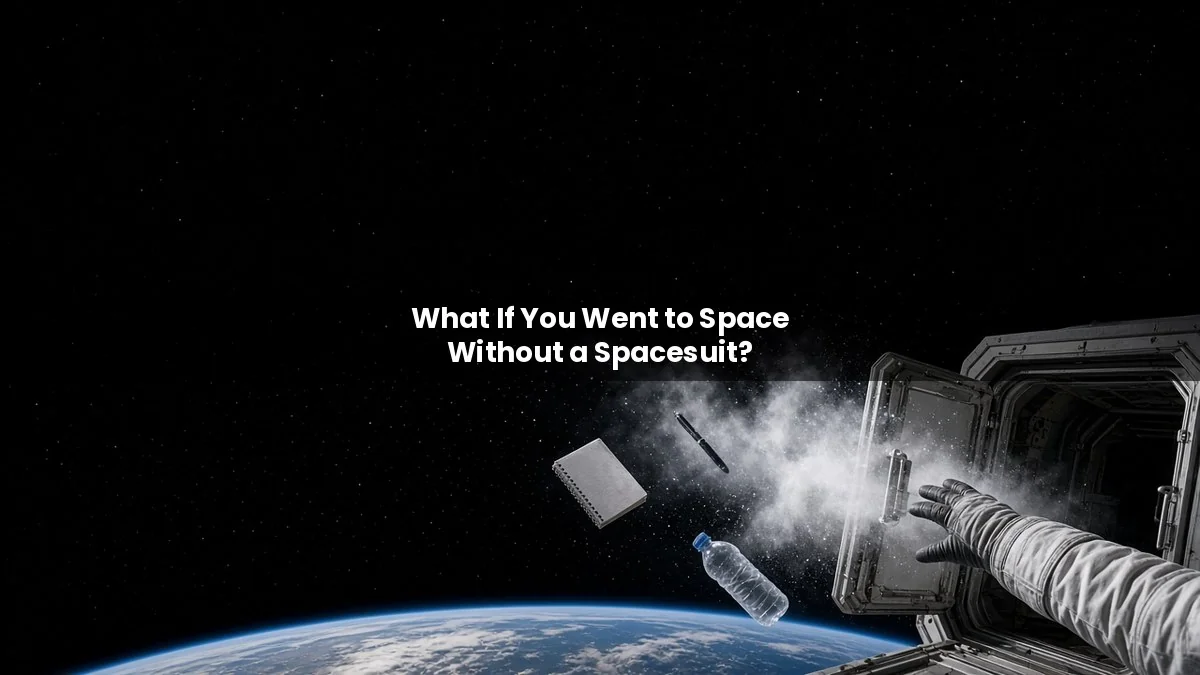
Movies love this scene: an astronaut’s helmet cracks, their eyes bulge, their body swells, and within seconds they freeze solid or explode. It makes for great cinema. It is also almost completely wrong.
So what really happens if you go into space without a spacesuit? The truth is quieter, faster and, in some ways, more unsettling. You would not explode. Your blood would not instantly boil. You would not freeze into an ice statue. But you would have only seconds to act before you lost consciousness.
Here’s what NASA, human-testing records and real accidents tell us, step by step. We’ll flag which parts are established, which come from animal studies and accidents, and which are educated guesses.
The short answer
- 0 to 15 seconds: you stay conscious, but oxygen drains from your blood fast.
- Around 10 to 15 seconds: you pass out.
- Within about 1 to 2 minutes: without rescue, you would die, mainly from lack of oxygen.
- If rescued quickly: people have survived brief vacuum exposure with surprisingly little lasting harm.
Why space is deadly: pressure, not cold
Status: established physics and physiology.
Space is a near-perfect vacuum. There is essentially no air pressure and no oxygen. Your body is built for about 101 kPa (14.7 psi) of air pressing on it at sea level. Take that pressure away, and three things start happening at once:
- The air in your lungs rushes out.
- Oxygen stops reaching your blood. In fact, the lungs start pulling oxygen out of the blood.
- Body fluids begin to turn to vapor at body temperature, a process called ebullism.
Cold, surprisingly, is the least of your worries in the first minutes. A vacuum is an excellent insulator. With no air to carry heat away, your body loses warmth mainly by radiation and evaporation, which is slow.
Second by second: what you would feel
The first seconds
Status: established, from NASA and accident reports.
If you were holding your breath, that’s the worst thing you could do (for the body’s side of breath-holding, see what happens if you hold your breath too long). The air in your lungs would expand and could rupture lung tissue. NASA’s advice is blunt: breathe out. Exhaling keeps the pressure inside your chest from tearing you apart.
The moisture on your tongue and eyes would start to bubble and evaporate. Your ears might pop painfully. You would feel no explosion, because skin and tissues are strong enough to hold your body together.
About 10 to 15 seconds
Status: established.
NASA’s Imagine the Universe team says you would lose consciousness after about 15 seconds, as oxygen-starved blood reaches the brain. The University of Houston’s Engines of Our Ingenuity, drawing on high-altitude research, puts useful consciousness at about 12 seconds. That’s the window to grab something, pull a lever or get back to an airlock.
Then the lights go out. The same process that happens when the brain runs out of oxygen on Earth plays out here, only faster.
From 15 seconds to 2 minutes
Status: based on animal studies and NASA estimates.
While unconscious, your body would swell, possibly to around twice its normal size, as water in soft tissues turns to vapor under the skin. This is ebullism. It looks horrific, but tight skin limits it, which is why a properly fitted suit (or even tight clothing) helps.
Your blood would not boil inside your arteries, NASA explains, because your circulatory system keeps the blood under its own pressure. The swelling happens in tissues, not in the bloodstream.
NASA estimates you would die within about one to two minutes without help, mainly from oxygen starvation.
Myth-busting the movie version
Status: established.
- “You would explode.” No. Your skin and tissues are far too strong.
- “Your blood would boil.” Not inside your blood vessels. Moisture in tissues and on exposed surfaces would vaporize, but your blood stays liquid because blood pressure keeps it contained.
- “You’d freeze instantly.” No. Vacuum doesn’t conduct heat. Freezing would take a long time.
- “You could hold your breath to survive longer.” Dangerous. It risks rupturing your lungs.
- “Your eyes would pop out.” No. They might swell and dry out, but they stay in place.
The man who survived a vacuum
Status: documented accident.
On December 14, 1966, NASA technician Jim LeBlanc was testing a spacesuit in a vacuum chamber at the Johnson Space Center. A hose came loose, and his suit lost pressure. The chamber was at about 0.1 psi, equivalent to an altitude of about 120,000 feet.
LeBlanc later said the last thing he remembered was feeling the saliva on his tongue begin to bubble. He passed out within seconds. Engineers began repressurizing the chamber right away, and he was back at normal pressure within about 87 seconds, according to Guinness World Records. He recovered with little more than an earache.
His case, along with a handful of other accidents and decades of research, is why NASA is confident about the short survival window.
Where does “space” begin for your body?
Status: established.
You don’t have to reach orbit to face these effects. Above about 63,000 feet (around 19 km), the air pressure is so low that water boils at normal body temperature. This altitude is called the Armstrong limit, after the US Air Force physician Harry Armstrong. Above it, exposed fluids such as saliva and tears boil. Pilots who fly that high wear pressure suits for exactly this reason.
What about the Sun and the cold later?
Status: projection, based on known physics.
In direct sunlight in Earth’s orbit, unprotected skin would quickly get a severe sunburn, because there is no atmosphere filtering ultraviolet light. In shadow, your body would cool slowly over many hours. Temperature only becomes a serious factor long after the oxygen problem has already been fatal.
Radiation from cosmic rays and the Sun would add to the damage over time, but over a two-minute exposure it isn’t what kills you.
A different question is what would happen to the whole planet if the Sun went out, not just to a person in orbit. See what happens if the Sun went dark for 8 minutes.
Could you survive if you were rescued?
Status: based on accidents and animal experiments.
Yes, if the exposure is very short. NASA-funded animal studies in the 1960s found that dogs mostly survived near-vacuum exposures shorter than about two minutes, with deaths rising sharply beyond that. Chimpanzees that had breathed pure oxygen beforehand did better: in one 1967 follow-up, eight of nine survived exposures of up to 3.5 minutes and recovered. Human accidents like LeBlanc’s fit the same pattern: fast repressurization is everything.
How astronauts are protected
Status: established practice.
Because the danger is pressure loss, spacesuits are really personal pressure vessels. NASA’s spacewalk suits hold about 4.3 psi of pure oxygen, far below sea-level pressure but enough to keep fluids liquid and lungs working. Astronauts “pre-breathe” pure oxygen before a spacewalk to flush nitrogen from their blood, which prevents the bends.
Spacecraft are built with layers of protection too. If a cabin leaks, crews have time to find the hole, seal it, or move to a safe module. Real leaks, such as small ones found on the International Space Station, have been slow and manageable. The sudden, total decompression of the movies is extremely rare.
Fact vs projection vs speculation
- Established: consciousness lasts around 12 to 15 seconds; you don’t explode or instantly freeze; holding your breath is dangerous; LeBlanc survived about 87 seconds at near-vacuum.
- Based on animal studies: survival is possible after exposures of up to about two minutes, and longer when animals were pre-breathing pure oxygen.
- Projection: how long a specific person could survive depends on health, breath and luck.
FAQ
How long can a human survive in space without a suit?
About one to two minutes before death, according to NASA. You would lose consciousness after roughly 10 to 15 seconds.
Would your blood boil in space?
No. Your blood stays liquid because your circulatory system keeps it under pressure. Moisture in your mouth, eyes and soft tissues would vaporize.
Would you freeze in space?
Not quickly. A vacuum doesn’t conduct heat, so your body would cool slowly.
Has anyone survived exposure to a vacuum?
Yes. NASA technician Jim LeBlanc survived a 1966 vacuum chamber accident after being repressurized in about 87 seconds.
Should you hold your breath in space?
No. Breathe out. Holding your breath could rupture your lungs as the air inside expands.
Would it be any different on the Moon or Mars?
Not much. The Moon has essentially no atmosphere, so it’s the same as open space. Mars has a thin atmosphere, but its surface pressure is less than 1% of Earth’s, far below the Armstrong limit. Without a pressure suit, the same countdown would start.
Would it hurt?
Accounts from accidents describe ear pain, a feeling of swelling and the strange sensation of saliva bubbling, followed quickly by blackout. Most of the damage would happen after you lost consciousness.
The takeaway
Space without a suit isn’t an explosion. It’s a race against the clock. You’d have about a quarter of a minute of awareness and perhaps a minute or two of life. Fast rescue can turn a fatal accident into a story you get to tell.
Keep exploring: see what would happen if you fall into a black hole, if Earth stopped spinning, Earth and space what-if scenarios, or browse all our “what would happen if” scenarios.
Sources
- NASA Imagine the Universe: Ask an Astrophysicist: Human body in a vacuum
- University of Houston, Engines of Our Ingenuity: The Body at Vacuum
- Guinness World Records: First person to survive exposure to a vacuum
- NASA Technical Reports: The Effect on the Chimpanzee of Rapid Decompression to a Near Vacuum
- PubMed: Experimental animal decompressions to a near vacuum environment
- StatPearls (NCBI): Aerospace Pressure Effects