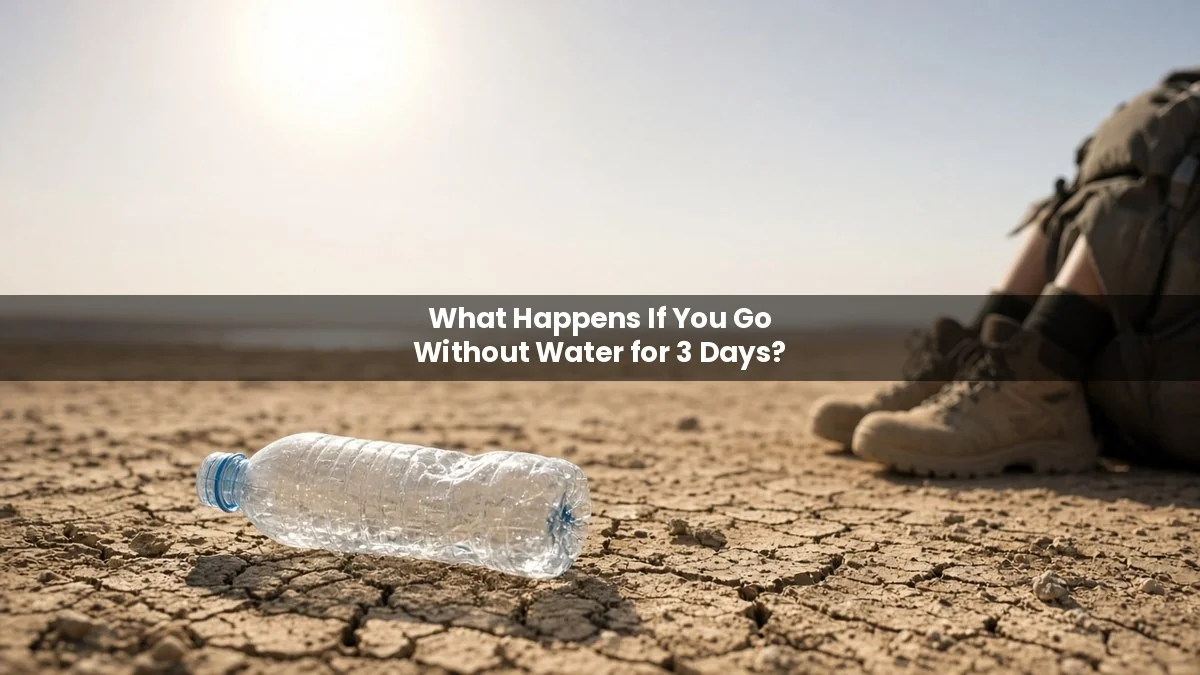
What Happens If You Go Without Water for 3 Days?
You’ve probably heard the survival “rule of threes”: three minutes without air, three days without water, three weeks without food. It’s a rough guide, not a law of nature. So what actually happens if you go without water for 3 days, and how long can a person really survive?
The honest answer is that it depends on heat, activity, age and health. In a cool room at rest, some people last longer than three days. In desert heat while walking, serious trouble can start within hours. This guide explains what happens inside your body as you dehydrate, using medical sources and documented cases, and it flags which parts are firm and which vary from person to person.
The short answer
- Typical survival: most people can survive only a few days without any water, and heat or exercise can shorten that dramatically.
- Around 2% of body weight lost: thirst kicks in, and focus and physical performance start to slip.
- Around 4%: blood pressure can drop, and you may feel dizzy or faint.
- Around 7% or more: the body starts shutting down blood flow to organs like the kidneys, which can cause lasting damage.
- The extreme case: an Austrian teenager reportedly survived 18 days without food or water in 1979, a case listed by Guinness World Records.
How much water do you actually need?
Status: established guidance.
Your body is mostly water, and you lose it all day through urine, sweat, breath and stool. The US National Academies set an “adequate intake” of total water at about 3.7 liters a day for men and 2.7 liters a day for women. That total includes water from food, which supplies roughly 20% of it. Fruit, vegetables, soup and even bread all contribute.
Needs rise sharply in heat. According to a BBC Future report quoting fluid-balance researcher Professor Dileep Lobo, a person exercising in a hot environment can sweat out 1.5 to 3 liters an hour.
Day 1: thirst and the body’s first defenses
Status: established physiology.
Thirst usually appears when you’ve lost about 2% of your body weight as water. By then, your body has already started saving fluid:
- Your kidneys hold back water, so you pee less and your urine turns dark yellow.
- Your blood thickens slightly, so your heart beats faster to keep oxygen moving.
- You sweat less, which makes it harder to cool down.
- Your thinking slows. Losing 2% or more of body water can impair short-term memory, attention and coordination, especially during hard exercise in heat.
The NHS lists common early symptoms as thirst, headache, light-headedness, dark strong-smelling pee, peeing less often, tiredness, and a dry mouth and lips.
Day 2: dizziness and falling blood pressure
Status: established, though timing varies.
As water loss approaches about 4% of body weight, blood volume falls enough that blood pressure can drop, especially when you stand up. People feel weak, dizzy and may faint. Water moves out of your cells into your bloodstream to compensate, and the cells shrink.
In heat, this stage can arrive within hours, not days. Without water, your body can’t sweat enough to cool itself, so the risk of heat exhaustion and heatstroke climbs quickly.
Day 3 and beyond: organs under strain
Status: established medical consequences; exact timing is individual.
Around 7% body weight loss, the body prioritizes the brain and heart. It reduces blood flow to “non-vital” organs such as the kidneys and gut. Without enough blood flow, the kidneys can’t filter waste properly, and acute kidney injury can follow.
Other serious problems at this stage include:
- Confusion, extreme sleepiness or being hard to wake.
- Rapid breathing and a fast heart rate.
- Cold, pale or blotchy skin, which the NHS says can be a sign of shock.
- Seizures from salt imbalances in the blood.
Without treatment, organ failure and death follow. With fluids, most people recover. As one emergency doctor told the BBC, dehydration is reversible, and replacing body water usually leads to full recovery, although kidney damage can take weeks to heal.
So, how long can you survive without water?
Status: no single answer; based on cases and expert estimates.
Most scientists agree it’s a matter of days. Three days is a reasonable average for a healthy adult in mild conditions, but there’s a wide range:
- Shorter: in extreme heat, during hard physical effort, or for babies, young children and older adults, who the NHS says are at higher risk of dehydration.
- Longer: in cool, humid conditions, at rest, and if any food still provides some moisture.
The longest case on record is Andreas Mihavecz, an 18-year-old held in a police cell in Austria in 1979 after officers forgot about him. He survived 18 days, a case Guinness lists as the longest survival without food or water. It’s an extreme outlier, not a guide.
A real-world example: 10 hours in 48°C heat
Status: documented account.
BBC Future described expedition guide Chaz Powell, who ran out of water while walking the Zambezi gorges in temperatures close to 50°C (122°F). Within hours, he was overheating, panicking and struggling to think clearly. He eventually climbed down a cliff to reach the river, fainting on a ledge on the way. He was without water for about 10 hours, and it nearly killed him. His story shows how heat compresses the “three days” rule into a single afternoon.
Who is most at risk?
Status: established.
- Babies, young children and older adults.
- People with diabetes, or who have vomiting, diarrhea or a fever.
- People taking medicines that make them pee more, such as diuretics.
- Anyone working or exercising hard in the heat.
- People who rely on others to give them drinks.
When to get help
Status: NHS guidance.
Ask for urgent medical advice if you feel unusually tired, stay dizzy when you stand, have very dark pee or are peeing much less, or have a fast heart rate. Call emergency services if someone with dehydration is confused, very sleepy, breathing quickly or has blue, grey or blotchy skin.
In an emergency where water is scarce, such as a long blackout, store drinking water in advance. Our guide to what happens if the power grid fails for a month covers how much to keep at home.
Can you drink too much water?
Status: established.
Yes. Drinking very large amounts quickly, especially during endurance events, can dilute the sodium in your blood. This condition, called hyponatremia, can cause headache, nausea, confusion and, in severe cases, seizures or coma, according to the Mayo Clinic. When rehydrating, steady sips are better than gulping liters at once. After vomiting or diarrhea, the NHS suggests oral rehydration solutions to replace salts as well as water.
Fact vs projection vs speculation
- Established: the stages of dehydration by body-weight loss; the daily water intake guidance; the NHS warning signs.
- Variable: exactly how long any one person survives. The “three days” figure is an average, not a promise.
- Myth: that you should drink your own urine to survive. Researchers say it may help briefly but doesn’t provide enough fluid and adds salt your body is trying to get rid of.
FAQ
How long can a person go without water?
Usually a few days, often cited as about three. Heat, exercise and age can shorten this to hours or a day or two.
What happens after 24 hours without water?
You’ll be very thirsty, pee less and feel tired, headachy and less focused. In hot weather, you may already be at risk of heat exhaustion.
What are the first signs of dehydration?
Thirst, dark yellow pee, peeing less, a dry mouth, headache and feeling light-headed.
Does food count toward your water intake?
Yes. About 20% of the water most people take in comes from food, according to the US National Academies.
What would happen if all water disappeared?
That’s a different question, about the planet rather than your body. Read what would happen if water disappeared from Earth.
The takeaway
Going without water for three days pushes your body through a clear sequence: thirst and dark urine, then dizziness and falling blood pressure, then strain on your kidneys and brain. Heat speeds the whole process up. The good news is that dehydration is usually reversible if you catch it early, so drink before you’re very thirsty, and drink more in heat or illness.
Related reads: what happens if you have two drinks a day, what happens if you go to space without a spacesuit, or browse all our “what would happen if” scenarios.
This article is for general information and is not medical advice.
Sources
- NHS: Dehydration
- National Academies: Dietary Reference Intakes for Water, Potassium, Sodium, Chloride, and Sulfate
- BBC Future: How long can you survive without water?
- Guinness World Records: Rested Guinness World Records titles and why we no longer monitor them
- MedlinePlus: Dehydration
- Mayo Clinic: Hyponatremia