What Happens If an Infection Turns Into Sepsis?
Former LSU head coach Ed Orgeron revealed this week that a leg infection nearly killed him in August. His story shows what happens if an infection turns into sepsis: the body’s defenses start attacking its own organs, blood pressure can crash within hours, and every hour without treatment matters.
Short answer: If an infection turns into sepsis, your immune system overreacts and begins damaging your own tissues. Blood pressure can fall, organs can fail, and septic shock can follow within hours. Fast antibiotics, IV fluids and hospital support save most patients, but at least 1 in 5 U.S. adults with sepsis dies or is discharged to hospice.
Below, we separate confirmed facts from what doctors still debate. This article is general information, not medical advice.
What happens if an infection turns into sepsis?
Normally, your immune system fights germs where they are. With sepsis, that response spreads through the whole body. The CDC calls it “the body’s extreme response to an infection.” Inflammation leaks into blood vessels, so they widen and leak fluid. As a result, blood pressure drops and less oxygen reaches the kidneys, brain, lungs and heart.
Next, organs start to struggle. Kidneys make less urine, the brain gets confused, and breathing speeds up. If blood pressure stays dangerously low despite fluids, doctors call it septic shock, the deadliest stage.
Almost any infection can turn into sepsis. According to the CDC, sepsis most often starts in the lungs, gut, skin or urinary tract. Bacteria cause most cases, but viruses like influenza and some fungal infections can also lead to sepsis.
How did Ed Orgeron’s infection turn into sepsis?
Status: details come from the coach and his hospital, FMOL Health, published in November 2026.
Orgeron, now LSU’s special assistant for recruiting and defense, had cellulitis, a bacterial skin infection, on his leg. During a preseason practice in August, he began limping and his leg swelled. Hours later, a colleague found him on the floor around midnight, barely able to respond. He thought he was having a heart attack.
By the time he reached Our Lady of the Lake Regional Medical Center in Baton Rouge, his blood pressure had fallen to 60/40. Meanwhile, a rapid blood test called IntelliSep flagged the highest probability of sepsis. Treatment started right away. He then spent seven days in intensive care and went home 28 pounds heavier from fluid, according to FMOL Health.
How common is sepsis, really?
Sepsis is far more common than many people think. Here are the verified numbers:
- United States: about 1.7 million adults and more than 18,000 children develop sepsis each year. At least 350,000 adults die during their hospital stay or are discharged to hospice (CDC).
- Worldwide: data published in 2020 counted 48.9 million cases and 11 million sepsis-related deaths. That equals 20% of all global deaths (World Health Organization).
- Children: almost half of global cases, about 20 million, occurred in children under 5 (WHO).
- Cost: the average hospital cost topped US$32,000 per patient in high-income countries (WHO).
Importantly, most cases begin outside the hospital. The CDC also notes that most people with sepsis already have at least one health condition, such as chronic lung disease or a weak immune system.
What are the warning signs of sepsis?
Sepsis can look like flu, a heart problem or exhaustion. However, these signs should raise alarm, especially during an infection (CDC and NHS):
- Confusion, slurred speech or being hard to wake
- Fast heart rate or a weak pulse
- Shortness of breath or very fast breathing
- Fever, uncontrollable shivering or feeling very cold
- Clammy, sweaty, pale, blue or blotchy skin
- Peeing very little, or not at all, for a day
In the U.S., call 911. In the UK, call 999. In Canada, call 911, and in Australia, call 000. Ask directly: “Could this be sepsis?”
Why does every hour matter once sepsis starts?
Doctors often say sepsis is easy to diagnose when it’s hard to treat, but hard to diagnose when it’s easy to treat. The data back that up.
A major 2017 study in the New England Journal of Medicine looked at 49,331 sepsis patients at 149 New York hospitals. Each extra hour before patients got antibiotics was linked to 4% higher odds of dying in the hospital (odds ratio 1.04 per hour). The same was true for completing the first set of sepsis care steps. In contrast, the speed of the first IV fluid bolus showed no clear link.
That is why hospitals now use sepsis protocols: blood cultures, broad-spectrum antibiotics, lactate tests and fluids. Some, like Orgeron’s hospital, also use rapid tests. IntelliSep received FDA clearance in December 2022. In a validation study of 572 emergency patients, its median result time was 7.2 minutes. Still, it is a decision aid, not a replacement for a doctor’s judgment.
What happens in the hospital if you have sepsis?
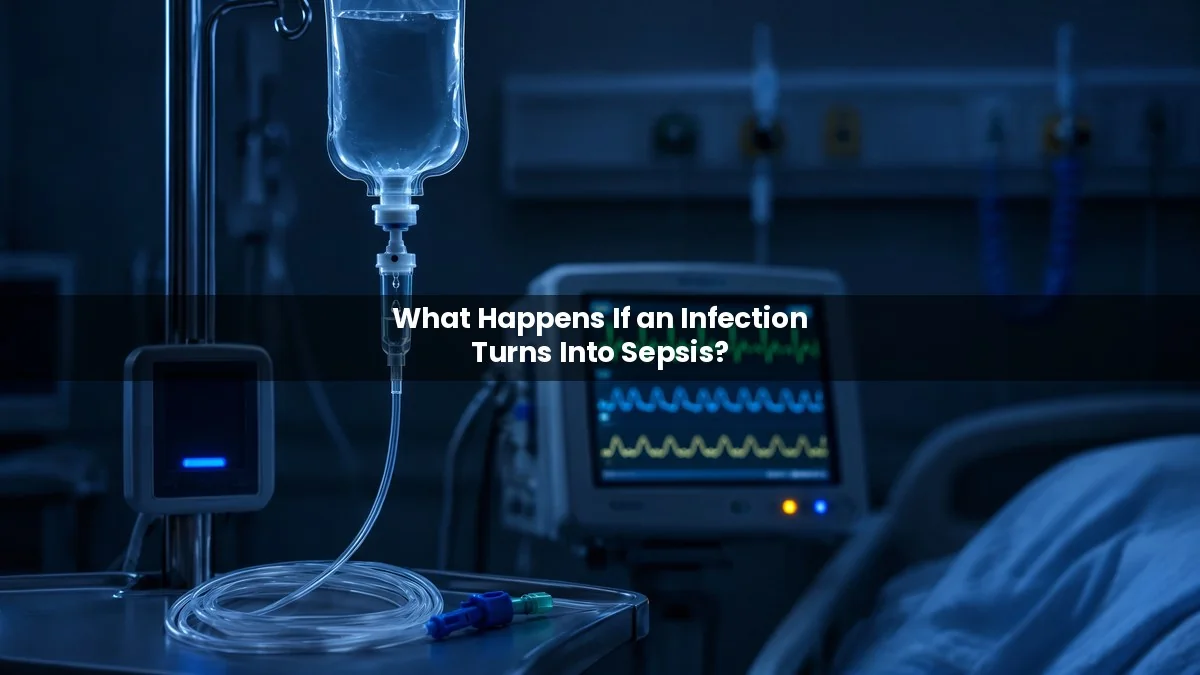
First, doctors try to keep blood flowing to your organs. They give IV fluids and antibiotics, often before they know the exact germ. If blood pressure stays low, they add drugs called vasopressors to tighten blood vessels. Some patients need oxygen, a breathing machine or dialysis.
Then, doctors hunt for the source. Sometimes that means draining an abscess or removing infected tissue with surgery. Once lab cultures identify the germ, antibiotics can be narrowed. Drug-resistant infections make this harder, which is why sepsis and superbug infections are closely linked.
Sepsis can also disrupt clotting. Tiny clots may form while the body runs low on clotting factors, a dangerous mix we explain in what happens if your blood stops clotting.
What happens after an infection turns into sepsis and you survive?
Leaving the hospital is not always the end. Orgeron needed weeks of follow-up care for a swollen leg and extra fluid. Many survivors report:
- Deep tiredness and muscle weakness
- Poor sleep, memory problems or trouble concentrating
- Anxiety, low mood or flashbacks from intensive care
Low blood pressure can starve the brain of oxygen for a time, which may explain some of these lingering problems. For more on that, see what happens when the brain runs out of oxygen.
Fact vs. uncertainty: what do doctors still debate?
- Fact: faster antibiotics are linked to better survival in large studies.
- Still debated: how much IV fluid is ideal, and how fast. Studies have not settled it.
- Still uncertain: how much rapid blood tests improve survival across many hospitals. Early studies look promising, but evidence is still growing.
- Not known: whether Orgeron’s outcome would have differed without the rapid test. His doctors credit it, but one case cannot prove that.
How can you stop an infection from turning into sepsis?
You can’t remove all risk, but a few habits help:
- Clean cuts and scrapes, and watch them for spreading redness, swelling or heat.
- Take dog bites and other puncture wounds seriously. Bacteria can be pushed deep into the tissue. See what happens when a dog bites someone.
- Stay current on vaccines, such as flu, pneumonia and COVID-19 shots, since these infections can lead to sepsis.
- Take antibiotics exactly as prescribed when you need them.
- Get help fast if an infection gets worse instead of better, especially with fever, confusion or fast breathing.
Vaccines also matter for other outbreak diseases. Measles can lead to pneumonia, and in November 2026 PAHO confirmed that the United States lost measles elimination status. See what happens if the US loses measles elimination status.
Health departments also screen close contacts after a tuberculosis diagnosis, including young children who may have been exposed at childcare. See what happens if you’re exposed to tuberculosis.
New treatments can also change the odds in other serious diseases. See what happens if a pancreatic cancer pill works.
Frequently asked questions
How fast can an infection turn into sepsis?
Very fast. The NHS says sepsis usually develops over a few hours. Orgeron went from limping at practice to critical condition by that night.
Can a small cut or skin infection cause sepsis?
Yes. Skin infections like cellulitis are one of the common starting points, according to the CDC. Most minor cuts heal without trouble, but spreading redness, fever or feeling very unwell need prompt care.
Who is most at risk of sepsis?
The WHO says older people, the very young, pregnant people and those with other health problems face higher risk. Still, anyone can get sepsis.
Can you fully recover from sepsis?
Many people do, especially with early treatment. However, some deal with fatigue, weakness or memory issues for months.
Sources
- CDC: About Sepsis (case numbers, signs, causes)
- World Health Organization: Sepsis fact sheet
- New England Journal of Medicine (2017): Time to Treatment and Mortality during Mandated Emergency Care for Sepsis
- FMOL Health: Coach Orgeron’s Toughest Comeback Started at Our Lady of the Lake
- Critical Care Explorations: Validation of a Novel, Rapid Sepsis Diagnostic for Emergency Department Use
- NHS: Sepsis symptoms and treatment