Can Ozempic Cause Vision Loss? What the FDA’s New Warning Means
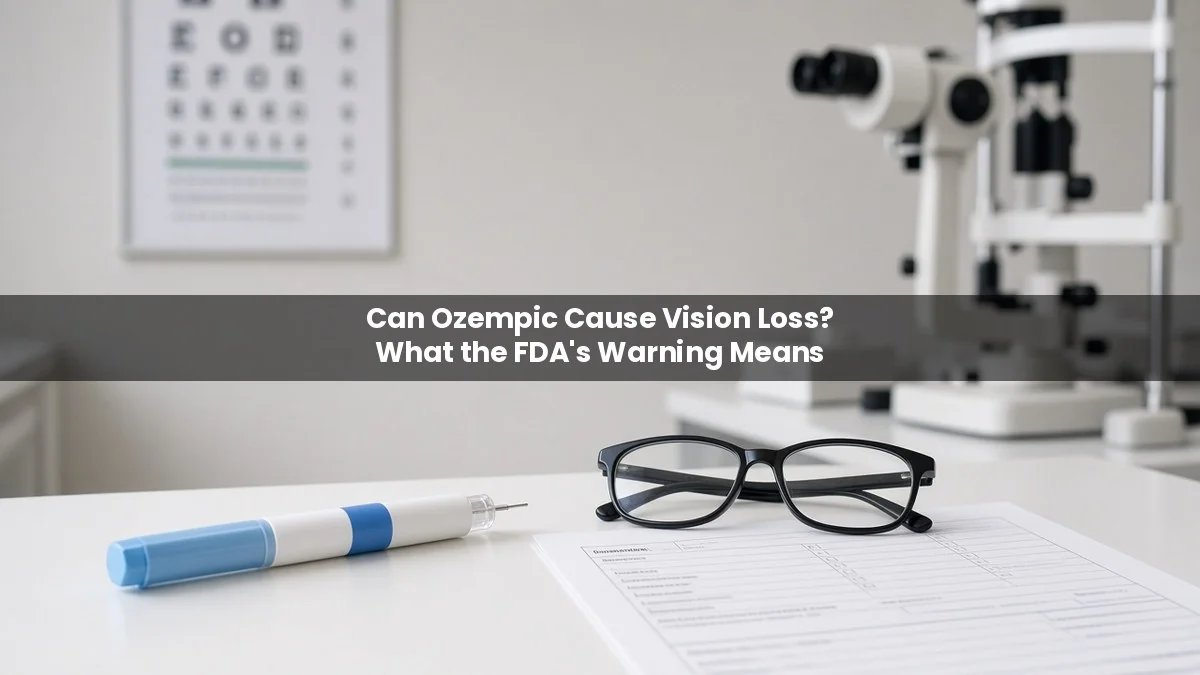
The FDA now wants every GLP-1 drug label, from Ozempic and Wegovy to Mounjaro and Zepbound, to warn about a rare eye condition that can cause sudden, permanent vision loss. The news spread fast this week, and many of the millions of people on these drugs are asking the same thing: should I worry?
Short answer: GLP-1 drugs may slightly raise the risk of NAION, a rare “eye stroke” of the optic nerve. In the FDA’s own analysis of 126 clinical trials, it occurred in about 6.4 people per 100,000 per year on GLP-1s versus 3.8 on comparison treatments. The absolute risk stays very small, causation is not proven, and doctors say you should not stop your medication without talking to them first.
Below we separate established facts, what the studies suggest and what is still unknown. This article explains the science; it is not medical advice.
What did the FDA announce?
Status: established (FDA Drug Safety Communication, 9 November 2026).
- The change: the FDA is requiring makers of all GLP-1 receptor agonist medicines to add a potential increased risk of non-arteritic anterior ischemic optic neuropathy (NAION) to the Warnings and Precautions section of their labels.
- Which drugs: the list covers semaglutide (Ozempic, Wegovy, Rybelsus), tirzepatide (Mounjaro, Zepbound), liraglutide (Victoza, Saxenda), dulaglutide (Trulicity), the new pill orforglipron (Foundayo), and older or combination products.
- The wording: the FDA calls it a “potential increased risk of rare NAION events.” It is a warning, not a recall or a ban.
- The mechanism: the FDA says animal data did not reveal how these drugs could cause NAION. Nobody knows the mechanism yet.
What is NAION, and what happens to your eye?
Status: established medical knowledge.
NAION happens when blood flow to the front of the optic nerve, the cable that carries signals from your eye to your brain, suddenly drops. The nerve swells and some of its fibers die. Doctors often call it an “eye stroke.”
According to the FDA, typical symptoms include:
- sudden, painless vision loss in one eye, often noticed on waking
- blurred or missing parts of your vision, such as blind spots or tunnel vision
- colors that look washed out or distorted
- hazy or less sharp central vision
The American Academy of Ophthalmology says no known treatment reliably reverses vision lost to NAION. That is why the warning matters even though the condition is rare. Having NAION in one eye also raises the chance of it happening in the other.
The optic nerve is as sensitive to a lack of blood and oxygen as brain tissue. For what happens when the brain itself is starved, see what happens when the brain runs out of oxygen.
How big is the risk, really?
Status: data from FDA analyses and published studies; interpretation still debated.
The FDA looked at three kinds of evidence:
- Clinical trials: across 126 trials with 134,253 patients, it found 15 probable NAION cases. That was 10 among people on GLP-1 drugs and 5 among people on placebo. That works out to 6.4 cases per 100,000 person-years on GLP-1s versus 3.8 on comparators.
- Real-world records: in adults with type 2 diabetes from 2019 to 2024, NAION rates on GLP-1s (30–32 per 100,000 person-years) did not differ significantly from those on SGLT-2 inhibitors (31). They were higher than on DPP-4 inhibitors (26).
- Published research: a 2024 Massachusetts Eye and Ear study in JAMA Ophthalmology first raised the alarm for semaglutide. The FDA said it had limitations but warranted a deeper look.
Put simply: even if the trial numbers are right, a few extra cases per 100,000 people per year means the large majority of users will never get NAION. In June 2025 the European Medicines Agency reached a similar view for semaglutide, calling NAION a “very rare” side effect that may affect up to 1 in 10,000 users.
Who is most at risk?
Status: established risk factors; the GLP-1 link is uncertain.
The people who take GLP-1 drugs often already have NAION risk factors. The FDA lists smoking, diabetes, high blood pressure, sleep apnea, anemia and kidney disease. Ars Technica’s summary of the evidence adds cardiovascular disease, high cholesterol and metabolic syndrome. This overlap is the main reason experts struggle to tell whether the drug, the underlying disease, or both drive the extra cases.
The FDA also notes that NAION is the most common cause of sudden optic nerve damage in people over 50, at roughly 2.3 to 10.2 cases per 100,000 per year in that age group, with or without any drug.
What should you do if you take Ozempic, Wegovy or Mounjaro?
Status: guidance from the FDA and the American Academy of Ophthalmology.
- Don’t stop on your own. The American Academy of Ophthalmology told the BBC: “Don’t stop your medication without talking to your doctor.” GLP-1s lower heart, kidney and diabetes risks that are far more common than NAION.
- Know the warning sign. Sudden, painless vision loss in one eye is an emergency. Contact a doctor right away and ask for an urgent eye exam.
- Tell your prescriber about your eye history. If you have already had NAION, the FDA says you should discuss with your doctor whether to continue the drug.
- Manage the other risk factors. Treating sleep apnea, quitting smoking and controlling blood pressure help your eyes whether or not GLP-1s play a role.
Weighing a small risk against a big daily benefit is a familiar puzzle in medicine. We work through similar trade-offs in what happens if you take aspirin every day and what happens if you use nicotine pouches every day.
What is still unknown?
Status: open questions.
- Causation: Novo Nordisk says the data “do not establish a cause-and-effect relationship,” and the AAO agrees causation has not been shown.
- Drug-by-drug differences: most studies focused on semaglutide. The AAO says data for other GLP-1s remain limited.
- Dose and duration: whether higher weight-loss doses or long-term use change the risk is not settled.
Myths spreading this week
- “Ozempic makes you go blind.” Misleading. The FDA describes a potential increase in a rare condition. The vast majority of users are not affected.
- “The FDA pulled GLP-1 drugs.” False. The drugs remain approved; only the labels change.
- “Blurry vision on Ozempic means NAION.” Not necessarily. Rapid changes in blood sugar can blur vision for other reasons, and diabetes has its own eye risks. Any sudden change still needs a professional check.
Browse more health scenarios in our what would happen if scenarios hub.
Thinking about quitting the drug because of this warning? Talk to your doctor first, and see what happens if you stop taking Ozempic, including what a new study found about heart risk.
Frequently asked questions
Can Ozempic cause blindness?
It may slightly raise the risk of NAION, which can cause permanent vision loss in one eye. The FDA calls the risk rare and potential, and causation is not proven.
Does the warning apply to Mounjaro and Zepbound?
Yes. The FDA’s labeling change covers all GLP-1 receptor agonists, including tirzepatide (Mounjaro, Zepbound), even though most early studies looked at semaglutide.
What are the first signs of NAION?
Sudden, painless loss or dimming of vision in one eye, often noticed on waking, sometimes with blind spots or washed-out colors.
Should I stop taking my GLP-1 medication?
Not without talking to your doctor. Experts say the benefits outweigh this small risk for most patients. If you develop sudden vision loss, seek care right away.
Is NAION reversible?
Usually not. There is no proven treatment to restore vision lost to NAION, which is why early reporting of symptoms matters.
Sources
- FDA Drug Safety Communication: GLP-1 RAs and NAION (9 Nov 2026)
- BBC: Makers of GLP-1 drugs ordered to add warnings about rare eye condition
- Ars Technica: FDA warns GLP-1 drugs may pose risk of rare condition (10 Nov 2026)
- Washington Post: The FDA has a new warning about GLP-1s and vision loss
- European Medicines Agency: NAION a very rare side effect of semaglutide (June 2025)
- Hathaway et al., JAMA Ophthalmology (2024): NAION risk in patients prescribed semaglutide