What Happens If You’re Exposed to Tuberculosis?
Parents of about 100 young children in Adelaide, Australia, learned this week that their kids may have been exposed to tuberculosis (TB) at childcare. Health officials stress the risk is low. Still, the news raises a common question: what actually happens if you’re exposed to tuberculosis?
Short answer: If you’re exposed to tuberculosis, you will most likely not get sick. Some people breathe in the bacteria and develop a silent, non-contagious “latent” infection. Without treatment, about 5% to 10% of them develop active TB disease later in life. A skin or blood test can detect infection, and short antibiotic courses prevent most cases.
Below, we explain the Adelaide case and what science says about each stage, from exposure to treatment.
What happened at the Adelaide childcare centers?
SA Health said a part-time childcare worker was diagnosed with pulmonary (lung) TB in November 2026. Before the diagnosis, the worker had attended three Sunrise Christian School Early Learning Centres, in Fullarton, Marion and Paradise, “on several occasions for relatively short periods.”
All the children involved are aged five or younger. Officials said 16 children at the Fullarton site, who were exposed more recently, will be offered screening and preventive treatment, known as window prophylaxis. About 80 children at the Marion and Paradise centers, who Chief Public Health Officer Nicola Spurrier said were exposed some eight-plus weeks earlier, will be offered precautionary screening from the week of November 23. Spurrier said a test now should be able to detect infection in that larger group if it has developed.
A specialist team from the South Australian TB Service, operated by the Central Adelaide Local Health Network, will visit the centers to conduct tuberculin skin tests over the coming weeks. Parents can also arrange screening through the SA TB Service or the Women’s and Children’s Hospital. SA Health described the exposure as “limited” and the risk of infection as low. Spurrier said the worker’s shifts were about four hours, below the eight-hour threshold often used for an adult close contact, but young children need extra caution because their immune systems are still developing. The centers do not need to close from an infectious-disease standpoint, she said. Parents are not considered at increased risk, and any staff screening will be assessed case by case.
The worker is receiving treatment and recovering well, officials said. Spurrier added that “exposure to TB does not mean someone will develop the infection or become unwell, and the risk to the wider community is low.”
How does tuberculosis spread?
TB spreads through the air. When a person with active TB in the lungs or throat coughs, speaks or sings, tiny droplets carrying the bacteria can hang in the air. Others may then breathe them in.
However, TB is not as easy to catch as a cold or measles. Infection usually takes prolonged, close contact in a shared indoor space. You cannot catch it from shaking hands, sharing food or touching surfaces, according to the U.S. Centers for Disease Control and Prevention (CDC).
Importantly, people with latent TB cannot spread it at all. Only people with active disease in the lungs or airways are contagious.
What happens if you’re exposed to tuberculosis and the bacteria get in?
There are three possible outcomes after someone is exposed to tuberculosis:
- Your body clears it. Many people’s immune systems destroy the bacteria before infection takes hold.
- Latent TB infection. The CDC explains that within 2 to 8 weeks, immune cells wall the bacteria off inside small clusters called granulomas. You feel fine and test positive, but you are not contagious.
- Active TB disease. The bacteria break out and multiply. This can happen soon after infection or years later.
Latent infection is far more common than many people realize. The CDC estimates that up to 13 million people in the United States have it. Without treatment, about 5% to 10% of them will develop TB disease during their lifetime. The risk is highest in the first two years after infection.
Who is most at risk after TB exposure?
Some groups are more likely to move from infection to illness. According to the CDC, these include:
- Children younger than 5
- People with HIV
- People infected within the last two years
- People taking immune-suppressing drugs, such as high-dose steroids or TNF blockers
- People with diabetes, kidney failure or certain cancers
That is why young children get extra caution. Their immune systems are still developing, so TB can progress faster and spread beyond the lungs.
How do doctors test someone exposed to tuberculosis?
Two tests can show whether you are infected:
- TB skin test. A nurse injects a small amount of tuberculin under the skin of the forearm. A trained worker reads the reaction 48 to 72 hours later. The CDC prefers this test for children under 5.
- TB blood test. Known as an IGRA, it measures your immune response in a blood sample. It is preferred for people who had the BCG vaccine, because that vaccine can cause false-positive skin tests.
Timing matters. The body takes several weeks to react to TB, so an early test can be falsely negative. For high-risk young children, CDC guidance calls for a repeat test 8 to 10 weeks after the last exposure.
Meanwhile, doctors often start “window prophylaxis.” Young children take preventive medicine while they wait for the final result, even if the first test is negative. That is exactly what SA Health is offering the most recently exposed children in Adelaide.
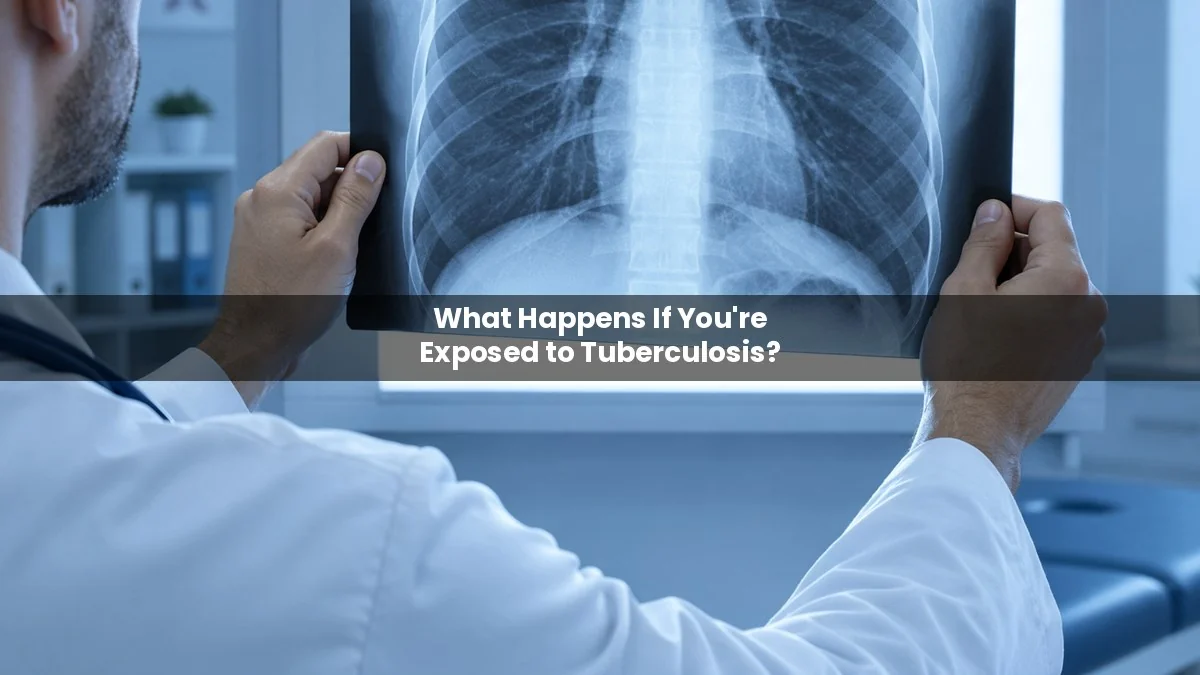
A positive test does not mean active disease. Doctors usually order a chest X-ray to rule it out.
What happens if a TB test comes back positive?
If you have latent TB, treatment is simple and effective. The CDC says treating latent infection is 90% effective at preventing TB disease. Preferred short courses include:
- Three months of once-weekly isoniazid plus rifapentine (3HP)
- Four months of daily rifampin (4R)
- Three months of daily isoniazid plus rifampin (3HR)
Active TB needs a longer course of several antibiotics, usually for months. Stopping early can let the bacteria survive and become drug-resistant. To understand why that matters, see our guide to what happens if you get a superbug infection.
What symptoms should you watch for after being exposed to tuberculosis?
Most exposed people never develop symptoms. Even so, see a doctor if you notice any of these, according to the CDC:
- A cough lasting three weeks or longer
- Coughing up blood or mucus
- Chest pain
- Fever, chills or night sweats
- Unexplained weight loss or tiredness
Untreated TB can damage the lungs and spread to other organs. In rare cases, serious infections can also trigger body-wide reactions, as our explainer on what happens if an infection turns into sepsis describes.
How common is tuberculosis today?
Globally, TB remains one of the deadliest infectious diseases. The World Health Organization (WHO) estimates that 10.7 million people fell ill with TB in 2024, and 1.23 million died.
In wealthy countries, it is much rarer. The CDC provisionally counted 10,260 US cases in 2025, a rate of 3.0 per 100,000 people. Australia also has low TB rates, which is why a childcare case makes headlines.
Keeping rates low depends on fast contact tracing, like the screening now under way in Adelaide. Public health systems face the same test with other diseases. For a look at what happens when that protection slips, read what happens if the US loses measles elimination status. For another outbreak response, see what happens if Ebola spreads.
A different kind of exposure, a dog bite, also needs prompt wound care because of infection and, in some cases, rabies. See what happens when a dog bites someone.
Frequently asked questions
Can you get TB from a short contact?
It is unlikely. TB usually spreads through prolonged, close contact indoors with someone who has active lung TB.
How long after being exposed to tuberculosis will a test turn positive?
It can take several weeks. That is why doctors often repeat the test 8 to 10 weeks after the last exposure.
Is latent TB contagious?
No. People with latent TB infection cannot spread the bacteria to others, according to the CDC.
Can TB be cured?
Yes. Both latent infection and active TB disease are treatable with antibiotics, as long as people finish the full course.
Should adults worry about the Adelaide case?
SA Health says parents are not considered at increased risk and the wider community risk is low.
When will the Adelaide children be screened?
SA Health said tuberculin skin tests will take place over the coming weeks. The 16 more recently exposed children at Fullarton are being offered screening and preventive treatment first. About 80 children at Marion and Paradise are to be offered precautionary screening from the week of November 23, 2026.
Do the Adelaide childcare centers need to close?
No. Chief Public Health Officer Nicola Spurrier said there is no infectious-disease requirement to shut the centers while screening and treatment go ahead.
Sources
- ABC News: Tuberculosis in worker at three Adelaide childcare centres creates exposure risk (Nov 18, 2026)
- SA Health: Tuberculosis (TB) symptoms, treatment and prevention
- Glam Adelaide: Children at three Adelaide childcare centres offered TB screening
- CDC: Clinical Overview of Latent Tuberculosis Infection
- CDC: Tuberculosis Clinical Care for Children
- CDC: Provisional 2025 Tuberculosis Data, United States
- WHO: Global Tuberculosis Report 2025, TB mortality