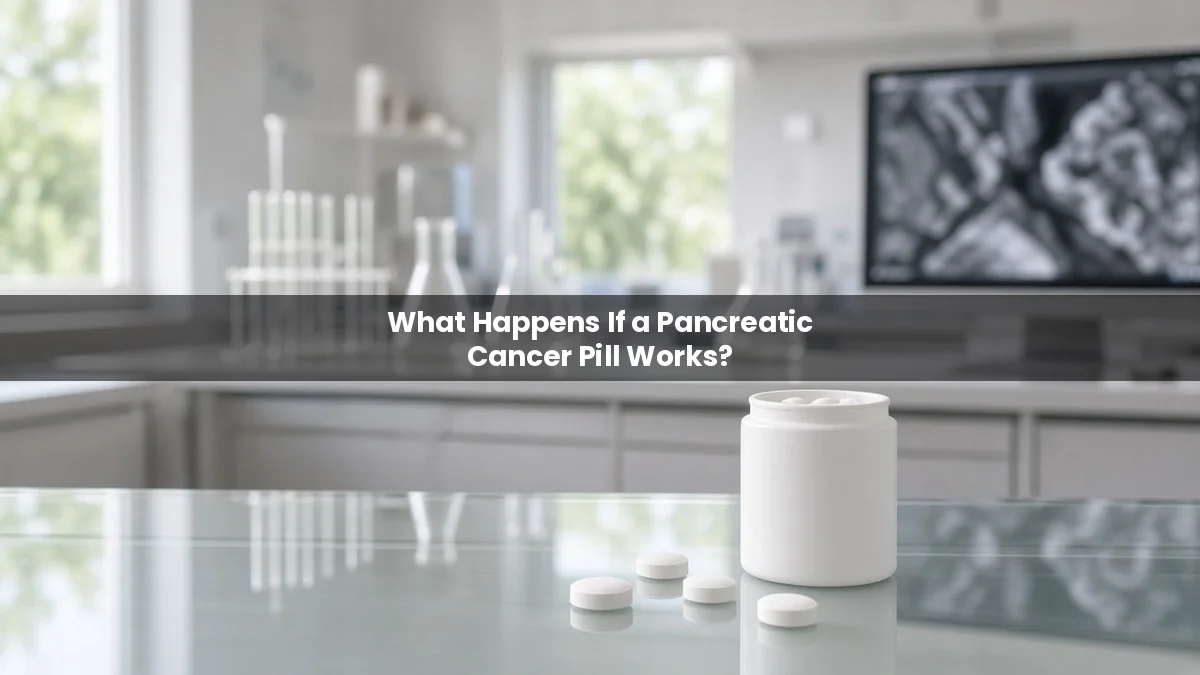
What Happens If a Pancreatic Cancer Pill Works?
On November 19, 2026, researchers presented updated results for a daily pill already used against advanced pancreatic cancer, this time combined with chemotherapy in patients who had not been treated before. So what happens if a pancreatic cancer pill works? Early data look unusually strong, but doctors are clear that this is not a cure.
Short answer: In a 61-patient first-line trial, daraxonrasib plus chemotherapy produced confirmed tumor responses in 60.7% of people, including complete responses in 8.2%. Disease control reached 90.2%. A larger Phase 3 trial is still testing whether the combination extends life. Doctors say scans that look clear are not the same as a lasting cure.
What did the new pancreatic cancer pill trial find?
The update comes from the Phase 1/2 RMC-GI-102 study and was presented as a late-breaking talk at the EORTC-NCI-AACR Symposium in Barcelona. Revolution Medicines, which makes the drug, reported the figures on November 19. Memorial Sloan Kettering medical oncologist Dr. Wungki Park, an investigator on the study, presented the data.
As of a September 28, 2026 cutoff, 61 people with previously untreated metastatic pancreatic adenocarcinoma had received daraxonrasib, sold as Rasonque, at 200 mg a day plus gemcitabine and nab-paclitaxel. Median follow-up was 18.3 months. According to the company:
- The confirmed objective response rate was 60.7% (95% confidence interval, 47.3 to 72.9), including complete responses in 8.2% of patients.
- The disease control rate was 90.2% (95% CI, 79.8 to 96.3).
- Median duration of response was 11.1 months (95% CI, 7.6 to 18.4).
- Median progression-free survival was 12.8 months (95% CI, 10.8 to 18.4).
- An estimated 76.6% of patients were alive at 12 months (95% CI, 63.7 to 85.4).
The company said the safety profile was consistent with what was already known for both treatments. This was an open-label early study, not a final test of first-line care.
What happens if a pancreatic cancer pill works in everyday terms?
For patients and families, the headline numbers mean something simpler. In this small first-line group, tumors shrank in a majority of people, and in a smaller share they could no longer be seen on scans. The disease stayed under control for a median of more than a year before it started growing again in the typical patient.
That would be a big change from ordinary expectations in metastatic pancreatic cancer, where chemotherapy often buys months, not a year of control. Dr. Park said the team is seeing “deep complete responses” and “durable disease control, with median progression-free survival exceeding one year.”
It still does not prove that a pancreatic cancer pill works better than chemotherapy alone at extending life. Cancer Research UK’s Dr. Sam Godfrey told the BBC the results were “incredibly exciting,” but he also stressed that cancer can return even after scans look clear. “You don’t necessarily know you are cancer-free until more time has passed,” he said.
Is this pancreatic cancer pill already approved?
Yes, in a different setting, which is easy to miss when asking what happens if a pancreatic cancer pill works. On August 26, 2026, the U.S. Food and Drug Administration approved daraxonrasib (Rasonque) for adults with metastatic pancreatic adenocarcinoma who have already had at least one systemic treatment, or who are not candidates for multi-agent therapy. That approval rested on the Phase 3 RASolute 302 trial in previously treated patients, where median overall survival was 13.2 months with the pill versus 6.7 months with standard chemotherapy.
The November update is about using the same pill earlier, with chemotherapy, in people not yet treated for metastatic disease. The company said the FDA has granted Breakthrough Therapy Designation to that first-line combination. A Breakthrough designation speeds review. It is not a first-line approval.
A larger trial, RASolute 303, is already testing daraxonrasib alone and with chemotherapy against chemotherapy alone in treatment-naive metastatic pancreatic cancer, regardless of RAS genotype. Until that study reads out, the first-line combination remains experimental.
Other cancer research is moving at the same time. Our earlier guide to what happens if a personalized cancer vaccine works covers a different approach, built around a patient’s own tumor mutations rather than a daily RAS-blocking pill.
Why is pancreatic cancer so hard to treat?
Most pancreatic cancers are driven by RAS mutations, long considered almost impossible to drug. Daraxonrasib is a multi-selective RAS(ON) inhibitor designed to shut off those growth signals, which is why a pancreatic cancer pill works against this tumor type at all.
The human cost is steep. The U.S. National Cancer Institute’s SEER program estimates 67,530 new pancreatic cancer cases in the United States in 2026, or 3.2% of all new cancers, and 52,740 deaths, or 8.4% of all cancer deaths. The five-year relative survival rate is 13.7%. In the United Kingdom, Cancer Research UK reports 11,479 new cases in a combined 2019 and 2021-2022 period, and 10,200 deaths in 2022-2024.
Those figures explain the attention, and the caution. A 61-person study can look striking and still be too small to change first-line practice on its own.
What don’t we know yet if a pancreatic cancer pill works?
Several limits remain. The first-line results come from an open-label Phase 1/2 study, not a randomized comparison with chemotherapy alone. Median overall survival for this group has not been reported as a final number, only a 12-month estimate. It is still unclear how long complete responses last.
Side effects were described only as consistent with known profiles. Conference chair Prof. Elena Garralda told the BBC the combination could “potentially significantly improve” survival and the time before tumors grow again. That is a hopeful reading of early data, not a finished Phase 3 result.
For now, the honest summary is this: the pill already helps some previously treated patients, and early first-line results suggest a pancreatic cancer pill works more deeply when paired with chemotherapy. The definitive test is still running. For another medical explainer, see what happens if an infection turns into sepsis and our full list of science-backed scenarios.
Frequently asked questions
Is the new pancreatic cancer pill a cure?
No. Doctors involved in the research and Cancer Research UK have said it should not be seen as a cure. Some patients had scans with no visible tumors, but longer follow-up is needed to know whether the cancer stays away.
What happens if a pancreatic cancer pill works in the larger trial?
If RASolute 303 confirms a survival benefit, the combination could become a new first-line option. If it does not, the early 61-patient signal would remain encouraging but not practice-changing. Those results are not in yet.
Can patients get this combination now?
Daraxonrasib is FDA-approved for certain previously treated patients. The first-line combination is still being studied. Whether a pancreatic cancer pill works for an individual patient is a decision for an oncologist, based on approved uses and trials.
How common is pancreatic cancer?
SEER estimates it will account for 3.2% of new U.S. cancers and 8.4% of U.S. cancer deaths in 2026, with a 13.7% five-year relative survival rate.
Sources
- Revolution Medicines: updated Phase 1/2 data for daraxonrasib plus chemotherapy (Nov. 19, 2026)
- FDA: approval of daraxonrasib for metastatic pancreatic adenocarcinoma (Aug. 26, 2026)
- National Cancer Institute SEER: pancreatic cancer stat facts
- Cancer Research UK: pancreatic cancer statistics
- BBC News: trial saw tumors vanish in some patients (Nov. 20, 2026)