
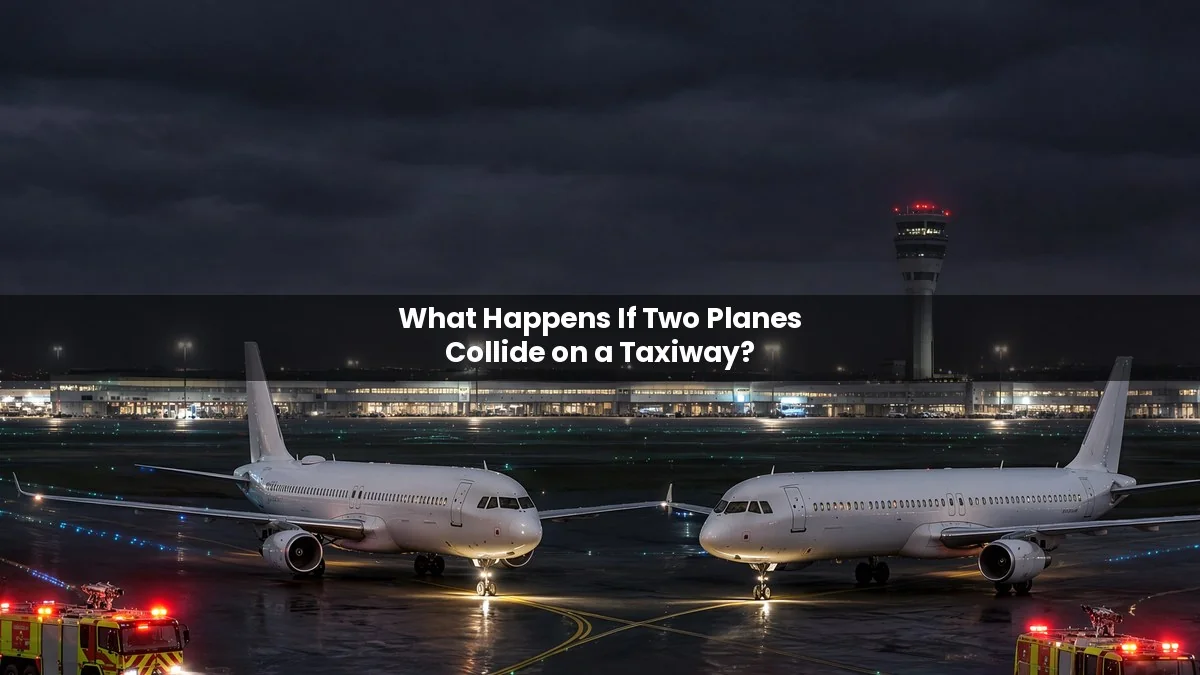
What Happens If Two Planes Collide on a Taxiway?
On Saturday night, November 14, 2026, a UPS cargo jet and a Copa Airlines passenger jet touched at a taxiway intersection at Miami International Airport. The low-speed crash shows what happens if planes collide on a taxiway: flights stop, crews and passengers get checked, and investigators start piecing together who was supposed to yield.
Short answer: If planes collide on a taxiway, the impact is usually slow, so injuries tend to be minor. Air traffic control halts nearby traffic, firefighters inspect both jets, and passengers wait or get bused to the terminal. The damaged aircraft are grounded for repairs, and U.S. investigators may open a probe into why the jets got too close.
Below, we separate what officials have confirmed from early reports that may change. This is a developing story as of Sunday, November 15, 2026 (Eastern Time).
What happened at Miami International Airport?
Status: confirmed by the FAA, Miami-Dade Aviation and both airlines; the cause has not been officially determined.
The FAA says the wingtip of a Copa Airlines Boeing 737, which was taxiing to the gate, struck the nose of a UPS Boeing 767 that was taxiing for departure to Bogotá, Colombia. The agency put the time at around 9 p.m. local time on Saturday, November 14, 2026. Miami-Dade Aviation spokesperson Greg Chin said the aircraft made contact at about 9:15 p.m. “at the intersection of two taxiways.”
- UPS Flight 358 was departing for Bogotá. UPS said its crew is safe.
- Copa Airlines Flight 427 had just arrived from Panama City, Panama, with 166 passengers and six crew members.
- Two people were treated on the scene for minor injuries and were not taken to a hospital, according to Miami-Dade Aviation. Copa said that, aside from the two people treated for “apparent minor injuries,” the rest of its passengers and crew were in good condition. Officials have not said whether the injured people were passengers or crew.
- The airport sent other flights to different taxiways and said operations were not affected.
The FAA also said air traffic controllers had told the UPS crew to give way to the Copa flight. The agency is investigating. It has not said why the UPS jet did not give way.
Air traffic control audio reported by ABC News captures a pilot saying, “Somebody hit us.” Other recordings shared with news outlets include a UPS pilot saying the jet “went too far” and was then clipped by the wing. Those radio comments are not an official finding. Photos published by ABC News showed damage to the nose of one aircraft.
The crash came one day after the FAA’s rare nationwide halt on flights. We explain that event in what happens if the FAA issues a nationwide ground stop. No link between the two events has been reported.
What happens in the first minutes after planes collide on a taxiway?
First, both crews stop and report the contact to ground control. Controllers then hold or reroute nearby aircraft so nobody else taxis into the area. Meanwhile, airport fire crews race out to check for fuel leaks, fire and injuries.
Next, passengers usually stay seated while crews and firefighters assess the damage. If the jet can’t safely taxi, people leave by stairs and ride buses to the terminal. That is exactly what happened after a similar crash at New York’s LaGuardia Airport in 2025.
Finally, tugs tow the damaged planes away for inspection.
Why do planes collide on a taxiway at all?
Busy airports are crowded mazes, especially at night. Big jets have wide wings, and pilots sitting up front can’t see their own wingtips. As a result, they rely on painted lines, signs, lights and controller instructions to keep their distance.
Common factors in ground collisions include:
- Missed or misheard instructions, such as an order to “give way” to another plane
- Complex intersections where several taxiways meet
- Darkness, rain or glare that make markings harder to see
- Busy radio channels after delays, when many planes are moving at once
These factors explain risk in general. Investigators have not said which, if any, applied in Miami. Notably, skies were clear at LaGuardia in 2025, so good weather alone does not prevent these crashes.
What did the 2025 LaGuardia taxiway crash show?
On October 1, 2025, two Delta Connection regional jets operated by Endeavor Air collided at LaGuardia. The right wing of Flight 5155 hit the nose and the captain’s windshield of Flight 5047 where taxiways M and A cross, according to the NTSB’s preliminary report. Investigators found substantial damage to both jets.
- Flight 5155 carried 32 people. One flight attendant suffered minor injuries.
- Flight 5047 carried 61 people. Nobody was hurt.
- Everyone left by the main cabin stairs and rode buses to the terminal.
Importantly, the NTSB report shows the ground controller had told Flight 5155 to “give way” to another Endeavor Air jet at taxiway M, and the crew read back that instruction. The full investigation is meant to explain how the collision still happened. That pattern looks a lot like the early, unofficial audio from Miami.
How common are runway and taxiway safety events?
It is rare for planes to collide on a taxiway. Close calls are far more common. The FAA tracks a wide range of ground events under its Surface Safety Metric. That metric includes runway collisions, taxiway collisions, runway incursions and taxiway surface incidents.
Here are recent numbers reported by AVweb from FAA and federal watchdog data:
- 1,758 runway incursions in fiscal 2024
- Nearly 62% of those involved pilot deviations, the DOT Inspector General found
- More than 1,600 runway incursions in 2025, down about 1%
- 44% more severe Category A and B incursions in 2025 than the year before
Keep in mind that a runway incursion is not the same as a taxiway crash. Most incursions involve a plane, vehicle or person in the wrong place, with no contact at all.
Who investigates when planes collide on a taxiway?
In the U.S., the NTSB leads investigations of aircraft “accidents,” while the FAA handles many lesser incidents. Under federal rules, an accident involves death, serious injury or “substantial damage.” Notably, the rule says damage limited to wingtips does not count as substantial damage.
So the label depends on details. A scraped wingtip alone may be logged as an incident. By contrast, the LaGuardia crash damaged a nose and windshield, and the NTSB opened a full investigation. For Miami, the airlines and the FAA have not published a full damage assessment. Photos and radio traffic point to a damaged UPS nose and a missing Copa left wingtip, but that is not the same as an official finding of “substantial damage.”
Investigators typically review controller audio, ADS-B tracking data and cockpit recorders. Preliminary reports often arrive within weeks, while final reports can take a year or more.
What happens to passengers and flights afterward?
For passengers, a ground collision usually means a long night. Damaged jets come out of service, so airlines must cancel flights or swap planes, and travelers may need rebooking.
For the airport, the impact is often small. Miami simply sent traffic down other taxiways. Still, a crash during an already disrupted weekend can add stress to tired crews and controllers. Weak links in aviation technology are a recurring theme, as we explore in what happens if GPS stops working.
Facts vs. open questions
- Confirmed: a Copa 737 wingtip struck a UPS 767 nose at a Miami taxiway intersection around 9 to 9:15 p.m. on November 14 (FAA and Miami-Dade Aviation).
- Confirmed: controllers had told the UPS crew to give way to the Copa flight, and the FAA is investigating.
- Confirmed: the Copa flight carried 166 passengers and six crew; two people were treated on scene for minor injuries and were not hospitalized; airport operations continued.
- Reported, not an official finding: ATC audio of the crews describing the contact, and photos of nose damage.
- Unknown: why the UPS jet did not give way; a full official damage assessment; and whether the NTSB will open its own investigation. As of Sunday, November 15, the FAA’s statement did not mention the NTSB, and the NTSB had not announced a probe.
For more scenario explainers like this one, browse our what would happen if scenarios hub. Other incidents can also stop a flight on the ground or force a diversion. See what happens if your flight gets a bomb threat.
Tower staffing is another weak point on the ground. See what happens if an airport control tower goes empty.
Frequently asked questions
Is it dangerous if planes collide on a taxiway?
It can be, but most taxiway collisions happen at low speed. In the Miami and LaGuardia cases, injuries were minor. The bigger risks are fuel leaks and fire, which is why fire crews respond immediately.
Who has the right of way on a taxiway?
Ground controllers decide. They often tell one aircraft to hold short or “give way” to another. Pilots must read back and follow those instructions.
Will the Miami collision be investigated?
Yes. The FAA says it is investigating. As of Sunday, November 15, the NTSB had not announced its own investigation. Under federal rules, the NTSB leads cases that meet the definition of an aircraft accident, which requires death, serious injury or “substantial damage.” Damage limited to a wingtip does not count as substantial damage, so any NTSB case may depend on the 767’s nose damage.
Can a plane fly after a taxiway collision?
Not until engineers inspect and repair it. Even minor wing damage can affect how a plane flies, so it stays grounded until cleared.
Sources
- FAA: Statements on Aviation Accidents and Incidents (Miami, November 14, 2026)
- ABC News: UPS plane, Copa Airlines flight collide on taxiway at Miami International Airport (November 15, 2026)
- CBS News Miami: UPS plane, Copa Airlines jet collide at Miami International Airport
- NTSB: Preliminary report DCA26FA001 (LaGuardia, Oct. 1, 2025)
- AVweb: Severe Runway Incursions Jump 44% in 2025
- FAA: Runway Safety fact sheet (Surface Safety Metric)
- eCFR: 49 CFR 830.2 definitions (aircraft accident, substantial damage)