Can You Live Without Part of Your Skull? Craniectomy Explained
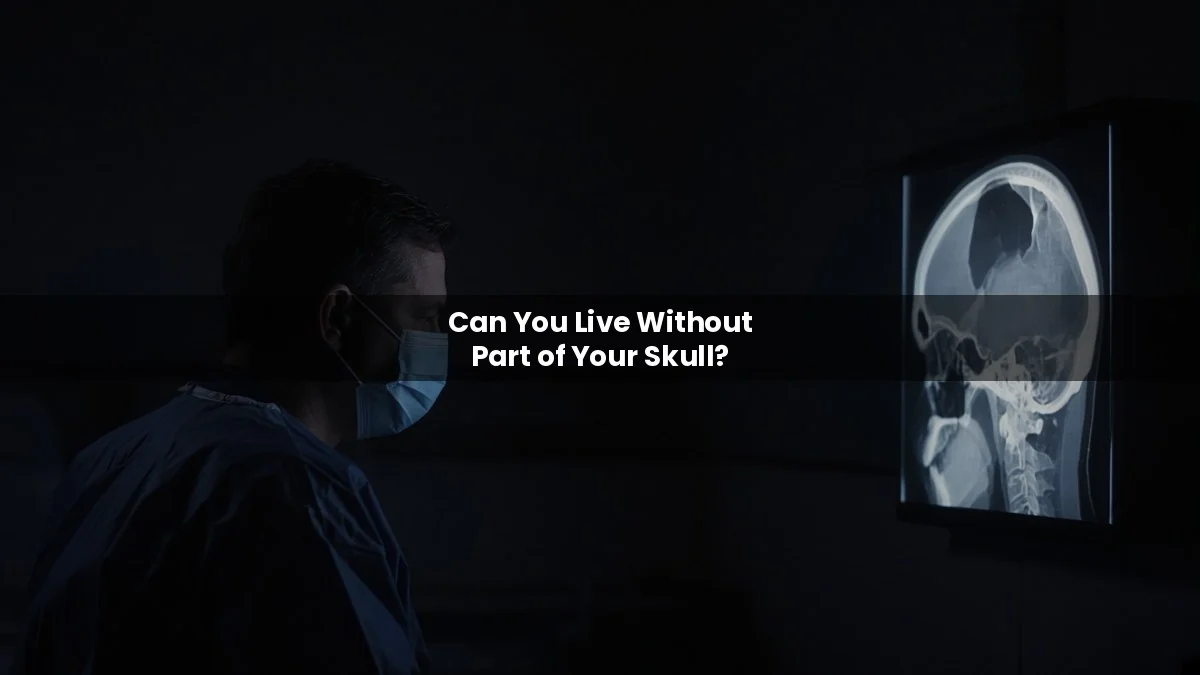
Short answer: yes. People can live for months with part of their skull removed. Surgeons do it on purpose in an operation called a decompressive craniectomy, which gives a dangerously swollen brain room to expand. The missing bone is usually replaced later in a second operation called a cranioplasty. Until then, patients wear a protective helmet. Living with no skull at all, however, is not possible.
This article is general information, not medical advice. We label points as established facts, research findings or hypotheticals.
Why would doctors remove part of the skull?
The skull is a closed box. After a severe head injury, stroke or brain bleed, the brain can swell, and because it has nowhere to go, the pressure inside the skull rises. High pressure squeezes blood vessels and can push brain tissue downward, which can be fatal.
Fact: in a craniectomy, a surgeon removes a large piece of bone, often a section of the side of the skull. The scalp is closed over the gap, and the brain can then bulge outward instead of being crushed.
Lack of blood flow is one of the main dangers. See what happens when the brain runs out of oxygen.
Does it actually save lives?
Research finding: the RESCUEicp trial (New England Journal of Medicine, 2016) followed 408 patients with severe traumatic brain injury and very high brain pressure. At 6 months:
- Deaths: 26.9% with craniectomy vs 48.9% with medical care alone
- Vegetative state: 8.5% vs 2.1%
- Dependent on others for care: 21.9% vs 14.4%
- Moderate disability or good recovery: similar in both groups
In other words, the surgery saves many lives, but more of the survivors live with severe disability. That’s why doctors and families weigh the decision carefully.
Where does the missing bone go?
Fact: hospitals commonly use one of two methods:
- Frozen storage: the bone is sterilized, packed and kept in a bone freezer, typically at −20 °C to −40 °C.
- Inside the body: the bone is tucked into a pocket under the skin of the abdomen, where the body keeps it alive.
Studies have not shown a clear winner between the two. If the original bone can’t be used, surgeons replace it with titanium mesh, acrylic or a custom 3D-printed implant.
What is daily life like without part of your skull?
- A protective helmet: the brain under the gap is covered only by skin, so patients wear a soft helmet whenever they are up and about.
- A visible dip or bulge: the scalp may swell outward at first, then sink inward as swelling goes down.
- Rehabilitation: most patients are recovering from a serious brain injury, so physical, speech and occupational therapy are common.
- Waiting for repair: timing varies. An international consensus describes ultra-early repair (up to 6 weeks), early (6 weeks to 3 months) and delayed (beyond 6 months). Doctors wait until wounds have healed, infection is ruled out and swelling has settled.
The “syndrome of the trephined”
Research finding: some patients get worse while they wait. Without bone, outside air pressure pushes the sunken scalp against the brain. This can cause headaches, dizziness, mood changes, weakness or trouble speaking. Doctors call it the syndrome of the trephined or “sinking skin flap syndrome”. It can become serious, but replacing the bone often reverses the symptoms.
Could you live with no skull at all?
Hypothetical: no. Without any skull, the brain would have no protection from even minor bumps, and the skull also anchors the muscles and tissues of the face and scalp. Craniectomy works only because most of the skull stays in place and the opening is temporary. For the bigger picture, see what would happen if the human body lost its bones.
Related: what happens if the brain loses memory and what happens if your blood stopped clotting.
Frequently asked questions
Can you live without a skull?
Not without any skull. But people do live, usually for weeks to months, with a large piece of skull removed after a decompressive craniectomy, until it’s replaced.
How long can you live without part of your skull?
There’s no fixed limit. Replacement is often done within about 3 to 6 months, sometimes earlier or later depending on recovery and infection risk.
Why do they put the skull bone in your stomach?
Storing the bone under the skin of the abdomen keeps it alive and sterile inside your own body until it can be put back.
Is a craniectomy dangerous?
Yes. It’s major brain surgery, usually done only when brain swelling is life-threatening. Risks include infection, bleeding, fluid build-up and syndrome of the trephined.