
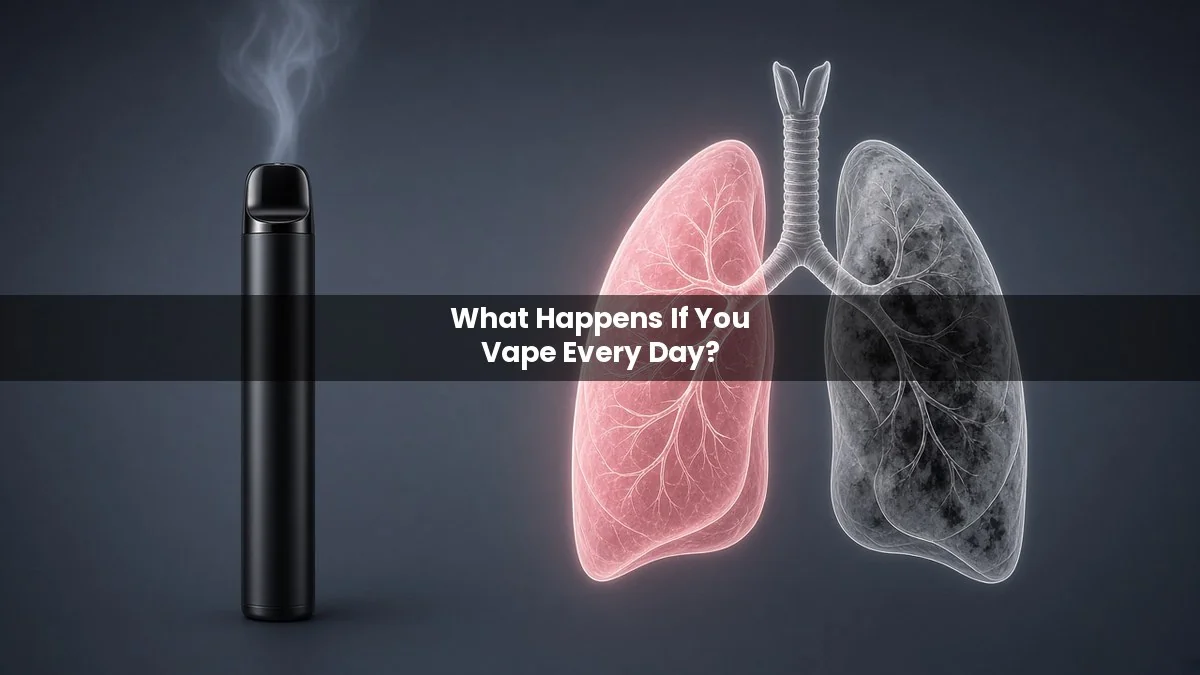
What Happens If You Vape Every Day? New Lung Study
What happens if you vape every day for years? A small new study in the journal Tobacco Control suggests your lungs may slowly pay a price. Researchers tracked young adults who vape and found their lung function dropped over about a year. The findings are early, but they add to a growing list of reasons experts say vaping isn’t harmless.
Short answer: If you vape every day, you’ll most likely become dependent on nicotine, and you’ll breathe in an aerosol that can contain heavy metals and cancer-causing chemicals. New pilot data link long-term daily vaping in young adults to a measurable drop in lung function, which could raise the risk of COPD later. However, vaping is likely far less harmful than smoking cigarettes, so it can help smokers quit. For non-smokers, health agencies say it isn’t recommended.
We separate measured facts, expert guidance and open questions below. This is general information, not medical advice.
What did the new vaping study find?
Status: preliminary research (pilot study).
Researchers at Florida International University, the University of Miami and the University of Michigan ran the study. It appeared online in Tobacco Control, and the BMJ Group publicized it on November 10, 2026.
- Who took part: 22 people aged 21 to 35 who mainly used e-cigarettes.
- How it worked: each person took lung function tests twice, about 12 months apart on average. To avoid short-term effects, they skipped all tobacco and vaping products for 12 hours before each test.
- The result: FEV1, the amount of air you can blow out in one second, fell from 3.85 liters to 3.75 liters on average. That drop of about 100 milliliters was statistically significant.
FEV1 matters because a falling FEV1 is a hallmark of chronic obstructive pulmonary disease (COPD), a long-term lung disease that makes breathing harder.
Does it matter how often you vape every day?
Status: a trend, not a confirmed effect.
The researchers also compared how often people vaped. Compared with those who vaped 0 to 4 times a day, FEV1 fell by:
- About 100 mL in people who vaped 5 to 9 times a day
- About 190 mL in people who vaped 10 to 29 times a day
- About 240 mL in people who vaped 30 or more times a day
That pattern looks like a dose-response effect, where more vaping means more harm. Still, the authors note this trend wasn’t statistically significant. In other words, it could partly reflect chance in such a small group.
How much should you trust these results?
Status: important limitations.
The authors are upfront about the weak spots. First, the sample was tiny. Second, they only measured lungs at two points in time. Third, there was no comparison group of people who don’t use tobacco at all. Because lung function naturally changes with age, a control group would help show how much of the drop comes from vaping.
Even so, the researchers call it the first sign that prolonged vaping could have “persistent and clinically important cumulative effects” on lung function. Larger, longer studies are now needed.
What happens to your brain and body if you vape every day?
Status: established health guidance.
Lung function is only one piece of what happens when you vape every day. According to the CDC, here is what daily vaping can expose you to:
- Nicotine addiction: most vapes contain nicotine, which is highly addictive. Daily use makes dependence much more likely.
- Brain effects in young people: the brain keeps developing until about age 25. During that time, nicotine can affect attention, learning, mood and impulse control.
- More than “water vapor”: the aerosol can contain cancer-causing chemicals, heavy metals such as nickel, tin and lead, volatile organic compounds, ultrafine particles and flavorings like diacetyl.
If you use nicotine in other forms too, the dependence adds up. We covered a similar habit in what happens if you use nicotine pouches every day.
Can vaping cause sudden lung injury?
Status: documented outbreak (2019–2020).
Yes, although it’s rare and tied mainly to certain products. In 2019, the US saw an outbreak of e-cigarette or vaping product use-associated lung injury, known as EVALI. By February 18, 2020, the CDC had recorded 2,807 hospitalized cases or deaths, including 68 confirmed deaths.
Investigators strongly linked the outbreak to vitamin E acetate, an additive found in some THC-containing vaping products, often from informal sources. Consequently, buying illicit or modified products carries extra risk. Daily nicotine vaping from regulated products is a different issue, and the new study looks at that slower, long-term effect.
Is vaping every day better than smoking?
Status: official public health positions.
If you’re a smoker who chooses to vape every day instead of smoking, the answer is generally yes. The NHS says e-cigarettes are likely to be far less harmful than cigarettes and can help people quit for good. That’s because vapes don’t burn tobacco, so they don’t produce tar or carbon monoxide.
However, “less harmful” doesn’t mean safe. The NHS also says vapes aren’t recommended for non-smokers. Meanwhile, the CDC says no tobacco product, including e-cigarettes, is safe, and that youth, young adults and pregnant women shouldn’t use them. Vapes may help adult smokers only when they fully replace cigarettes. Using both, known as dual use, may expose you to more toxins than either one alone. The new study fits that message: if you never smoked, daily vaping adds risk rather than reducing it.
It’s a familiar trade-off in health advice. As with taking aspirin every day, something that helps one group of people can add risk for another.
What happens if you stop vaping?
Status: general guidance.
Quitting nicotine often brings short-term cravings, irritability and trouble concentrating. These usually ease over a few weeks. Free support makes quitting easier. In the US, you can call 1-800-QUIT-NOW. In the UK, the NHS offers free local stop smoking services.
Whether lungs fully recover after years of vaping is still an open question. Researchers simply don’t have enough long-term data yet. Similarly, our look at two drinks a day shows how “moderate” habits can carry hidden costs over time. The same pattern shows up with kratom, which can cause tolerance and withdrawal with daily use. See what happens if you take kratom every day.
Frequently asked questions
Is vaping every day bad for your lungs?
Early evidence says it may be. A small 2026 pilot study found young adults’ lung function dropped over about a year of regular vaping. Bigger studies are needed to confirm it.
Can vaping cause COPD?
It isn’t proven. However, the study’s authors say the drop in FEV1 they saw could raise COPD risk over time.
Is nicotine-free vaping safe?
Not necessarily. Nicotine drives addiction, but the CDC notes that vape aerosol can also contain other harmful substances, including tiny particles and flavorings such as diacetyl, which is linked to serious lung disease.
How many puffs a day is too many?
No safe number has been set. In the new study, people who vaped 30 or more times a day showed the largest drop, although that trend wasn’t statistically significant.
Explore more body and health scenarios in our what would happen if scenarios hub.