
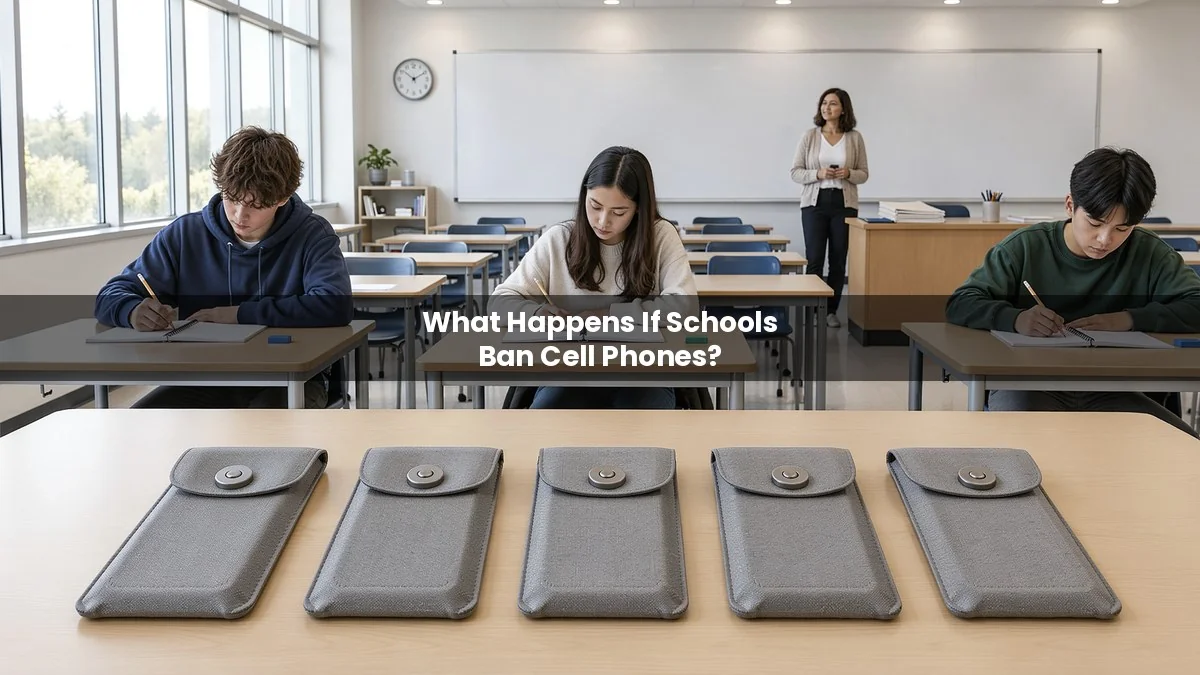
What Happens If Schools Ban Cell Phones?
On November 17, 2026, Harvard researchers released the first national study that follows individual students before and after strict phone bans. So what happens if schools ban cell phones? The short version is that grades rise a little, every year, and the gains seem to add up.
Short answer: When schools ban cell phones and lock them away all day, students learn slightly more. A Harvard-led study of 3.3 million US students found math and reading growth rose by about 0.01 standard deviations per year. That equals one to two extra weeks of learning annually, or roughly half the yearly decline seen since 2013.
Below, we separate what the data shows from what remains uncertain, including mental health and life outside the school gates.
What did the new Harvard study find?
The study comes from the Center for Education Policy Research (CEPR) at Harvard, working with Dartmouth and the testing group NWEA. It tracked about 3.3 million students in grades 3 to 10. Those students attended 4,600 schools in 49 states and Washington, D.C., from the 2021–22 school year through 2025–26.
The researchers focused on strict bans. In these schools, students sealed their phones in lockable pouches for the whole day. Then the team compared each student’s test growth before and after the ban with students at similar schools without one.
Here are the headline findings, according to CEPR:
- Steady gains: Achievement growth rose by about 0.01 standard deviations per year in math and reading.
- Real time back: That is like adding one to two weeks of teaching each year, or about two minutes per hour of class.
- Lasting effect: Gains began in the first year and still appeared three years later.
- Fewer big drops: Fewer students suffered large losses in reading in a given year.
- Same across groups: Results did not differ much by grade level, school poverty or prior achievement.
Why does a small number like 0.01 matter?
At first glance, 0.01 standard deviations sounds tiny. However, context changes the picture. Between 2013 and 2024, eighth-grade math and reading scores fell by roughly one full grade level, CEPR says. That slide happened slowly, at about 0.01 to 0.02 standard deviations per year.
In other words, students were losing two to three weeks of learning every year. The ban recovers about half of that loss. Because the decline built up gradually, researchers argue the recovery can build up gradually too.
The cost is also low. CEPR estimates pouches cost about $25 per student. For a class of 17, that is roughly $425. By comparison, paying an average teacher for one extra week would cost about $2,080.
What happens in the classroom when schools ban cell phones?
Teachers have complained about phones for years. In a 2023 Pew Research Center survey of 2,531 US public school teachers, 72% of high school teachers called cellphone distraction a major problem in their classroom.
When schools ban cell phones with pouches, the first change is simple: fewer devices in use. CEPR estimates the number of phones used in schools fell by about 20% after bans began. As a result, teachers spend less time policing screens and more time teaching.
Still, the study measured test scores, not behavior. So any claim about calmer hallways or better focus comes from teacher reports and news coverage, not from this dataset.
Do all phone bans work the same way?
No. The strongest evidence covers strict, all-day bans with locked pouches. Lighter rules are harder to judge.
The study also looked at statewide rules in 22 states during 2025–26. Students in states with “bell-to-bell” bans gained about 0.016 standard deviations in reading. Meanwhile, states that banned phones only during class time saw math gains of about 0.019 standard deviations.
However, the researchers urge caution here. These states may have already been on different paths before their bans began. Therefore, the statewide numbers are suggestive, not proof.
Earlier research was also mixed. One 2025 study of a single Florida district found small score gains by the second year. Another national study using school averages found no statistically significant boost. CEPR’s study differs because it follows individual students on the same test through the school year.
What happens if schools ban cell phones around the world?
The US is not alone. UNESCO’s Global Education Monitoring (GEM) Report says 114 education systems now have a national ban on phones in schools. That is 58% of countries worldwide. By contrast, fewer than one in four countries (24%) had bans in June 2023.
England, Australia and several Canadian provinces have also restricted phones in schools in recent years. Their rules vary widely, though, from full-day bans to class-time limits. As a result, results from US pouch bans may not transfer neatly to every country.
What don’t we know yet when schools ban cell phones?
Several big questions remain open. Here is what the evidence does not yet answer:
- Mental health: The study did not measure anxiety, depression or bullying. CEPR says more research is needed on these outcomes.
- Phones at home: Kids still use phones after school. Researchers now want to study whether out-of-school use explains the rest of the learning decline.
- Long-term payoff: Gains appear to last three years, but no one knows yet how they compound over a full school career.
- Safety concerns: Some parents worry about reaching children during emergencies. The study does not address this trade-off.
For a related look at screens and the mind, see what happens when you try quitting social media for 30 days. Phones also affect sleep, and our guide on going without sleep for days explains why rest matters for memory.
Should parents and schools act on this?
Based on this study, when schools ban cell phones with pouches, the result looks like a modest, cheap tool rather than a miracle fix. CEPR’s own advice is clear: schools should not expect large jumps right away. Instead, the benefit is a slow, steady return of lost learning time.
For parents, a few practical steps follow from the evidence:
- Ask your school how its policy works, and whether phones are stored or simply “away.”
- Agree on an emergency plan, such as calling the school office.
- Consider phone-free homework time, since home use is still an open question.
Attention and memory are closely linked. To learn more, read what happens if the human brain loses memory. And for the bigger tech debate, see what happens if AI becomes smarter than humans.
Frequently asked questions
Do phone bans improve test scores?
Modestly, yes. Harvard’s CEPR found strict pouch bans raised yearly math and reading growth by about 0.01 standard deviations, or one to two weeks of learning.
How much does a school phone ban cost?
CEPR estimates lockable pouches cost about $25 per student, or roughly $425 for a class of 17.
Do bans help younger and older students equally?
The study found no significant difference between elementary, middle and high schools.
What happens if schools ban cell phones only during class?
States with class-time bans saw math gains of about 0.019 standard deviations in 2025–26. However, researchers say these results may be skewed by earlier trends.
How many countries ban phones in schools?
UNESCO’s GEM Report counts 114 education systems with national bans, or 58% of countries, up from 24% in June 2023.
Sources
- Harvard CEPR: Strict Cell Phone Bans Restore 1–2 Weeks of Student Learning Each Year (Nov 17, 2026)
- Harvard CEPR: Phone-Free Schools and Achievement Growth, findings at a glance
- CEPR news: Banning phones really does help kids learn, researchers say
- Pew Research Center: 72% of US high school teachers say cellphone distraction is a major problem
- UNESCO GEM Report: How many countries have phone bans in school?