What Happens If a Personalized Cancer Vaccine Works? Melanoma Trial Explained
For decades, a “cancer vaccine” sounded like science fiction. Now, a large trial suggests a personalized cancer vaccine can cut the chance that melanoma comes back. Results presented at the ESMO 2026 congress in Madrid have doctors talking. So what happens if this approach works, and what does it really mean for patients? Here is a plain-English guide.
One note first: this is a developing story. The treatment is still investigational, regulators have not approved it, and key survival data are not mature yet.
What Is a Personalized Cancer Vaccine?
Most vaccines prevent infections. This one is different. It is a treatment given after cancer surgery, and it is built for one patient only.
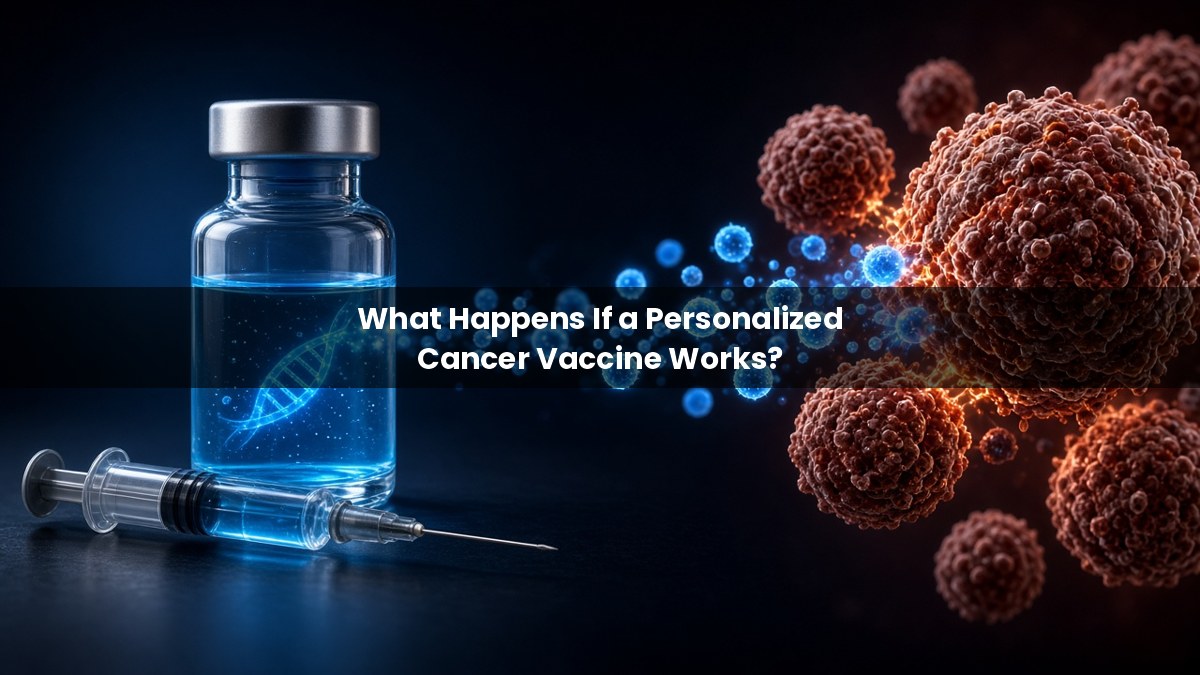
Here is how it works. First, doctors take a sample of the patient’s tumor. Next, scientists read its genetic code and look for mutations unique to that cancer. These mutations create odd proteins called neoantigens. Then, a custom mRNA shot is made to teach the immune system to spot them.
The drug in the trial is called intismeran autogene, also known as V940 or mRNA-4157. Merck and Moderna are developing it together. It is given alongside Keytruda (pembrolizumab), an immunotherapy that releases a brake on immune cells.
What Did the Trial Find?
The Phase 3 trial is called INTerpath-001. It enrolled 1,137 people with high-risk melanoma (stage IIB to IV) whose tumors had been fully removed. Patients got either the vaccine plus Keytruda, or a placebo plus Keytruda.
According to Merck, after a median follow-up of 24.6 months, the combination reduced the risk of recurrence or death by 42% compared with Keytruda alone. It also cut the risk of distant spread or death by 38%.
In real terms, Cancer Network reports that 82.2% of patients in the vaccine group were free of recurrence at two years. In the Keytruda-only group, that figure was 70.0%.
Moderna calls this the first positive Phase 3 readout for an individualized neoantigen therapy.
Why the Benefit Showed Up After Six Months
One detail stands out. In the first six months, the two groups did about the same. After that, however, the gap opened wide.
In a pre-specified analysis beyond six months, the vaccine combination reduced the risk of recurrence or death by 58%, according to Moderna. The company says this pattern matches its earlier Phase 2 study.
Why the delay? The vaccine needs time. Patients receive a series of doses, and the immune system must learn to recognize the targets. In this trial, the median time to the first dose was 64 days, and patients received a median of nine doses.
What Happens If a Personalized Cancer Vaccine Gets Approved?
Merck says it is now engaging with regulators. If approval follows, several things could change.
First, cancer care gets more custom. Every patient’s shot would be different. That is a big shift from one drug for everyone.
Second, tumor samples matter more. In the trial, 302 of 1,749 screened patients (17.3%) were excluded because their tumor sample was not good enough, Cancer Network reports. So hospitals may need new routines for collecting and storing tissue.
Third, manufacturing becomes a race. Encouragingly, the vaccine was successfully made for more than 99% of patients in the combination group. Still, scaling this up to many thousands of people is a different challenge.
Finally, other cancers come into view. If the mRNA approach works in melanoma, researchers will naturally test it elsewhere. However, success in one cancer does not guarantee success in another.
What About Side Effects?
So far, safety looks similar to Keytruda alone. Serious treatment-related side effects (grade 3 to 5) occurred in 14.2% of the vaccine group versus 13.4% of the Keytruda-only group, Moderna reports.
The most common side effects with the combination were fever, injection site pain, and fatigue. That fits what people often feel after other mRNA shots. Merck says no new safety signals were seen.
What We Still Don’t Know
This is where caution matters. The headline results measure recurrence, not survival. Overall survival data are still immature.
In fact, Cancer Network notes that the overall survival result did not meet its pre-set significance boundary at this point. The hazard ratio was 0.77, with a wide confidence interval. Follow-up is ongoing, so this could change with more time.
Also, some smaller subgroups had uncertain results. For example, the US subgroup for distant spread was based on only 10 events. Small numbers like that make firm conclusions hard.
Cost and access are open questions too. No price has been announced, and making a custom drug for each patient is complex.
Who Could Benefit First?
If approved, the first patients would likely match the trial: adults with high-risk melanoma that has been surgically removed. The benefit appeared across both lower and higher stage groups, and in patients both under and over 65.
Melanoma Institute Australia, whose co-medical director Georgina Long presented the data, described the results as opening the door to a new era of treatment. Australia has one of the highest melanoma rates in the world, so the findings carry special weight there.
If you or a loved one has melanoma, talk with your oncologist before drawing conclusions. They can explain whether a clinical trial might be an option.
The Bigger Picture
The immune system is remarkably powerful when it knows what to attack. For more on how the body defends and repairs itself, read what happened if your blood stopped clotting. And for a look at how technology is reshaping medicine and more, see what happens if AI becomes smarter than humans.
Bottom Line
A personalized cancer vaccine just cleared a major test. It lowered the chance of melanoma returning, and its safety looked similar to standard care. Even so, survival data are not mature, and approval is not guaranteed. The next few years of follow-up will decide whether this becomes routine care or remains a promising chapter.