
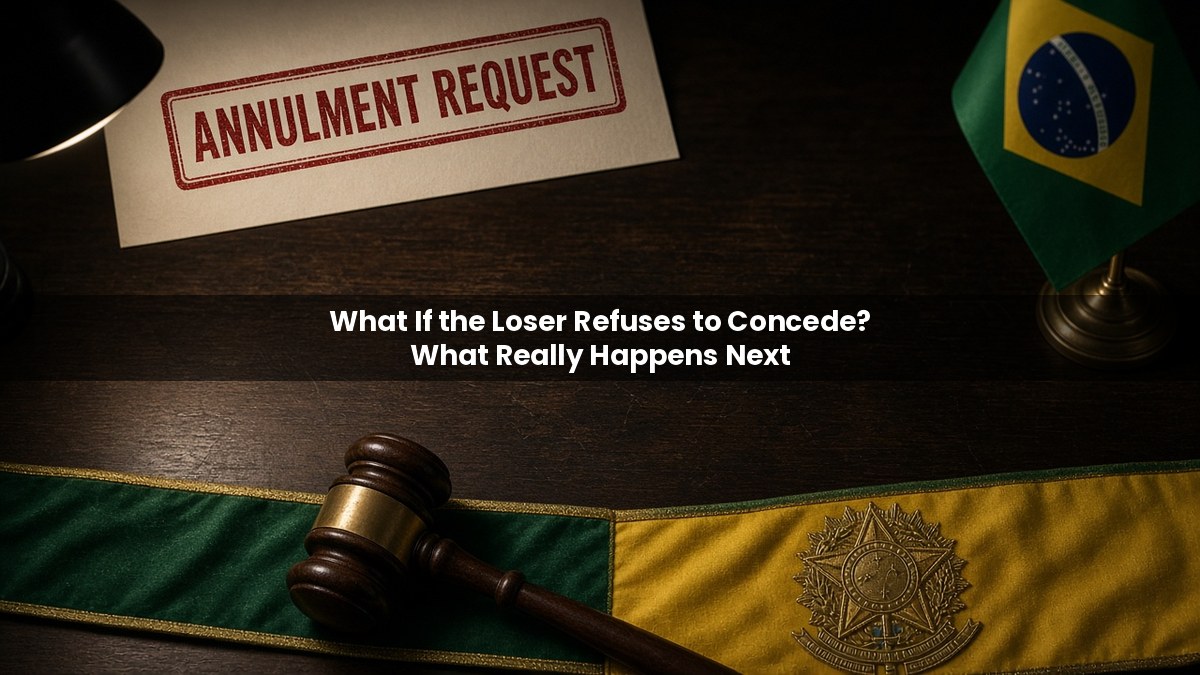
What Happens If a Presidential Candidate Refuses to Concede?
On election night, the loser usually steps up to a microphone, thanks supporters and congratulates the winner. It feels like a formality. But what happens if a presidential candidate refuses to concede? Does the result freeze, can the courts overturn it, or does power change hands anyway?
This question is suddenly real again. On Sunday, October 25, 2026, Brazil’s defeated candidate Flávio Bolsonaro said it was “impossible” to recognise his loss and promised to seek an annulment. Here is what that means in Brazil, how the same situation works in the United States, and what history tells us.
What Just Happened in Brazil?
President Luiz Inácio Lula da Silva won the presidential runoff with 51.79% of the vote, against 48.21% for Senator Flávio Bolsonaro, according to BBC News Brasil. AP News reported the margin was nearly 4.4 million votes.
Bolsonaro, the son of former president Jair Bolsonaro, objected to a decision by Supreme Court justice Cristiano Zanin to extend voting by two hours. He argued it broke equality between voters in different states. Therefore, he said his lawyers would ask for the election to be annulled.
However, there is a twist. As G1 reported, his own campaign had asked the electoral court to extend voting hours in several states hit by storms. Meanwhile, the head of the Superior Electoral Court (TSE), Kassio Nunes Marques, said he had “absolute confidence” in the process.
Does a Candidate Have to Concede?
In most democracies, the short answer is no. A concession speech is a tradition, not a legal step. In other words, the loser’s words do not decide who wins. Instead, official vote counts and legal certification do.
That matters because it means a refusal cannot, on its own, stop a transfer of power. Still, it can cause real trouble. It can fuel distrust, trigger lawsuits, delay cooperation and, in the worst cases, inspire unrest.
What Happens Next in Brazil
Brazil has a specialised electoral justice system, led by the TSE. As a result, disputes go to courts that deal only with elections.
Step 1: The legal challenge
A losing campaign can file a challenge, but it must show evidence that problems could have changed the outcome. According to G1, TSE judges privately believe the annulment request is unlikely to succeed. They point to the large margin and to the fact that both campaigns asked for more voting time.
Step 2: Certification (diplomação)
Next comes diplomação, when the electoral court formally certifies the winners. Under the official calendar reported by the Brazilian Senate’s news agency, the deadline is December 18, 2026.
Step 3: Inauguration
Finally, the winner takes office. For the first time, Brazil’s presidential inauguration moves to January 5, under Constitutional Amendment 111 of 2021, as G1 explains. Previously, it was held on January 1.
Brazil has been here before
After the 2022 election, Jair Bolsonaro never clearly conceded to Lula. His party filed a challenge that the TSE rejected, and it fined the coalition for bad-faith litigation. Then, on January 8, 2023, his supporters stormed government buildings in Brasília. In 2025, Brazil’s Supreme Court convicted Jair Bolsonaro of plotting a coup to stay in power. Because of that history, many Brazilians are watching this new refusal closely.
What Happens If a US Presidential Candidate Refuses to Concede?
The United States has no legal requirement to concede either. Instead, a fixed chain of deadlines moves the result forward, whatever the loser says.
1. States count and certify
Each state counts its ballots, handles recounts and court cases, and certifies its results. Under the Electoral Count Reform Act of 2022, which was part of a larger spending law, each governor must issue a certificate naming the state’s electors by a set deadline in December.
2. Electors cast their votes
The electors meet in their states in mid-December and vote. Their votes are then sent to Congress.
3. Congress counts on January 6
Congress meets in a joint session to count the electoral votes. The 2022 reform made clear that the vice president’s role is only ceremonial. It also raised the bar for objections: one-fifth of members in both the House and the Senate must sign on before an objection can be debated.
4. The term ends at noon on January 20
Finally, the 20th Amendment says the president’s term ends at noon on January 20. So the outgoing president’s power expires automatically, concession or not.
The transition can still suffer
Even so, a refusal can slow things down. In 2020, the federal agency that releases transition funds and office space waited weeks before acting, as the election dispute dragged on. Since then, Congress has updated transition rules to reduce that kind of delay.
What History Shows
- 2000, United States: Al Gore withdrew his concession on election night as Florida’s count narrowed. After the Supreme Court’s Bush v. Gore ruling on December 12, he conceded the next day.
- 2020, United States: Donald Trump did not concede and filed dozens of lawsuits, nearly all unsuccessful. Joe Biden still took office on January 20, 2021, despite the attack on the Capitol on January 6.
- 2022, Brazil: Jair Bolsonaro avoided a clear concession, yet authorised the transition to begin. Lula was inaugurated on January 1, 2023.
The pattern is clear. Refusing to concede rarely changes the result. However, it often changes the mood, and sometimes the safety, of the weeks that follow.
Why Concession Speeches Still Matter
If the law moves on without it, why care? Because a concession sends a signal. It tells supporters the contest is over and that the system worked. Without it, many voters may believe an election was stolen, even when courts find no evidence. That distrust can last for years.
Consequently, political scientists often describe graceful defeat as one of the quiet guardrails of democracy. It is not written in law, yet peaceful transfers depend on it.
Frequently Asked Questions
Is conceding an election legally required?
No. In Brazil, the US and most democracies, a concession is a tradition. Official certification determines the winner.
Can a court overturn a presidential election?
In theory, courts can order recounts or, in rare cases, annul results if serious problems could have changed the outcome. In practice, that bar is very high, especially when the margin is large.
When will Brazil’s next president take office?
On January 5, 2027, after certification by the electoral courts by December 18, 2026.
What happens if a sitting US president refuses to leave?
Under the 20th Amendment, their term simply ends at noon on January 20. The new president takes the oath and gains the powers of the office.
Has a losing US presidential candidate ever refused to concede?
Yes. Most notably, Donald Trump did not concede the 2020 election. Even so, the transfer of power went ahead on schedule.
The Bottom Line
So, what happens if a presidential candidate refuses to concede? Legally, very little changes: votes are certified, deadlines arrive and the winner takes office. Politically, though, a refusal can deepen division and test a country’s institutions. Brazil now faces that test again, and the next key date to watch is December 18.
This is a developing story. Details reflect reporting as of October 27, 2026, and may change as the legal challenge proceeds.