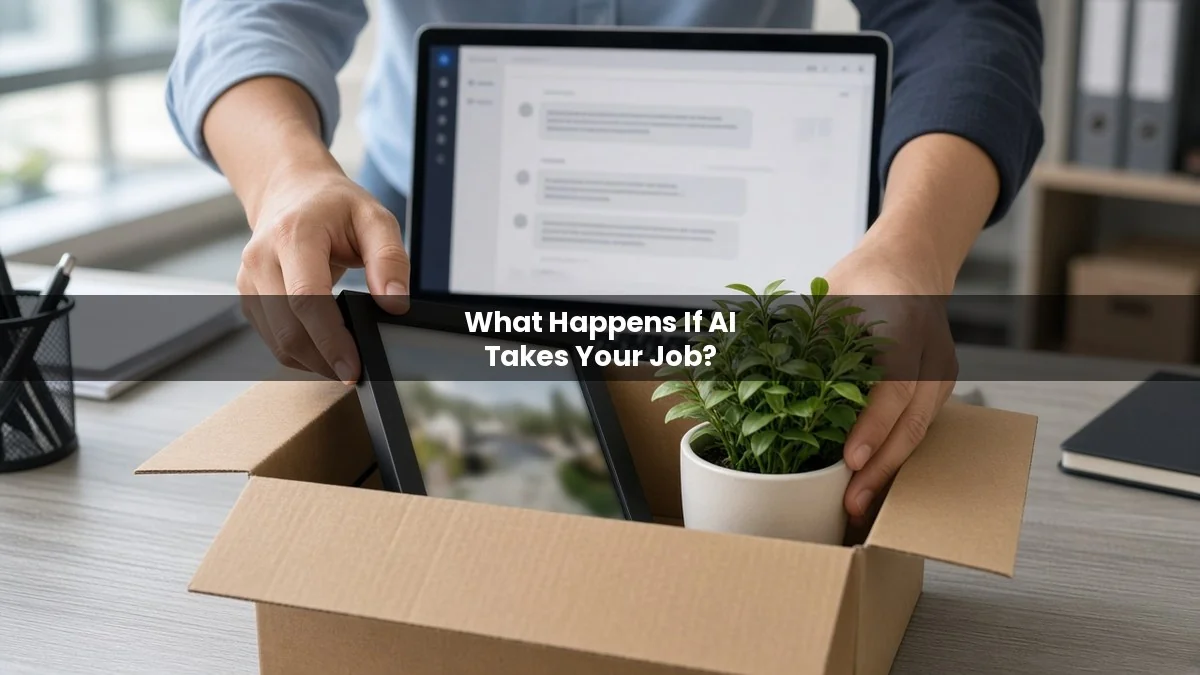
What Happens If AI Takes Your Job? Real Data and Next Steps
Every few weeks, another headline warns that artificial intelligence is coming for millions of jobs. If you write, code, answer customer emails or process paperwork, it’s natural to wonder: what happens if AI takes your job?
The real picture is more mixed than the headlines. AI is already linked to tens of thousands of layoffs, and early-career workers in some fields are feeling it first. Yet economy-wide data so far shows change, not collapse. This guide separates what’s actually happening from what’s projected, and explains what to do if your role is affected.
The short answer
- It’s happening, in pockets: US employers cited AI for 121,401 announced job cuts from January to October 2026, about 20% of all announced cuts, according to Challenger, Gray & Christmas.
- Young workers feel it first: a 2025 Stanford study found a 13% relative drop in employment for 22- to 25-year-olds in the jobs most exposed to AI.
- Most jobs change rather than vanish: the International Labour Organization says about 1 in 4 jobs worldwide is exposed to generative AI, but transformation is far more likely than replacement.
- New jobs appear too: the World Economic Forum projects 170 million jobs created and 92 million displaced worldwide between 2025 and 2030.
- If you lose your job, unemployment benefits, retraining and moving into AI-adjacent roles are the main paths forward.
Is AI really taking jobs right now?
Status: established, from 2025–2026 data.
Yes, but it’s not the whole story. Outplacement firm Challenger, Gray & Christmas tracks the reasons US employers give for layoffs. Its October 2026 report found:
- AI was cited in 121,401 announced job cuts so far in 2026, about 20% of the 617,189 total.
- Since Challenger began tracking AI as a reason in 2023, it has been cited in 193,226 cuts.
- AI dominated layoff announcements through spring and summer 2026, but in October it was cited for just 1,265 cuts, its lowest monthly total of the year. Economic conditions overtook it as the top reason.
- The technology sector led all industries with 171,501 cuts through October.
One caveat: these are reasons companies announce, not proof that AI did the work. Some firms may cite AI for cuts they’d have made anyway.
What the wider job market shows
Economy-wide data is calmer. In October 2025, the Yale Budget Lab reported no discernible disruption to the overall US labor market since ChatGPT’s release in November 2022. It found that changes in the mix of jobs were modest and had mostly started before generative AI. The researchers stressed this doesn’t rule out bigger effects later, since past technologies took years or decades to reshape work.
Who is most at risk?
Status: established research, with projections.
Entry-level workers in exposed jobs
In August 2025, Stanford economists Erik Brynjolfsson, Bharat Chandar and Ruyu Chen published “Canaries in the Coal Mine?”, using payroll data from millions of US workers. They found that 22- to 25-year-olds in the occupations most exposed to AI, such as software development and customer service, saw a 13% relative decline in employment. More experienced workers in the same jobs were stable or growing. The drop was concentrated in roles where AI automates tasks rather than helping people do them.
Clerical and office jobs
The ILO’s 2025 global index found that clerical jobs have the highest exposure to generative AI. Exposure is also rising in highly digital jobs in media, software and finance. In high-income countries, about 34% of jobs are potentially exposed, compared with 25% globally.
Women in high-income countries
The ILO found that in high-income countries, jobs at the highest risk of automation make up 9.6% of women’s employment, compared with 3.5% of men’s. That’s largely because women are more likely to work in clerical roles.
What the big forecasts say
Status: projections, not certainties.
- IMF (2024): AI is likely to affect almost 40% of jobs worldwide and around 60% in advanced economies. About half of those affected could benefit from higher productivity, while the other half could face lower demand, lower wages or job loss.
- World Economic Forum (2025): employers surveyed expect 170 million new jobs and 92 million displaced between 2025 and 2030, a net gain of 78 million. AI is one of several drivers, alongside other technology, economic and demographic trends.
- ILO (2025): exposure refers to potential, not actual job losses. Full automation of whole jobs remains limited, because many tasks still need human input.
“Exposed” doesn’t mean “replaced”. It means AI can do some of the tasks in a job. In many roles, that changes what people spend their day on rather than removing the role entirely.
What happens if AI takes your job: the first 90 days
Status: practical guidance; US-focused, rules vary by country and state.
Week 1: get the basics in order
- File for unemployment insurance. According to the US Department of Labor, workers who lose their job through no fault of their own, which includes layoffs, are generally eligible if they meet their state’s work and wage requirements. Most states pay regular benefits for up to 26 weeks.
- Check your severance and health coverage. Read any agreement carefully before signing.
- Make a budget based on reduced income.
Weeks 2 to 6: map your skills
List the tasks you did that AI handled poorly, such as managing people, judgment calls, client relationships or hands-on work. These are often the skills employers still need. Also list what you already know about the AI tools that replaced your tasks. Knowing how to supervise, check and improve AI output is a growing skill.
Weeks 6 to 12: retrain or pivot
- Look for roles that use AI rather than compete with it, such as AI-assisted analysis, quality checking or operations.
- Consider short courses, apprenticeships or certifications in fields with steady demand.
- Check whether your state or country offers free retraining programs for laid-off workers.
How to protect your career now
Status: practical tips based on the research above.
- Learn the tools in your field. Research suggests experienced workers who use AI to augment their work are faring better than entry-level workers in automated roles.
- Lean into human skills: communication, leadership, negotiation and judgment.
- Build an emergency fund of several months’ expenses, if you can.
- Track your industry. Watch layoff reports and hiring trends, and notice which tasks your company is automating.
The money side matters too. If an AI-driven shock hit markets, it could affect savings and pensions as well as jobs. Read what happens if the AI bubble bursts for that scenario, and what happens if Social Security benefits get cut in 2032 for the retirement side.
Fact vs projection vs speculation
- Established: AI was cited for about 20% of announced US job cuts in 2026 through October; young workers in exposed jobs have seen a relative employment decline; economy-wide disruption had not appeared in data through late 2025.
- Projection: the IMF’s 40% exposure estimate; the WEF’s 170 million created and 92 million displaced by 2030.
- Speculation: claims that AI will cause mass permanent unemployment within a few years, or that it will create no disruption at all. Neither is supported by current evidence.
FAQ
Which jobs are most likely to be replaced by AI?
Clerical and administrative roles have the highest exposure, according to the ILO. Entry-level jobs in software and customer service have also seen early declines among young workers.
How many jobs has AI replaced so far?
No one knows exactly. US employers cited AI in 193,226 announced job cuts from 2023 through October 2026, according to Challenger, Gray & Christmas. That’s a count of stated reasons, not a precise measure.
Will AI create new jobs?
Forecasts say yes. The World Economic Forum projects a net gain of 78 million jobs worldwide by 2030, though many will require different skills.
Can I get unemployment if AI replaces my job?
In the US, generally yes, if you were laid off and meet your state’s requirements. Each state sets its own rules and benefit amounts.
Will AI become smarter than humans?
That’s a separate, more speculative question. See what happens if AI becomes smarter than humans.
The takeaway
If AI takes your job, you won’t be alone, and you won’t be out of options. The evidence so far shows targeted disruption, hitting young workers and routine digital tasks first, rather than a wave of mass unemployment. The people best placed to ride the change are those who learn to work alongside AI, build skills it can’t easily copy, and keep a financial cushion.
Related reads: what happens if towns ban data centers, or browse all our “what would happen if” scenarios.
This article is for general information and is not financial, legal or career advice.
Sources
- Challenger, Gray & Christmas: October Layoffs at Three-Year Low; Seasonal Hiring Plans Up 26% (November 2026)
- Brynjolfsson E, Chandar B, Chen R. Canaries in the Coal Mine? Six Facts about the Recent Employment Effects of Artificial Intelligence. Stanford Digital Economy Lab, 2025.
- Yale Budget Lab: Evaluating the Impact of AI on the Labor Market: Current State of Affairs
- ILO: One in four jobs at risk of being transformed by GenAI (May 2025)
- IMF: AI Will Transform the Global Economy. Let’s Make Sure It Benefits Humanity (January 2024)
- World Economic Forum: Future of Jobs Report 2025
- US Department of Labor: State Unemployment Insurance Benefits