What Happens If Your Flight Gets a Bomb Threat?
The U.S. State Department has just warned Americans in Europe to stay alert this holiday season, pointing to a wave of hoax bomb threats that disrupted dozens of flights in November. So what happens if your flight gets a bomb threat? In short, it is stressful and slow, but the process is built to keep you safe.
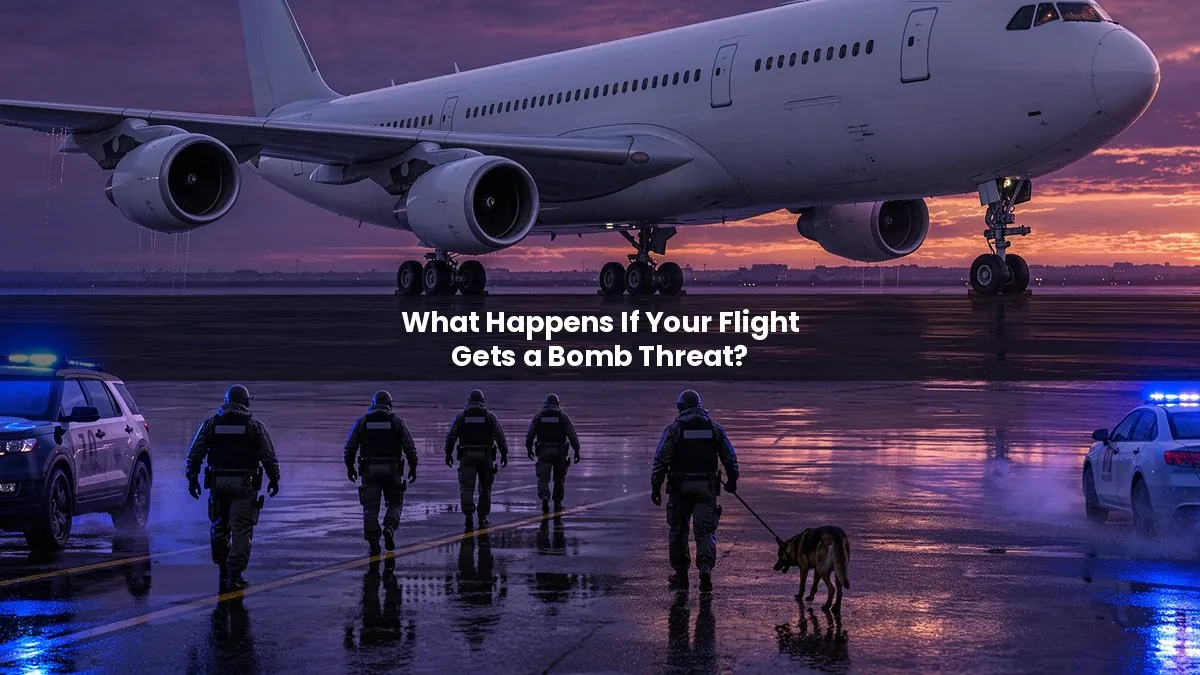
Short answer: If your flight gets a bomb threat, the crew follows a set security plan. The plane may divert or stay on the ground, park away from the terminal and be searched by police and sniffer dogs. Passengers are screened again, and delays can last hours. Most threats are hoaxes, and in Europe’s November wave no explosives were found.
Below, we separate confirmed facts from general guidance. Procedures vary by airline, airport and country.
Why are bomb threats on flights in the news?
In early November 2026, a series of fake threats hit airlines across Europe. According to the BBC, at least 21 aircraft and several airports were targeted in the second wave in a single week. Flights to Austria, Belgium, Bulgaria, the Czech Republic, France, Italy, Poland and Romania were affected.
The disruption was dramatic. An Aer Lingus flight from Dublin to Rome diverted to an air base in France. Italian fighter jets escorted a Finnair flight into Rome. In addition, AFP reported that about 20 commercial flights were hit on a third day of alerts, with fighter jets scrambled in Italy, France and Bulgaria.
Then, on November 13, the State Department issued a Europe-wide holiday security alert. U.S. embassies in London, Berlin and Dublin repeated it on November 16. The alert notes that “hoax bomb threats targeted civil aviation in numerous European countries, disrupting flights.”
What happens if your flight gets a bomb threat before takeoff?
If the threat arrives while you are still at the gate or taxiing, the plane usually does not leave. For example, Al Jazeera reported that a flight to Paris already taxiing at Warsaw Chopin Airport was stopped. Passengers got off, and security services searched the aircraft. They found nothing dangerous.
Typically, the steps look like this:
- The aircraft moves to a remote area, away from terminal buildings.
- Passengers leave the plane, often with only essential items.
- Everyone goes through security screening again.
- Police and bomb disposal teams search the cabin, cargo hold and bags, often with sniffer dogs.
- Once cleared, the flight may continue, switch to another aircraft or be canceled.
An airport official described the same basic routine to Al Jazeera.
What happens if your flight gets a bomb threat in the air?
This is where things look scarier, but the logic stays the same. Pilots and authorities judge whether the threat seems credible. Then they decide whether to land at the nearest suitable airport or keep flying.
During the European wave, several outcomes played out:
- Diversion: A Ryanair flight from London to Sofia landed in Plovdiv instead, and a Wizz Air flight from Milan to Warsaw went to Vienna.
- Fighter escort: Air forces guided some planes through their airspace. Hungary said it scrambled jets three times.
- Normal landing with checks: Some flights landed as planned and were met by police. EasyJet said its flights from Newcastle and Glasgow were met in Prague as a precaution.
Fighter escorts sound alarming. However, they are a standard precaution, not a sign that a bomb is on board. In every case reported above, all jets landed safely.
How common are bomb threats on flights, and are they real?
Real bombs on passenger jets are extremely rare. Threats, on the other hand, are fairly common, and the vast majority turn out to be hoaxes.
In November’s European wave, the BBC reported that no explosives were found during searches, and the UK called it a “malicious hoax.” According to AFP, some threats claimed to come from a group calling itself the “Male State.” Investigators had not confirmed whether all the incidents were linked.
Meanwhile, the AP reported that Europe’s air traffic authority said the threats caused minimal disruption to aviation overall. Still, for the passengers on affected flights, the delays were very real.
Do you get compensation if a bomb threat delays your flight?
Usually not cash compensation, but you still have rights.
In the EU: Under EU air passenger rules, delays and cancellations can earn compensation of €250, €400 or €600, depending on distance. However, compensation is not due when the problem comes from “extraordinary circumstances,” and the regulation lists security risks among its examples. Even so, the airline must still offer care while you wait. That includes meals, refreshments and, if you must stay overnight, a hotel and transport to it.
Practical tip: If the airline does not provide care, keep every receipt. The EU says airlines should reimburse expenses that were “necessary, reasonable and appropriate.”
In the U.S.: There is no federal cash compensation law for delays. Instead, check your airline’s own policy and your travel insurance.
Major disruptions can also come from other sources. See what happens if the FAA issues a nationwide ground stop.
What happens to the person who makes a fake bomb threat?
The penalties are serious. In the U.S., federal law (18 U.S.C. 1038) allows up to 5 years in prison for hoaxes like these. Hoaxers can also be sued for the cost of the emergency response.
Real cases show how this plays out. In 2008, a man who called in bomb threats because he was late for a flight in Seattle was ordered to pay $81,249 in restitution, according to the Justice Department. In another case, a Philadelphia man got 15 months in prison for a fake explosives report, according to the Department of Transportation’s inspector general.
In the UK, section 51 of the Criminal Law Act 1977 makes bomb hoaxes a crime punishable by up to seven years in prison.
What should you do if your flight gets a bomb threat?
Stay calm and follow instructions. The crew trains for this, and quick cooperation speeds things up.
- Listen to the crew: Leave bags behind if told to, and move where staff direct you.
- Do not joke about bombs: Even a careless comment can lead to arrest.
- Keep essentials on you: Passport, phone, medicine and a charger make long waits easier.
- Tell someone: The State Department advises travelers to share plans with family and enroll in the Smart Traveler Enrollment Program (STEP).
- Check rebooking options: Use the airline app, which is often faster than the help desk.
Airports involve plenty of other rare risks. For more, read what happens if two planes collide on a taxiway and what happens if GPS stops working.
A security scare is not the only reason a landing can feel unusual. See what happens if an airport control tower goes empty.
Frequently asked questions
Will a plane always land after a bomb threat?
Not always. Authorities first assess how credible the threat is. Some flights divert, while others land at their planned destination and are searched there.
How long are you delayed if your flight gets a bomb threat?
It varies. A flight from Cork in Ireland was delayed 90 minutes during the November wave, while diverted flights can take many hours to reach their final destination.
Is it safe to fly in Europe this holiday season?
Yes, for most travelers. The State Department has not told Americans to avoid Europe. It urges extra vigilance at crowded places and advises checking with your airline about disruptions.
Can a passenger be arrested for saying “bomb” on a plane?
Yes. Many countries treat false threats as crimes, even as jokes. In the U.S., a hoax can bring up to 5 years in prison.
Sources
- U.S. Embassy London: Security Alert, November 16, 2026
- BBC News: Hoax bomb threats target European airlines and airports for second time in a week
- Al Jazeera: Hoax or bomb threats? What we know about flight disruptions across Europe
- AFP: New hoax bomb threats hit European flights
- AP: What to know about the hoax bomb threats that targeted flights in Europe
- Your Europe: Air passenger rights
- U.S. Code: 18 U.S.C. 1038, False information and hoaxes
- U.S. Department of Justice: Sentencing for false bomb threats at Sea-Tac (2008)
- UK legislation: Criminal Law Act 1977, section 51 (bomb hoaxes)