What Happens to the SS United States After It Sinks?
The fastest ocean liner ever built went to the bottom of the Gulf on Veterans Day. On 11 November 2026, crews about 22 nautical miles southwest of Destin-Fort Walton Beach, Florida, opened its valves at 1 p.m. local time and sent the SS United States to the seafloor as the world’s largest artificial reef. Okaloosa County had moved the sinking up a day because of forecast heavy winds. Hundreds of boats gathered to watch, and PBS streamed it live. So what happens to the ship now?
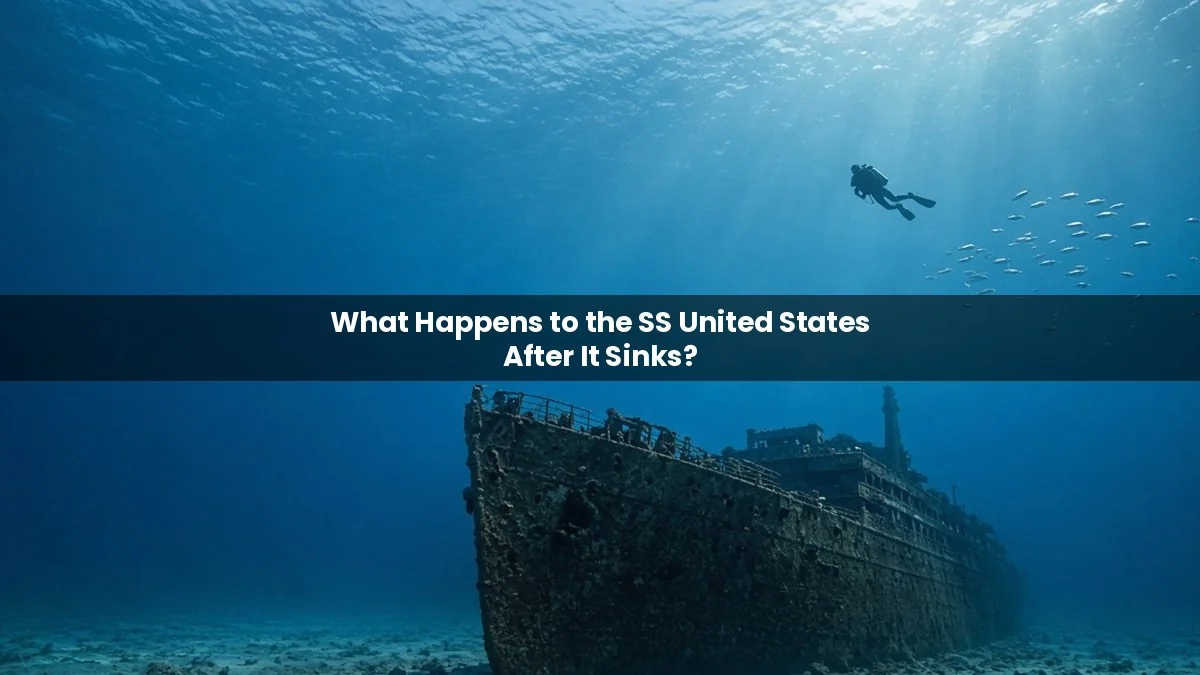
Short answer: the 990-foot liner becomes a habitat. Small fish move in within days, and snapper, grouper and amberjack are expected within a year. Over the following decades the steel will slowly crust over with life and corrode. The ship sits in about 180 feet of water, roughly 22 nautical miles southwest of Destin, with its highest parts about 55 feet below the surface, so divers of different skill levels can visit.
Here we separate established facts, expert expectations and open questions.
Why was the SS United States sunk?
Status: established.
- A record-breaker: on its 1952 maiden voyage, the liner crossed the Atlantic in about three and a half days. That speed record for an ocean liner still stands.
- A long retirement: it left service in 1969 as jet travel took over, then sat at Philadelphia’s Pier 82 for nearly 30 years while restoration plans failed.
- The last option: after a dispute with its pier landlord over rent and docking fees, the ship faced scrapping. Okaloosa County, Florida, bought it to sink it as a reef instead.
- The cost: the county allocated about $13 million for the whole project, including the purchase, towing, cleanup and funding for a land-based museum. The money comes from tourism bed taxes, not general funds.
How do you sink a 990-foot ship on purpose?
Status: established (Okaloosa County, PBS, Philadelphia Inquirer).
Federal environmental and explosives rules ruled out blowing it up. Instead, contractors in Mobile, Alabama, spent about a year preparing the hull:
- Cleaning: crews removed fuel, wiring, plastics and other non-metal materials under the EPA and US Maritime Administration’s best-practice rules for reef vessels.
- Cutting: workers sliced holes, some about 10 by 10 feet, in strategic spots so the ship would flood evenly and land upright. They also opened passages so marine life and divers can move through.
- Lightening: part of the aluminum superstructure was cut down to keep the wreck at a dive-friendly depth. The funnels and mast were saved for the museum.
- Flooding: on 11 November, crews opened valves on the ship’s original seawater intake pipes at 1 p.m. CT and let the sea pour in. The county planned the controlled flooding to take about 45 minutes.
What happens on the seafloor in the first year?
Status: expert expectations based on past reef ships.
A big steel hull is a hard surface in a mostly sandy seabed, and marine life seizes on it fast. Scientists told the Inquirer that small baitfish will likely show up in the first week. Algae, barnacles, sponges and soft corals start coating the steel within weeks to months.
Predators follow the food. Okaloosa County expects reef fish such as red snapper and grouper, and because the ship is so tall, open-water species like amberjack, mackerel and tuna. Groupers, snappers and amberjacks are expected to settle in within the year.
A recent global review of 82 artificial reefs, co-written by Northeastern University marine scientists, found that artificial reef units consistently increase fish numbers. One caveat: before the sinking, researcher Noah Haag noted that ideally a survey of local sea life would have been done beforehand, to give a clear before-and-after picture. Since then, the Woods Hole Oceanographic Institution has said its team will establish a baseline within the first month, documenting the ship’s condition, the surrounding water chemistry and the earliest marine life, and will return each year to track how the reef develops.
What happens to the ship over decades?
Status: general marine science; timelines are estimates.
- Corrosion: warm salt water slowly eats steel. Thin parts thin out and collapse first, while the heavy hull plates last far longer.
- Storms: hurricanes can shift big wrecks even at depth. Florida’s Spiegel Grove sank on its side in 2002, and Hurricane Dennis’s surge pushed it upright in 2005.
- A growing reef: as the structure breaks down, its nooks and crevices can actually shelter more small creatures, at least for a time.
How long the liner stays recognizable is an open question. It depends on storms, currents and how the steel was prepared, so treat any exact timeline you see online as a guess.
Is sinking a ship bad for the ocean?
Status: debated; official position vs. critics.
The county says the ship was cleaned to the national EPA/MARAD standard and holds an Army Corps of Engineers permit. Critics raised concerns about an old coating on the vessel. The county says that substance is not federally regulated for artificial reefing.
Marine scientists generally see well-cleaned reef ships as a net gain for fish habitat. Their usefulness varies, though, and purpose-built concrete structures with many holes often perform as well or better. As Haag put it, “sunken ships get the media’s attention.”
Can you dive the SS United States?
Status: official plans.
Yes. The upper deck sits around 55 feet down, within reach of trained recreational divers. The hull bottom at about 180 feet is technical-diving territory. The Inquirer reported that divers and anglers may be able to visit as early as the day after the sinking, weather permitting. The wreck joins more than 500 artificial reefs off Okaloosa County, including more than 20 large vessels. It takes the “world’s largest” title from the aircraft carrier USS Oriskany, sunk off Pensacola in 2006.
Prefer dry land? The SS United States Conservancy and the county plan a museum in the Destin-Fort Walton Beach area to display the funnels, mast and the ship’s history.
What would happen if the reef plan had failed?
Status: hypothetical.
The county says the alternative was the scrapyard. Had the ship landed on its side or broken apart, it would still form a reef, but with fewer safe dive routes. That is why crews cut holes so carefully to control how it filled.
The ocean shapes many of our scenarios. See what happens if La Palma triggers a megatsunami and what would happen if water disappeared from Earth. For another famous machine nearing its end, read what happens if NASA’s Swift telescope falls to Earth. More in the what would happen if scenarios hub.
Frequently asked questions
Where is the SS United States reef?
In the Gulf about 22 nautical miles southwest of Destin-Fort Walton Beach, Florida, in roughly 180 feet of water.
Is the SS United States bigger than the Titanic?
Yes. At about 990 feet, it is roughly 100 feet longer than the Titanic.
Why didn’t they turn it into a museum ship?
Restoration would have cost hundreds of millions of dollars, and decades of attempts failed to find the money or a permanent berth. Okaloosa County says the realistic choice was a reef or scrap.
How long until fish live on the wreck?
Small fish arrive within days. Larger reef fish such as grouper and snapper are expected within about a year.
Can anyone visit the wreck?
Certified divers can reach the upper decks at around 55 feet. Deeper sections need technical training. Non-divers can visit the planned museum on land.
Sources
- Okaloosa County: SS United States FAQs
- PBS News: SS United States sinks to become reef off Florida (11 Nov 2026)
- Philadelphia Inquirer: SS United States sinking live updates (11 Nov 2026)
- AP: The world’s fastest ocean liner is being sunk to make the largest artificial reef
- Pensacola News Journal: SS United States sinking timeline (11 Nov 2026)
- USA Today: SS United States enters its final chapter (updated 11 Nov 2026)
- Woods Hole Oceanographic Institution: SS United States sunk; scientists to study the new reef (11 Nov 2026)
- Northeastern Global News: How the SS United States will create the largest artificial reef (10 Nov 2026)