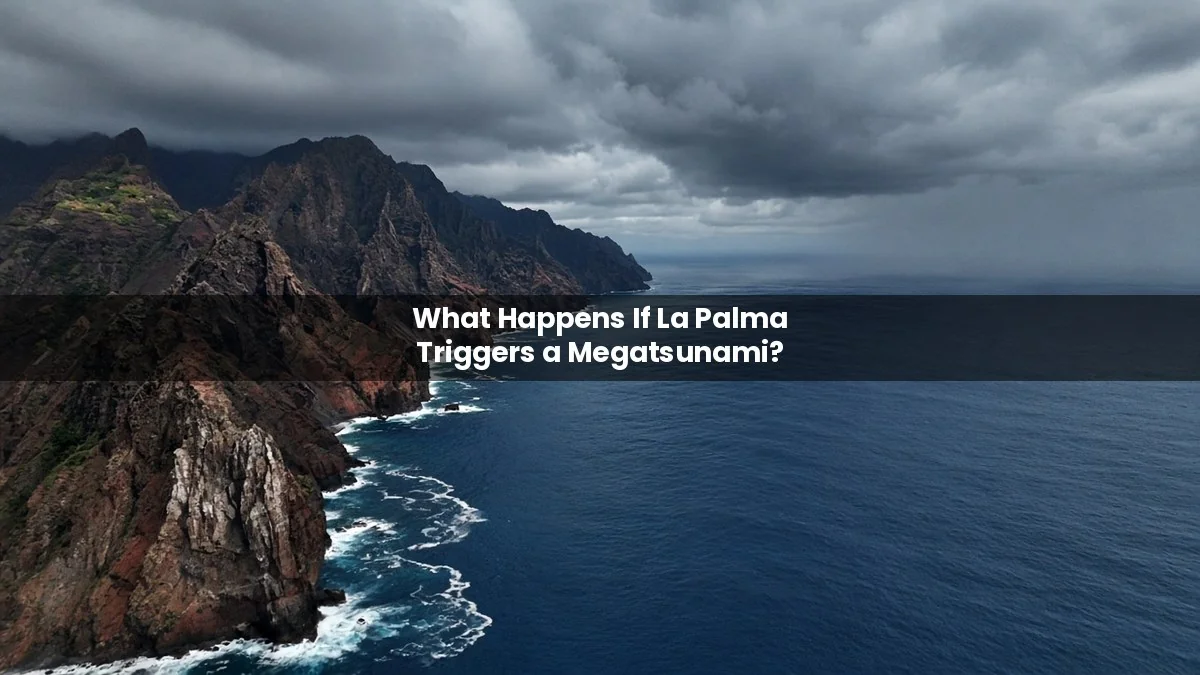
What Happens If La Palma Triggers a Megatsunami?
Short answer: if the western flank of Cumbre Vieja on La Palma slid into the Atlantic in one giant piece, models say a tsunami would race toward the Americas in about nine hours. How big the waves would be is fiercely debated. Older worst-case runs talked about tens of feet on the US East Coast. The US Geological Survey’s updated work points to roughly 3 to 7 feet (1 to 2 meters). Nothing in the science says a collapse is imminent.
Viral posts this week revived volcanologist Bill McGuire’s warning. We separate established geology, competing models and myths.
Key facts at a glance
- The volcano: Cumbre Vieja is an active volcanic ridge on La Palma in Spain’s Canary Islands. It erupted in 2021. Established.
- The hazard: a large flank landslide into the ocean can displace water and launch a tsunami. Smaller volcanic collapses have done this elsewhere. Established.
- McGuire’s view: he expects the unstable western flank to “eventually crash into the North Atlantic,” possibly centuries or millennia from now. Expert judgment, not a dated forecast.
- USGS view: a catastrophic single-block collapse is unlikely in the foreseeable future; updated simulations put American coasts near 3–7 feet even in a large event. Agency assessment.
- Travel time: about nine hours from the Canaries to Florida in the modeled scenarios. That is wave travel time, not an evacuation countdown starting today. Model result.
Where the 65-foot claim comes from
Status: model-based, contested.
Early 2000s simulations assumed a huge slice of the volcano fails as one fast-moving block. Those runs produced an enormous near-field water dome and, in extreme cases, waves on the order of 20 meters (about 65 feet) at parts of the US East Coast. McGuire has repeated the concern in BBC Science Focus and recent interviews covered by outlets such as MARCA, the Mirror and Daily Mail around 7 November 2026.
Other researchers and the Tsunami Society have called the megatsunami headlines overstated. Seafloor landslide deposits suggest volcanic flanks usually fail in stages, not as one slab. Newer models also spread wave energy more realistically across the Atlantic.
What the USGS says instead
Status: established agency position (2021 assessment, still cited in 2025–2026 explainers).
The USGS argues the single-block assumption is unrealistic. Its updated range for the eastern coasts of the Americas is about 1–2 meters. The agency also notes a lack of clear geologic deposits from giant transatlantic Canary tsunamis along those coasts. A 2025 review of US East Coast tsunami sources still includes hypothetical Cumbre Vieja cases among many low-probability scenarios.
What would happen if a large collapse did occur
Status: hypothetical based on models.
- Near La Palma: catastrophic local waves and coastal destruction within minutes.
- Across the Atlantic: a fast-moving tsunami, arriving in roughly nine hours at Florida under the classic model.
- On the US East Coast: flooding risk depends on which model you trust, local seafloor shape and tide stage. Even a few feet of surge can flood streets, damage harbors and force evacuations.
Real volcanic disasters look different. For a continental US eruption scenario, see what happens if Yellowstone erupts. For other sudden Earth shocks, see what would happen if an earthquake reached an impossible intensity and what happens if an asteroid hits Earth.
Myths this week got wrong
- “Americans have nine hours to evacuate starting now.” Myth. Nine hours is modeled ocean travel time after a collapse, not a clock that is already ticking.
- “65-foot waves are the scientific consensus.” Myth. That figure comes from contested worst-case runs. USGS work is far lower.
- “The volcano is about to collapse.” Unsupported. McGuire himself says it could be centuries or millennia away. Monitoring continues; there is no official imminent-collapse alert.
More Earth scenarios live in the what would happen if scenarios hub.
How scientists monitor the risk
Status: established practice.
La Palma sits in a dense monitoring network: seismometers, GPS stations, gas sensors and satellite radar. Those tools spotted unrest before the 2021 eruption. A sudden large flank failure would likely show accelerating deformation and earthquakes first. That is why agencies talk about “unlikely in the foreseeable future” even while they model tsunami travel times.
Public alerts for Atlantic tsunamis would come through national warning centers, not viral posts. Treat social media claims of an imminent collapse as unverified until civil authorities say otherwise.
Not every ship that meets the ocean floor is a disaster. See what happens to the SS United States after it sinks.
Tsunamis and earthquakes can bring buildings down. For what happens if you’re caught inside one, see what happens if you’re trapped in a building collapse.
Frequently asked questions
Is La Palma erupting right now?
The 2021 eruption has ended. The island remains volcanically active and monitored. A future eruption is expected someday; that is not the same as a flank collapse tsunami.
Could a megatsunami wipe out the East Coast?
Sensational headlines say yes. Agency modeling does not support continent-scale wipeout. Coastal flooding risk exists for many tsunami sources; the Canary megatsunami remains a debated low-probability case.
Have volcanic collapses made tsunamis before?
Yes. Anak Krakatau’s partial collapse in December 2018 killed more than 400 people in Indonesia. That was a regional disaster, not a transoceanic megatsunami.
Should East Coast residents prepare for this specifically?
Follow normal tsunami and hurricane readiness for your area. Do not treat viral La Palma posts as an imminent alert.