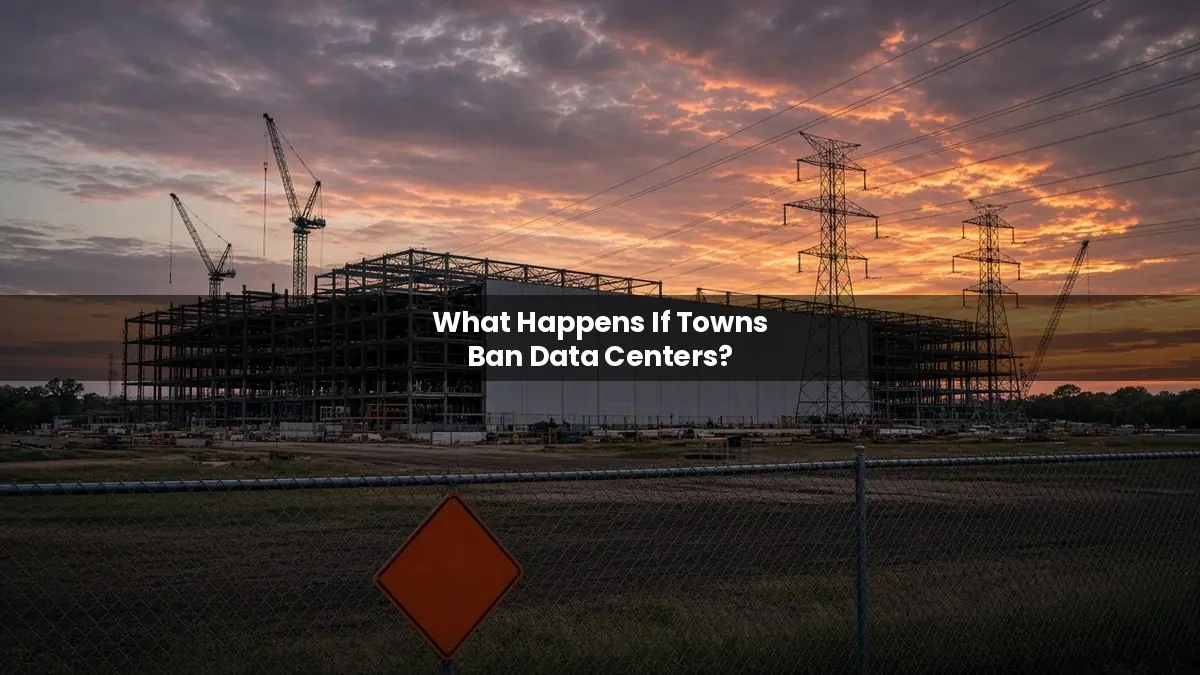
What Happens If Towns Ban Data Centers? The 2026 Vote Explained
Short answer: when towns ban or pause data centers, the AI boom doesn’t stop. It moves. Developers shift projects to friendlier places, timelines slip, and the fight moves to state rules on who pays for power and water. Locals keep control of land and avoid some costs, but they also give up tax revenue and construction jobs.
This became a live question on November 3, 2026. According to Ballotpedia, voters favored limits on data centers in 40 of 41 local ballot measures. We separate established facts, projections and hypotheticals below.
What voters actually decided
Status: established (Ballotpedia, CNBC, The Guardian, DCD).
- 41 local measures in 10 states were on the ballot. Ohio had 21 of them.
- Five full bans passed: one in California, one in Florida and three in Ohio. Twelve partial bans passed in Kansas, Maine and Ohio.
- Maine towns including Eliot, Wells, Peru, Sabattus and Wiscasset approved six-month or 180-day moratoriums.
- Grove City, Ohio now requires a public vote on projects over 50 acres, 20 megawatts or 500,000 gallons of water a day.
- The one exception: Harwood, North Dakota, rejected an extra review requirement.
- In Sunbury, Ohio, where Amazon proposed a $2 billion project, voters approved a ban on data centers above 25 MW.
The issue reached the top of the ticket too. CNBC reports that Democrat Sherrod Brown beat Sen. Jon Husted in Ohio after calling him “the face of data centers.” For the wider political picture, read what happens if Democrats win the midterms.
Why people are pushing back
Status: established concerns, with numbers from official sources.
- Electricity: a 2024 Lawrence Berkeley National Laboratory report found US data centers used about 4.4% of the nation’s electricity in 2023. It projected 6.7% to 12% by 2028. Residents worry that grid upgrades will show up on their own bills.
- Water: many large sites use water for cooling, often during the hottest weeks of the year.
- Noise, land and secrecy: people complain about constant fan hum, farmland turning into industrial zones, and nondisclosure agreements that hide who is building.
What happens next if bans spread
1. Projects move, not vanish
Status: projection. A ban covers one town. Developers can look for sites a county or a state away, especially where states have welcomed large loads. Expect more fights over siting at the edges of cities and in rural counties with spare grid capacity.
2. Slower AI buildout and higher costs
Status: projection. Every delay pushes back when new computing capacity comes online. Tech firms have committed hundreds of billions to AI infrastructure. If capacity arrives late, the cost of computing could stay high for longer. That pressure feeds the debate in what happens if the AI bubble bursts.
3. “Pay your own way” laws become the norm
Status: established trend. Many states now write rules that make big users cover their own grid costs. USLege counts 36 data center or large-load laws in 18 states in 2026 alone. Florida’s SB 484 stops utilities from passing data center costs to households. Tennessee’s HB 1847 bars subsidizing grid upgrades for sites of 50 MW or more.
4. Towns trade money for control
Status: established trade-off. Data centers pay large property taxes but employ relatively few people once they are built. A ban keeps local control and avoids some strain on power and water. It also gives up that tax base.
5. Grid strain shifts elsewhere
Status: projection. If fewer sites get built near cities, demand may concentrate where power is cheap. That can worsen local reliability risks during heat waves and storms. See what happens during a storm power cut.
What would NOT happen
- Your apps won’t go dark. Existing data centers keep running. Most measures cover new or expanded projects.
- AI won’t stop. Moratoriums are local and often temporary. Several Maine pauses end within six months unless towns extend them.
- A national ban isn’t law. Hypothetical: some politicians call for national pauses, but no federal ban has passed.
Existing sites can still fail for other reasons. A cloud-suite outage can take down email and workplace tools even when the buildings stay open. See what happens if Microsoft 365 goes down.
The bigger question: can AI grow without the buildings?
Status: hypothetical. More efficient chips and models reduce power per task. Demand keeps rising, though, so total use still climbs. If public resistance holds, the industry will likely put more money into on-site power, reuse of old industrial land, and community deals. OpenAI, for example, promised a Community Compact to cover full electricity costs. For the long-range view, read what happens if AI becomes smarter than humans.
The AI boom is also changing work, not just where computers are built. See what happens if AI takes your job.
Frequently asked questions
How many data center ballot measures passed in 2026?
Ballotpedia says voters favored limiting data center development in 40 of 41 local contests on November 3, 2026.
Can a town legally ban data centers?
Yes, through zoning, moratoriums or ballot measures, within state law. Some states, such as Florida, explicitly protect local authority to reject projects.
Do data centers raise electricity bills?
They can, if utilities spread grid upgrade costs across all customers. That is why many states now require large loads to pay their own share.
Will a moratorium stop a project that is already approved?
It depends on the wording. Some Maine measures were backdated to cover pending applications, while others apply only to new filings.
Sources
- Ballotpedia News: Voters favored limiting data center development in 40 of 41 measures (6 Nov 2026)
- CNBC: Voters rebuff data centers in every ballot measure except one
- The Guardian: Datacenters were on the ballot. US voters rejected them
- DCD: Local data center moratoria voted in across the US
- Florida Governor’s Office: SB 484
- USLege: Which states passed data center laws in 2026?
- Lawrence Berkeley National Laboratory: 2024 US Data Center Energy Usage Report