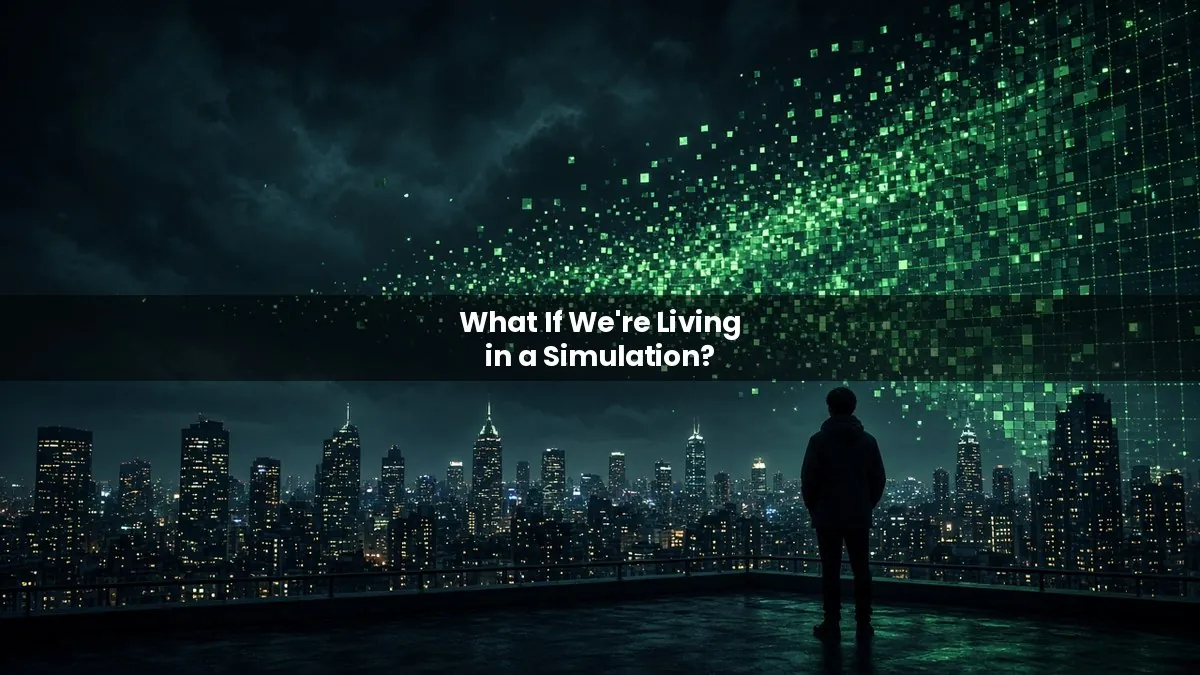
What If We’re Living in a Simulation? What Science Says
Short answer: if we were living in a computer simulation, everyday life might look exactly the same. Nobody has found evidence that we are, and nobody has proven that we aren’t. The idea started as a philosophical argument by Oxford philosopher Nick Bostrom in 2003. Physicists are still arguing about whether it can even be tested.
Here is what the simulation hypothesis actually says, what scientists have tried, and what would change if it were true. We separate facts, scientific arguments (claims still under debate) and hypotheticals.
What is the simulation hypothesis?
Fact: in his 2003 paper “Are You Living in a Computer Simulation?” in The Philosophical Quarterly, Nick Bostrom argued that at least one of three statements is probably true:
- Almost all civilizations like ours go extinct before they can build powerful computers.
- Advanced civilizations have little interest in running detailed simulations of their ancestors.
- We are almost certainly living in a simulation.
The logic: if advanced civilizations could and would run many simulations, simulated minds would vastly outnumber real ones, so a random mind like yours would most likely be simulated. Bostrom did not claim the third option is true. He argued only that we can’t confidently rule out all three.
Can science test it?
- Scientific argument (2012): physicists Silas Beane, Zohreh Davoudi and Martin Savage suggested that a simulation built on a grid might leave fingerprints in the highest-energy cosmic rays. No such signal has been confirmed.
- Scientific argument (2023): physicist Melvin Vopson proposed a “second law of infodynamics”, suggesting the universe tends to compress information the way a computer would. This idea is new and has not been widely accepted.
- Scientific argument (2025): Mir Faizal (UBC Okanagan), Lawrence Krauss and colleagues argued in the Journal of Holography Applications in Physics that Gödel’s incompleteness theorems mean reality can’t be fully described by any algorithm, so the universe cannot be a simulation. Critics reply that limits on what can be proven are not limits on what can be computed, so the debate continues.
Bottom line: no experiment so far has found evidence either way, and some scientists argue the question may never be testable.
What would happen if we found out we’re simulated?
Hypothetical scenarios, not predictions:
1. Daily life would probably not change
Gravity, chemistry and biology would work exactly as before. Your bills, relationships and pain would feel just as real. A simulated world is still the world you experience.
2. Physics would gain a new question
Scientists would start hunting for the “rules of the code”: limits on resolution, processing speed or memory. Some physicists already note that the speed of light and quantum limits look a bit like computational limits, though that is an analogy, not evidence.
3. Big questions for religion and ethics
Would the simulators be gods, scientists or bored teenagers? Do we have moral value if we’re code? Philosophers like David Chalmers argue that simulated beings and their experiences would still be real in every way that matters.
4. The risk of a shutdown
Bostrom has noted that if we are simulated, the simulation could in principle be switched off. There’s no way to estimate that risk, and no reason to think it is linked to anything we do.
5. Some people could struggle mentally
Doctors already describe people who feel the world is “unreal” (derealization), and that can be distressing. A public “proof” could make such feelings worse for some people. If the world often feels fake to you, speaking with a doctor can help.
Are humans artificial intelligence?
No, not in any scientific sense. Humans are biological organisms shaped by evolution, and our brains run on neurons, not code. The simulation hypothesis is a thought experiment about where our universe might run, not evidence that people are AI. To see how real AI compares with human minds, read what happens if AI becomes smarter than humans.
More mind-bending questions: what happens when you dream about someone, what happens if you fall into a black hole, and every what-if scenario.
Frequently asked questions
Is there proof we live in a simulation?
No. There is no experimental evidence that we live in a simulation, and no accepted proof that we don’t.
Who came up with the simulation theory?
The modern version comes from philosopher Nick Bostrom’s 2003 paper. Similar ideas appear much earlier, from Plato’s cave to Descartes’ “evil demon”.
Did scientists prove the universe is not a simulation?
A 2025 paper by Mir Faizal and colleagues claims to, using Gödel’s theorems. Other researchers dispute the reasoning, so it isn’t settled.
What would change if we were in a simulation?
Probably nothing in daily life. The biggest changes would be in physics, philosophy and religion, as people tried to understand who runs it and why.
Sources
- Nick Bostrom, “Are You Living in a Computer Simulation?” (2003)
- Beane, Davoudi & Savage, “Constraints on the Universe as a Numerical Simulation” (2012)
- UBC Okanagan News on Faizal et al. (2025)
- Faizal et al., “Consequences of Undecidability in Physics on the Theory of Everything”
- “Provability vs. Execution”, a critical comment