What Happens If the AI Bubble Bursts? Stocks, Jobs and Savings
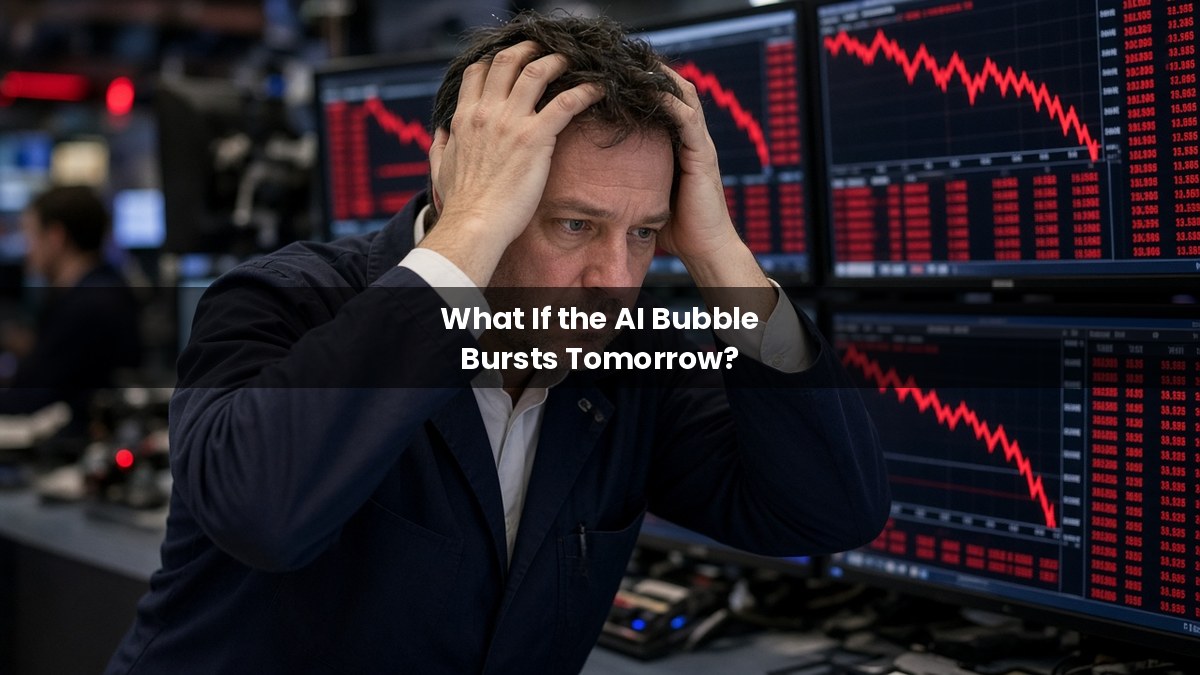
Wall Street is asking a big question again: is artificial intelligence a bubble? Tech stocks slid sharply last week, and a top economist now says AI has delivered almost no profit outside the tech industry. So what happens if the AI bubble bursts? Would it hit only a few giant companies, or could it reach your job, your pension, and the wider economy? Here is a calm, sourced look at the risks.
Important: nobody knows if AI is truly a bubble. Many experts believe the technology will pay off. This article explains what could happen if it does not, not what will happen.
Why People Fear the AI Bubble Bursts Soon
The latest worries began on Thursday, October 22, 2026. According to Al Jazeera, the tech-heavy Nasdaq fell 2.6% that day. It was the index’s steepest drop since June.
The trigger was spending. Meta raised its expected capital spending for this year to $135 billion to $145 billion, and its shares dropped nearly 7%. Amazon fell 4.6%, while Nvidia lost 4.4%.
Then, on October 25, TechCrunch reported on a note from Torsten Slok, chief economist at Apollo Global Management. Slok looked at the S&P 500 minus its seven biggest tech firms. He found that profit margins and revenue per worker there appear flat. “The technology has delivered zero financial payoff to corporate America outside of tech,” he wrote.
Still, not everyone agrees. One analyst told Al Jazeera the selloff was driven “much more by investor sentiment than any tangible reason.”
How Big Is the AI Boom?
The numbers are huge. Al Jazeera cited research firm Gartner, which forecasts global AI investment of $2.7 trillion in 2026 and $3.6 trillion in 2027.
Meanwhile, the International Monetary Fund (IMF) says spending by the largest cloud companies, often called hyperscalers, is projected to grow by about 20% to around $1 trillion in 2027. The IMF counts Alphabet, Amazon, Meta, Microsoft, and Oracle in this group.
In other words, a large part of today’s stock market and economic growth depends on AI spending continuing.
What Happens to the Stock Market If the AI Bubble Bursts?
If the AI bubble bursts, the first and most visible effect would be on share prices. That matters because a few companies now dominate the market. According to Al Jazeera, the “Magnificent 7” tech giants make up more than one-third of the overall US market.
As a result, a sharp fall in these stocks would drag down broad index funds. Many workers in the US, UK, Canada, and Australia hold such funds through retirement plans and pensions. So even people who never bought a single AI stock could see their savings shrink.
The IMF adds another warning. Household exposure to stock markets is at historical highs, it says. Therefore, a significant correction could “materially reduce household wealth,” which could weigh on spending and the wider economy.
Why Debt Could Make a Crash Worse
This is where the story gets more serious, because debt changes what happens if the AI bubble bursts. In the past, big tech firms paid for growth mostly with their own cash. Now, the IMF says, they rely more and more on borrowing.
Here are some key figures from the IMF’s October 2026 analysis:
- Hyperscalers made up almost 10% of global investment-grade corporate bond issuance so far in 2026, compared with 0.5% in 2024.
- Their interest costs in the second quarter of 2026 were more than twice as high as a year earlier, at nearly $6 billion.
- Assets in global leveraged equity funds have grown by around 56% since the end of 2025.
Why does this matter? Borrowed money magnifies losses. If AI profits disappoint, investors who used leverage may be forced to sell. In turn, those sales could push prices down further. The IMF says this “deleveraging” could amplify a market correction and tighten financial conditions for everyone.
There is already a real-world preview. In South Korea, the IMF notes, the KOSPI’s market-wide circuit breaker was triggered nine times in 2026 through July, amid swings in chip stocks and leveraged products.
What It Could Mean for Jobs and Everyday Life
If the AI bubble bursts, the damage would not stay on Wall Street. First, companies might cut back on new data centers and chip orders. That could hurt construction, energy, and manufacturing jobs tied to the AI build-out.
Next, tech firms might trim staff to protect profits. Startups that depend on cheap funding could struggle to raise money, and some could close.
On the other hand, some effects could be mixed. For instance, lower demand might ease pressure on electricity grids that are straining under data-center growth. However, these outcomes are possibilities, not predictions. The real impact would depend on how fast and how deep any fall turned out to be.
Global events add to the uncertainty. Al Jazeera noted that high oil prices linked to conflict in the Middle East also weighed on markets. For more on that risk, read our explainer on what happens if the Strait of Hormuz closes.
Would AI Itself Disappear If the AI Bubble Bursts?
Almost certainly not, even if the AI bubble bursts. History offers a useful lesson here. When the dot-com bubble burst in 2000, the Nasdaq lost most of its value over the next two years, and many internet firms vanished. Yet the internet did not go away. Instead, the strongest companies survived and grew.
Something similar could happen with AI. A crash would likely change who wins and how fast money flows. But chatbots, AI coding tools, and other products would still exist. Prices for AI services might even fall as competition increases.
If you are curious about the long-term future of the technology, see our piece on what happens if AI becomes smarter than humans.
What Could Stop the AI Bubble From Bursting?
There is another possible ending. AI could start to deliver clear gains in productivity and profit across the economy. If that happens, today’s spending might look sensible in hindsight.
Slok is skeptical. He argued that “in business, intelligence is mostly judgment,” and that AI does not understand things like trust and accountability. Even so, supporters argue that the technology is still young. Many big changes take years to show up in company accounts.
The IMF, for its part, does not predict a crash. Instead, it urges regulators to watch leverage closely and prepare tools to contain risks if they grow.
The Bottom Line
So, what happens if the AI bubble bursts? Most likely, stock prices would fall sharply, retirement savings would take a hit, and borrowing costs could rise. In addition, jobs linked to the AI build-out could be at risk. However, the technology itself would almost certainly survive.
For now, the best approach for most people is simple. Avoid panic, check how much of your savings depends on a handful of tech stocks, and remember that diversification exists for exactly these moments. This is not financial advice, so speak to a qualified adviser before making big changes.