What Happens If Social Security Benefits Get Cut in 2032?
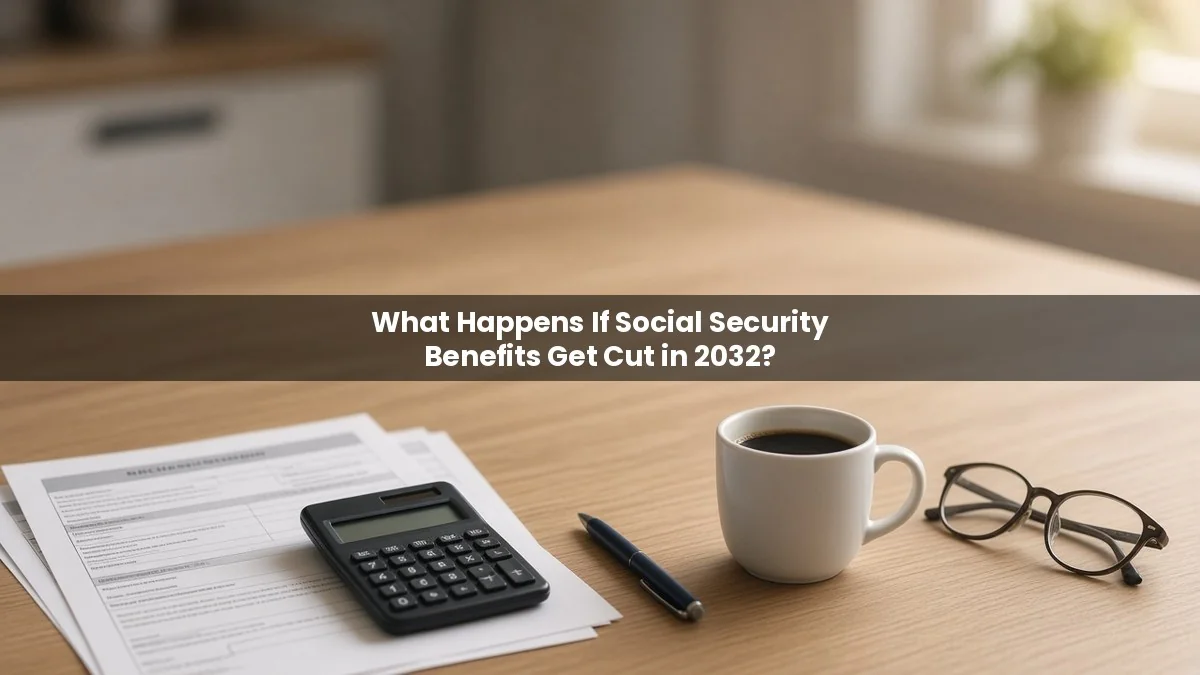
Short answer: the Social Security retirement trust fund is projected to run out of reserves in late 2032. Benefits would not stop. By law they would fall automatically to whatever payroll taxes still cover, about 78% of scheduled payments, or a 22% cut. Congress can change that timeline or prevent the cut at any time.
The question spiked in US search this week after coverage of the 2026 Trustees Report. We label each point as an established fact, a projection or a hypothetical.
Key facts at a glance
- OASI Trust Fund: pays retirement and survivor benefits. Trustees project depletion in the fourth quarter of 2032. Established (2026 Trustees Report).
- Automatic cut: continuing income would then cover about 78% of scheduled benefits, a 22% across-the-board cut unless Congress acts. Established projection.
- Combined OASDI: with Disability Insurance added, reserves last until about 2034. Established projection.
- CBO view: the Congressional Budget Office has a more pessimistic path, with mid-2032 depletion and cuts near 26%. Projection (CBO, via CNBC coverage).
- Who depends on it: in December 2025, Social Security paid benefits to about 70 million people. Established.
What “trust fund exhaustion” really means
Status: established.
Social Security is mostly a pay-as-you-go system. Workers’ payroll taxes fund today’s benefits. Extra money sits in special US Treasury securities. When costs exceed income, those reserves fill the gap. In 2025, total OASDI income was $1,449 billion and cost was $1,609 billion, so reserves covered a $160 billion shortfall.
Exhaustion does not mean the program vanishes. It means the cushion is gone and benefits can only equal ongoing tax income. That is the automatic 22% cut.
What a 22% cut would feel like
Status: projection based on Trustees math; dollar effects vary by person.
Someone due $2,000 a month would see about $1,560. The Center for a Responsible Federal Budget notes that today’s 61-year-olds would hit full retirement age around that window, and today’s youngest retirees would be about 68. Cuts would deepen over decades if lawmakers never fixed the gap, reaching roughly 38% by the end of the century under current projections.
For households already stretched by food and other costs, see what happens after losing SNAP benefits.
Why the date moved earlier
Status: established (Trustees explanation).
The 2026 report moved OASI depletion one quarter earlier than the prior year. Trustees cite a lower long-run fertility rate (1.75 children per woman), immigration changes and the One Big Beautiful Bill Act of 2025, which permanently keeps lower income-tax rates and reduces revenue from taxing Social Security benefits. Stronger near-term productivity partly offsets those hits.
Politics will shape any fix. Midterm shifts change who can pass payroll-tax, benefit or retirement-age rules. For the current map, see what happens if Democrats win the midterms.
What Congress could do
Status: established policy options; none are automatic.
- Raise or remove the payroll-tax wage cap.
- Increase the payroll-tax rate.
- Raise the full retirement age for younger workers.
- Change benefit formulas, including means-testing higher earners.
- Add other revenue.
The Trustees urge lawmakers to act early so changes phase in gradually. A last-minute deal would force steeper, faster changes.
Myths to ignore
- “Social Security will disappear.” Myth. Payroll taxes would still fund most benefits.
- “Your personal account is empty.” Myth. There are no individual investment accounts in traditional Social Security.
- “The cut is locked in today.” Myth. Congress can change the law any year before 2032.
Money stress also hits markets and jobs. For that angle, read what happens if the AI bubble bursts. More explainers sit in our what would happen if scenarios hub.
Who feels a cut first
Status: projection.
Retirees who rely on Social Security for most of their income would feel a 22% cut immediately in monthly cash flow. People with pensions, 401(k) balances or part-time work would soften the blow. States with older populations would see sharper hits to local spending. Disability Insurance sits in a separate trust fund projected to remain solvent through 2100, so DI beneficiaries are not on the same 2032 clock.
Claiming earlier permanently lowers your monthly check. Claiming later raises it. Those trade-offs matter more if Congress waits until the last minute.
Frequently asked questions
Will Social Security stop paying in 2032?
No. Under current law it would keep paying at a reduced level funded by ongoing taxes.
Is the 22% cut certain?
Only if Congress does nothing. Every recent Congress has had reform bills; none has yet closed the long-term gap.
Does Disability Insurance run out at the same time?
No. DI is projected to stay solvent through 2100. The combined OASDI date is later than OASI alone.
Should I claim benefits early because of this?
That depends on your health, savings and earnings. Claiming early permanently lowers your monthly benefit. This article is not personal financial advice.