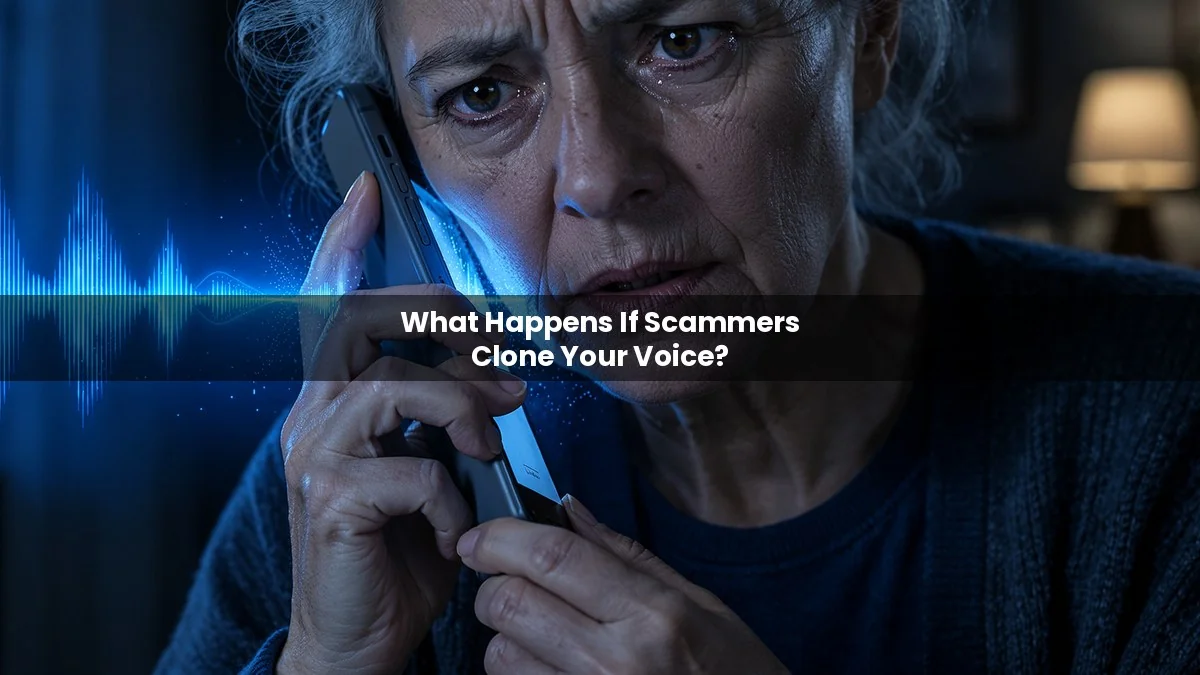
What Happens If Scammers Clone Your Voice?
This week, families across social media shared a simple defense against a fast-growing fraud: a secret family code word. The trend reflects a real fear. Cheap AI tools can now copy a voice from a short clip. So what happens if scammers clone your voice, and how do you protect the people who trust it?
Short answer: If scammers clone your voice, they can call your relatives or bank pretending to be you, often with a fake emergency. The FBI says distress scams using cloned voices cost victims over $5 million in 2025. Your voice alone cannot empty your accounts, but a convincing call can push loved ones to send money fast.
Below, we explain how the scam works, what the official numbers show and the steps that stop it.
How do scammers clone your voice?
Voice cloning uses AI to learn the sound, pitch and rhythm of a person’s speech. Then it can make that “voice” say anything a scammer types.
The raw material is often easy to find. Scammers can pull audio from public videos, voicemail greetings or social media clips. The FTC warned in 2023 that a short clip of a family member’s voice can be enough.
How short? In a 2023 test, the security firm McAfee found a free tool could produce about an 85% voice match from just three seconds of audio. That figure comes from a vendor study, not a government lab. Still, it shows how low the barrier has become.
What happens if scammers clone your voice and call your family?
The most common attack is the “distress” or “grandparent” scam. A relative gets a panicked call that sounds exactly like you. Typically, the story follows a script:
- You were in a car crash, got arrested or are stuck abroad.
- You need money right now for bail, a hospital or a lawyer.
- Please don’t tell anyone else in the family.
- Pay by wire transfer, gift cards, crypto or a payment app.
Often a second voice takes over, posing as a police officer or attorney. Meanwhile, the urgency leaves no time to think. As a result, victims send money before they check the story.
According to the FBI’s 2025 Internet Crime Complaint Center (IC3) report, victims claimed losses of over $5 million to distress scams in 2025. The FBI specifically names voice cloning as a tool in these schemes. The report also warns that the scam is spreading to mimic other relatives and close friends.
Can a cloned voice break into your bank account?
It can try. The FBI has warned that criminals use AI-generated audio clips to impersonate people and gain access to bank accounts. For that reason, banks that rely only on voice recognition face real risk.
Businesses are targets too. The same IC3 report says companies lost over $30 million in 2025 to business email compromise (BEC) scams involving AI. In some cases, a cloned voice of a boss asks staff to wire money.
However, a cloned voice usually is not enough on its own. Most bank logins also need a password, a one-time code or a device check. Therefore, the bigger danger is social: tricking a real person into moving money for the scammer.
How often do scammers clone your voice in the US and UK?
Official data does not track voice cloning alone. Even so, the wider numbers are large and rising.
- AI-related complaints: The FBI’s IC3 received 22,364 complaints that mentioned AI in 2025, with adjusted losses of about $893 million.
- Imposter scams: The FTC received over 1 million imposter scam reports in 2025, with reported losses of more than $3.5 billion.
- All fraud: Americans reported $15.9 billion in fraud losses to the FTC in 2025, up from about $12 billion in 2024.
- UK exposure: In a 2024 survey for Starling Bank, 28% of UK adults said they had been targeted by an AI voice cloning scam in the past year.
Keep in mind that the FTC and FBI totals cover many scam types, not only cloned voices. Also, survey figures from companies are self-reported. Many victims never report losses at all, so the true cost is likely higher.
What should you do if scammers clone your voice?
First, don’t panic. Next, act quickly to protect your family and accounts. Follow these steps:
- Warn your circle. Tell close family and friends that a fake “you” may call. Ask them to verify any money request.
- Call your bank. Ask whether your account uses voice ID. If so, request a different security method.
- Lock down audio. Make social profiles private and remove public clips of your voice where you can.
- Report it. In the US, file at ReportFraud.ftc.gov and ic3.gov. In the UK, use Report Fraud, which replaced Action Fraud in December 2025.
- Watch your accounts. Turn on alerts and two-factor authentication for banking and email.
If money already left an account, contact the bank or payment app right away. Fast action gives the best chance of a recall. Our guide on what happens if your gift card gets drained covers the recovery steps for gift card fraud in more detail.
How can families stop a voice cloning scam?
The best defense is surprisingly low-tech. Both the FBI and Starling Bank recommend a secret family word or phrase. If a caller can’t say it, hang up.
In addition, use these habits for any urgent call:
- Hang up and call back on a number you already know.
- Slow down. Real emergencies can survive a two-minute check.
- Question the payment. Gift cards, crypto and wire transfers are classic red flags.
- Ignore secrecy. A request to keep it quiet is a warning sign, so call another relative.
Scams often start with a link or a hacked account. To spot those first, read what happens if you visit a hacked website. Crypto payments are hard to reverse, as our explainer on what happens if a crypto exchange gets hacked shows. For the bigger picture, see what happens if AI becomes smarter than humans.
What could happen next?
This part is projection, not fact. Voice tools keep getting cheaper and more realistic. The FBI already warns that AI fakes are becoming harder to detect. As a result, many experts expect banks to move away from voice-only checks.
Regulators are also acting. In 2024, the US Federal Communications Commission ruled that AI-generated voices in robocalls fall under existing robocall restrictions. Even so, no rule can fully block a criminal call. That is why personal checks, like a family code word, still matter most.
Frequently asked questions
How much audio do scammers need to clone your voice?
Not much. McAfee’s 2023 test produced about an 85% voice match from three seconds of audio using a free tool.
Is it illegal to clone someone’s voice?
Cloning a voice to commit fraud is a crime. In the US, the FCC also ruled in 2024 that AI-voiced robocalls are covered by robocall rules.
Can I tell a cloned voice from a real one?
Sometimes. Listen for odd pauses, flat emotion or strange word choices. However, the FBI says fakes are getting harder to spot, so always verify by calling back.
What happens if scammers clone your voice and nobody falls for it?
Usually, nothing more happens. Still, warn family, report the attempt and review any account that uses voice ID.
What is a family safe word?
It is a private word or phrase only your family knows. Ask for it during any urgent money request.
Sources
- FBI: 2025 Internet Crime Complaint Center (IC3) Annual Report
- FBI IC3: Criminals Use Generative Artificial Intelligence to Facilitate Financial Fraud
- NPR: Scammers are using AI-generated voice clones, the FTC warns
- FTC testimony: Joint Economic Committee hearing on the rising scam economy (2025 fraud data)
- McAfee: Artificial Intelligence Voice Scams on the Rise
- Starling Bank: Safe Phrases campaign and voice cloning survey
- FCC: AI-generated voices in robocalls ruling