What Happens If a Crypto Exchange Gets Hacked? The $6B Binance Heist Explained
Imagine logging in to check your crypto and finding a red banner: withdrawals suspended. That is exactly what millions of Binance users saw this week. On October 29, 2026, hackers drained more than $6 billion from the world’s largest crypto exchange in a matter of hours. So what happens if a crypto exchange gets hacked? Is your money gone, who pays, and how do you protect yourself next time?
This guide explains the Binance hack in plain English, then walks through what usually happens to customers after any major exchange breach.
This is a developing story. Updated November 1, 2026, with Binance’s latest official figures.
Short answer: withdrawals usually freeze first, and then everything depends on whether the exchange can cover the loss, because crypto on exchanges usually lacks government deposit insurance. Binance says it will cover the roughly $6.3 billion to $6.4 billion stolen on October 29, 2026, from its own funds. The less crypto you keep on any exchange, the less a hacker can take.
Latest Update (Nov 1, 2026)
Binance says it has now replenished about 90% of the affected assets, up from roughly 80% in its previous update, CoinDesk and CNBC report. Here is what changed:
- Top coins fully backed: Binance says user holdings of BTC, ETH, USDT, BNB, SOL, USDC, XRP, USD1, RLUSD and ZEC are 100% backed.
- Where the money came from: Binance’s corporate treasury, part of its Futures Insurance Fund and a partial deployment of its SAFU fund. Binance says it will refill SAFU to about $1 billion.
- The last 10%: These are less liquid tokens. Binance is still buying them through markets and OTC deals.
- Proof of reserves: Binance took a new snapshot at 00:00 UTC on October 31. It expects the full zk-SNARK proof, which lets you check your own balance, by November 3.
- Withdrawals: As of its October 31 update, Binance said it remained on track to reopen withdrawals on Sunday, November 1, subject to security checks. It has not given an exact time, so check its official announcements.
- Attribution: The FBI said late on October 31 that North Korea was responsible, according to CNBC.
Binance’s message is the same: “Binance will absorb the financial impact of these stolen funds, not our users.”
Safety note: Phishing emails spike after every big hack. Binance never asks for your password, one-time code (OTP) or seed phrase. Ignore any email or message that does, and only trust updates on Binance’s official site and app.
Key Takeaways
- Hackers stole about $6.3 to $6.4 billion from Binance on October 29, 2026.
- Binance says it will cover all losses from its own funds.
- Binance says it has replenished about 90% of affected assets, and its top 10 coins are fully backed.
- The FBI says North Korea was behind the theft.
- Crypto on exchanges usually lacks government deposit insurance.
- Keeping long-term holdings in your own wallet limits your risk.
What Happened in the Binance Hack?
Around 4:20 p.m. Eastern Time on October 29, funds began leaving Binance “hot wallets” across multiple blockchains. According to blockchain analytics firm Chainalysis, the unauthorized transfers totaled about $6.4 billion, the largest theft in crypto history.
Rival firm Elliptic puts the figure at $6.43 billion. That is more than four times the $1.46 billion stolen from Bybit in 2025. Elliptic also says the attacker drained wallets on 11 blockchains in roughly three hours, including Ethereum, Bitcoin, Solana and XRP Ledger.
Here are the key facts so far:
- How it started: Binance’s official update says the breach may have begun with a compromised DevOps engineer’s laptop. The company says it found no evidence that wallet private keys leaked.
- A wider attack: Co-CEO Richard Teng later said investigators found additional breach points, as CoinDesk reported.
- Who is suspected: Chainalysis and Elliptic both link the theft to TraderTraitor, a North Korean hacking group. The FBI has since said North Korea was responsible, CNBC reports.
- What was frozen: Binance says about $3 billion of stolen assets were frozen on-chain, mostly stablecoins such as USDT and USDC.
What Happens to Your Money If a Crypto Exchange Gets Hacked?
The answer depends on two things: where your coins were stored, and whether the exchange can afford to cover the loss.
1. Withdrawals freeze first
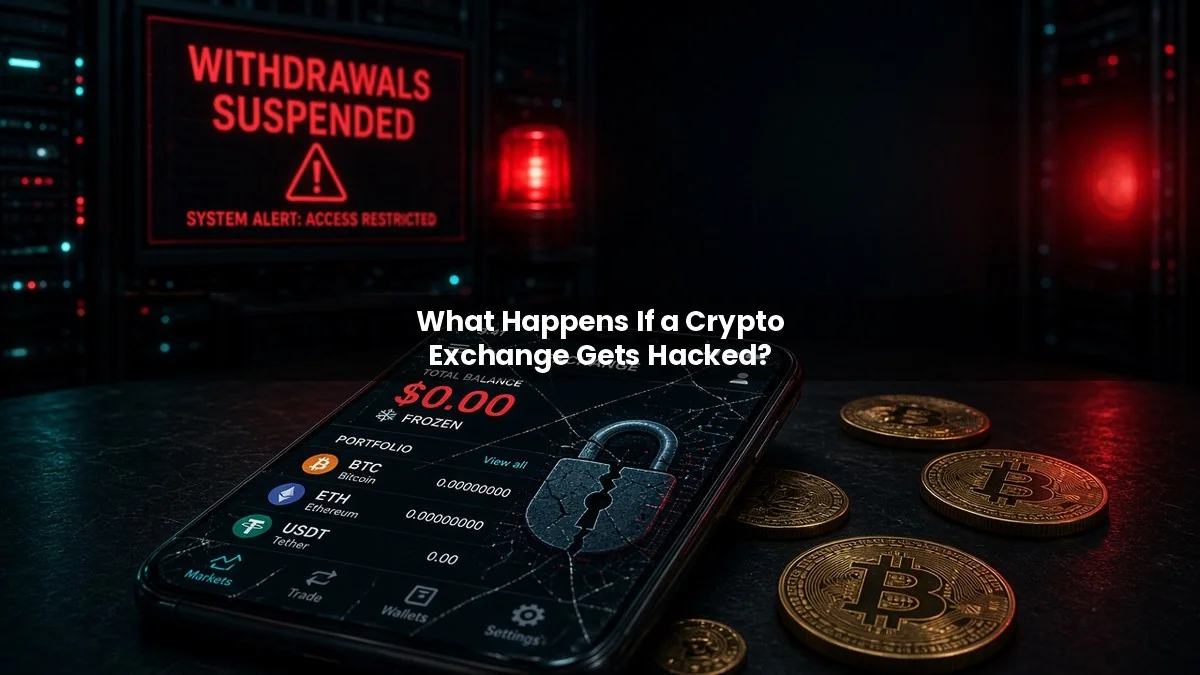
Almost every exchange halts withdrawals immediately. This stops the attacker from draining more funds. As a result, customers cannot move their coins out, even if their own accounts were untouched. Binance suspended withdrawals but kept deposits running, and it targeted a restart for Sunday, November 1.
2. The exchange decides who pays
Unlike a bank account, crypto held on an exchange usually has no government deposit insurance. In the US, the FDIC insures bank deposits, not crypto. Similarly, the UK’s Financial Conduct Authority warns that you are unlikely to get protection from its compensation scheme if something goes wrong with crypto.
So the outcome rests on the exchange itself. In this case, Binance says it will cover all losses from its SAFU emergency fund and company funds. According to CoinDesk, it has reserved more than $6.34 billion to do so.
3. If the exchange cannot pay, customers can lose out
History shows a darker path, too. When Japan’s Mt. Gox collapsed in 2014 after losing hundreds of thousands of bitcoin, customers waited about a decade for partial repayments. Likewise, when FTX failed in 2022, its users became creditors in a bankruptcy case. In short, a hack only stays “painless” when the platform has deep reserves.
Why Hackers Target Hot Wallets
Exchanges split their crypto between two types of storage:
- Hot wallets stay connected to the internet so that customers can withdraw quickly.
- Cold wallets stay offline, which makes them far harder to steal from.
Because hot wallets must sign transactions automatically, they make a tempting target. In this attack, Chainalysis says the hacker abused an Ethereum feature that lets one wallet run another’s code. That move let the attacker sweep funds without the usual approval steps.
Can Stolen Crypto Be Recovered?
Sometimes, at least partly. Every blockchain transaction is public, so investigators can follow the money. Moreover, stablecoin issuers such as Tether and Circle can freeze tokens on their networks.
That is why hackers rush to swap freezable coins into assets like ether, which no company can block. Chainalysis reports that the attacker swapped $325 million in stablecoins into about $285 million of ETH in roughly 20 minutes. Even so, freezes began within an hour.
Recovering the rest is much harder. North Korea-linked groups typically launder funds through mixers, cross-chain bridges and thousands of wallets over months.
What Happens to Crypto Prices After a Big Hack?
Large hacks often shake prices in the short term. Traders worry that the attacker will dump stolen coins, or that customers will pull money from other platforms. Therefore, expect volatility, wider price gaps between exchanges and heavy withdrawals elsewhere. Over the longer term, the market’s reaction usually depends on whether the exchange stays solvent.
How to Protect Your Crypto From an Exchange Hack
You cannot stop a hacker from breaching an exchange. However, you can limit your exposure:
- Keep only trading money on exchanges. Move long-term holdings to a wallet you control.
- Use a hardware wallet. A device that stores your keys offline keeps your coins out of an exchange’s hot wallet.
- Back up your seed phrase safely. Write it down offline and never share it.
- Turn on strong security. Use an authenticator app or a security key instead of SMS codes, and enable withdrawal allow-lists.
- Check proof of reserves. Many exchanges publish audits that show they hold customer assets one-for-one.
- Beware of scams. After every big hack, fraudsters pose as support staff and promise “refunds.” Only trust official channels.
A Timeline of the Binance Hack
- October 29, about 4:20 p.m. ET: Funds start leaving Binance hot wallets, Chainalysis reports.
- Within about three hours: The attacker drains wallets on 11 blockchains, according to Elliptic.
- By 5:14 p.m. ET: The first freezes of stolen stablecoins begin.
- October 30: Binance confirms the incident, suspends withdrawals and promises to cover all losses.
- Later on October 30: Co-CEO Richard Teng says the attack involved several breach points and sets a Sunday target to restart withdrawals.
- October 31: Binance says it has replenished about 90% of affected assets and takes a new proof-of-reserves snapshot. The FBI names North Korea.
- November 1: Binance’s target date to reopen withdrawals.
- By November 3: Binance expects to publish the full proof of reserves.
How the Biggest Crypto Hacks Compare
To understand the scale, compare it with earlier record thefts:
- Mt. Gox (2014): Hundreds of thousands of bitcoin lost; the exchange collapsed.
- Bybit (2025): About $1.46 billion stolen; the FBI attributed it to North Korea’s TraderTraitor group, Elliptic notes.
- Binance (2026): About $6.3 to $6.4 billion stolen, the largest on record.
In fact, Elliptic calls it “almost certainly the largest single theft of any kind in history.” Moreover, the attacker moved quickly: according to Elliptic, the largest losses came on Ethereum, where $3.80 billion was taken across 186 different tokens. The attacker also took 18,270 bitcoin, then worth about $1.48 billion.
What Happens to the Hackers?
Catching state-backed hackers is extremely difficult. If North Korea is responsible, the attackers sit beyond the reach of Western courts. Instead, authorities usually respond with sanctions, seizures of traceable funds and warnings to exchanges to block flagged wallets. Elliptic says it has already labeled addresses linked to the theft, so other platforms can screen against them. As a result, cashing out the stolen coins becomes slower and riskier.
Meanwhile, regulators may ask tougher questions about how exchanges protect hot wallets, employee devices and signing systems. Binance itself says it is reviewing its cloud systems, private-key management and transaction-signing procedures.
Frequently Asked Questions
Is my money safe on Binance after the hack?
Binance says user funds are safe and that it will cover the losses itself. It says about 90% of affected assets are already replenished, and its top 10 coins are fully backed. Withdrawals were set to reopen on November 1. Watch its official announcements for updates.
What does this mean for Binance users?
Your balance should stay intact, because Binance is absorbing the loss. Expect withdrawals to reopen first, then check the full proof of reserves due by November 3 to confirm your balance is included. Above all, watch out for fake “refund” or “verification” emails.
Who hacked Binance?
Blockchain firms Chainalysis and Elliptic attribute the theft to TraderTraitor, a North Korea-linked group. The FBI has since said North Korea was responsible.
Is crypto on an exchange insured?
Usually not by any government scheme. Some exchanges run private funds, such as Binance’s SAFU, but coverage depends entirely on the company.
What is the biggest crypto hack ever?
The October 2026 Binance hack, at about $6.3 to $6.4 billion, is now the largest. The previous record was the roughly $1.46 billion Bybit theft in 2025.
Should I move my crypto off exchanges?
Many security experts recommend self-custody for long-term holdings. Just remember that you then become fully responsible for your keys.
Crypto can also be stolen in your browser if a trusted site is poisoned. See what happens if you visit a hacked website.
Related: what happens if a website is not patched, what happens if the AI bubble bursts, what happens if the Strait of Hormuz closes, what happens if your GTA 6 code is stolen.
The Bottom Line
So, what happens if a crypto exchange gets hacked? First, withdrawals freeze. Then, everything depends on whether the exchange can cover the loss. Binance says it can, and it has already replenished about 90% of the affected assets. Yet the safest lesson is simple: the less crypto you leave on any exchange, the less a hacker can take.